
304 Stainless Steel (UNS S30400)
Austenitic · ASTM A240/A240M · Density 7.93 g/cm³
Type 304 (UNS S30400) is the workhorse chromium-nickel austenitic stainless steel for sheet, coil, plate, pipe, tube and bar. Annealed ASTM A240-family flat product offers formability, weldability and general corrosion resistance for kitchen, food-contact, architectural and fabrication duty — while warm chlorides, coastal deposits or as-welded heavy sections may call for 316/316L or an upgrade to 304L instead of treating 304 as universal.
Quotation brief
Quote 304 When
Quote 304 when the RFQ names sheet, coil, plate, pipe, tube or bar for indoor, atmospheric or moderately cleaned food-contact service, and the buyer needs the standard chromium-nickel austenitic rather than a lower-nickel 201 substitute or a molybdenum upgrade to 316. Annealed flat product under ASTM A240 is the usual starting condition for forming; cold-worked strip tempers, dual 304/304L chemistry and non-flat product standards must be ordered explicitly. Treat 304 as the default fabrication grade — not a universal answer for warm chlorides, coastal deposits or as-welded heavy sections that need 304L or 316/316L.
Best fit
- Annealed sheet, coil, plate and general fabrication where 18/8 corrosion margin, formability and cleanability matter more than molybdenum alloying.
- Kitchen, food-contact and architectural components after the cleaning chemistry, chloride level and appearance finish have been reviewed as moderate.
- Pipe, tube and bar orders that name ASTM A312, A554, A276 or the project code alongside UNS S30400 or EN 1.4301 with heat chemistry and inspection documents.
Limits to check
- Warm chlorides, coastal salt deposits and persistent crevices can initiate pitting; specify 316/316L or a higher alloy when those exposures dominate.
- As-welded heavy sections need sensitization review — upgrade to 304L (or dual-certified material meeting the 304L carbon limit) when post-weld anneal is not planned.
- The grade name does not define sheet, pipe, bar or fitting requirements; A240 annealed values cannot be copied across every form or cold-worked temper.
Quoted product forms
Quoted product forms for 304 Stainless Steel (UNS S30400)
We quote 304 Stainless Steel as sheet / plate, coil / strip, pipe / tube, bar against the named product standard.
- Traceability: heat or lot identity plus the inspection document named in the RFQ (EN 10204 3.1 when that route supports it).
- Processing: decoiling, cutting, polishing, shearing and beveling as ordered.
- Next step: send product form, size and quantity; we quote the supply route.
Chemical Composition (wt%)
| C | Mn | Si | Cr | Ni | P | S | N |
|---|---|---|---|---|---|---|---|
| ≤0.08 | ≤2.00 | ≤0.75 | 17.5–19.5 | 8.0–10.5 | ≤0.045 | ≤0.030 | ≤0.10 |
Single values are maximums unless a range is shown. Balance: Fe. Per ASTM A240/A240M.
Mechanical Properties
| Tensile strength | ≥515 MPa (75 ksi) |
|---|---|
| Yield strength (0.2%) | ≥205 MPa (30 ksi) |
| Elongation (50 mm) | ≥40% |
| Hardness | ≤201 HBW |
Room-temperature minimum values are summarized for annealed flat product under ASTM A240/A240M unless a condition is named in the property label; product form and thickness can change the requirement.
Properties by Condition
304 Annealed (standard flat-product supply)
The usual mill condition for ASTM A240 sheet, plate, coil and strip — maximum ductility for deep drawing, bending and general fabrication before intentional cold work.
| Tensile strength | ≥515 MPa (75 ksi) |
|---|---|
| Yield strength (0.2%) | ≥205 MPa (30 ksi) |
| Elongation | ≥40% |
| Hardness | ≤201 HBW |
304 1/4 Hard (ASTM A666 strip temper)
Cold-rolled strip temper under ASTM A666 for spring-back and structural stiffness. Formability drops versus annealed sheet; order the named temper table and thickness instead of assuming A240 annealed minima.
| Tensile strength | ≥860 MPa (125 ksi) |
|---|---|
| Yield strength (0.2%) | ≥515 MPa (75 ksi) |
| Elongation | ≥10% (thickness-dependent) |
304 1/2 Hard (ASTM A666 strip temper)
Higher cold-worked strength for flat springs and clips under ASTM A666. Beyond 1/2 hard, grade 301 is often the practical strip choice because it work-hardens faster with better retained ductility — confirm the ordered temper standard.
| Tensile strength | ≥1035 MPa (150 ksi) |
|---|---|
| Yield strength (0.2%) | ≥760 MPa (110 ksi) |
| Elongation | ≥6% (thickness-dependent) |
Physical Properties & Structure
| Density | 7.93 g/cm³ |
|---|---|
| Magnetic response | Essentially non-magnetic after solution annealing; cold work can introduce a measurable magnetic response. |
| Microstructure | Austenitic |
Corrosion Resistance & Limits
- 304 relies on a chromium-rich passive film for general atmospheric, indoor and many process duties, but it is not automatically suitable for warm chloride, coastal salt deposits or persistent crevice-prone service — 316/316L or a higher alloy may be needed.
- Against lower-nickel 201, annealed 304 usually offers more corrosion margin in humidity, outdoor wetting and chemically cleaned food-contact duty; against ferritic 430 it remains the more formable, weldable austenitic default when magnetism and deep drawing matter.
- Review chlorides, temperature, pH, deposits, crevices, drainage, cleaning chemistry, weld heat tint and surface finish for the actual component. A grade designation alone is not a service-life guarantee.
Fabrication & Heat Treatment
| Welding | Generally weldable with a qualified austenitic procedure, matching or over-alloyed filler where required, controlled heat input and heat-tint removal when corrosion service demands it. For as-welded heavy sections, prefer 304L or dual-certified material meeting the low-carbon limit rather than assuming standard 304 HAZ behavior. |
|---|---|
| Forming | Annealed 304 sheet and strip draw and bend well, but the alloy work-hardens during forming — tooling load, springback, bend direction, draw ratio and any intermediate anneal must be proven on the actual gauge and reduction route. |
| Machining | Use rigid tooling, positive feeds and controlled cutting heat to avoid a work-hardened surface; qualify the route on the delivered condition. Free-machining sulfur grades (for example 303) require separate corrosion and welding review. |
| Heat treatment | Solution annealing with rapid cooling restores the intended annealed austenitic condition after suitable cold work or fabrication where applicable. Conventional quench-and-temper treatment does not through-harden austenitic 304. |
Equivalent Grades
The closest international equivalents of 304 Stainless Steel are 1.4301 (X5CrNi18-10) in the EN system, SUS304 in the JIS system, 06Cr19Ni10 in the GB system, 304L / UNS S30403 / EN 1.4307 (low-carbon welding grade — not automatic substitute) in the Related system.
These are common corresponding designations, not unconditional substitutes. Verify chemistry, mechanical properties, product standard, delivery condition, dimensions and project approval before changing designation.
| System | Designation |
|---|---|
| UNS | S30400 |
| EN | 1.4301 (X5CrNi18-10) |
| JIS | SUS304 |
| GB | 06Cr19Ni10 |
| Related | 304L / UNS S30403 / EN 1.4307 (low-carbon welding grade — not automatic substitute) |
Ordering Checks for 304
- State UNS S30400 or EN 1.4301, product form (sheet/coil/plate/pipe/tube/bar), ASTM A240 or the governing standard edition, thickness or size, finish and annealed or named temper.
- Define indoor vs outdoor exposure, chlorides, cleaning chemicals, drainage and whether assemblies remain as-welded before accepting 304 instead of 304L or 316.
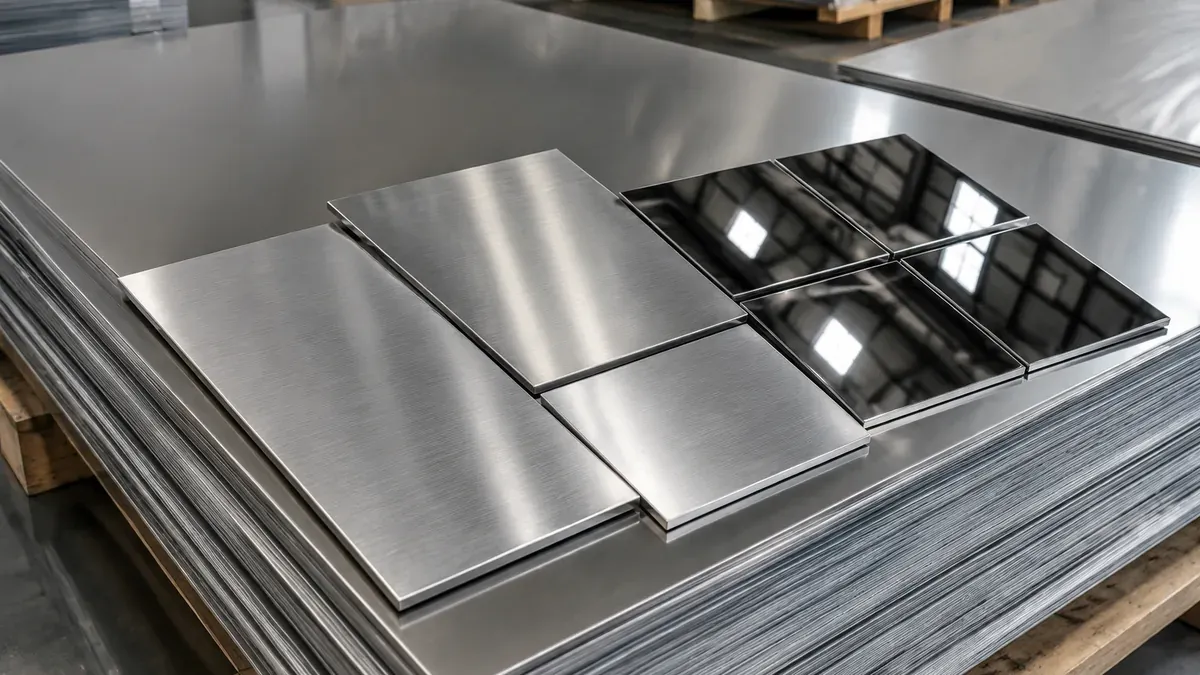
- Specify finish (2B, BA, No.4, mirror, etc.), critical face, protective film, flatness and any dual 304/304L certification requirement on the MTC.
- Request heat-specific MTC / EN 10204 3.1, destination port (MENA/SEA or other), packing method and lot traceability — use PMI and purchase-order wording guides when freezing documents.
Reference Product Forms & Dimensional Ranges
Common reference product forms for 304 stainless steel: Sheet / Plate, Coil / Strip, Pipe / Tube, Bar.
| Finishes | No.1, 2B, BA, No.4, hairline, 8K mirror |
|---|---|
| Sheet / coil thickness | 0.3–6.0 mm |
| Plate thickness | 6–80 mm |
| Pipe / tube / bar | Quoted to the governing product standard (for example ASTM A312, A554 or A276) with size, schedule or diameter named in the RFQ |
Common surface and delivery options
- No.1, 2B, BA or mechanically polished finish when supported by the product route
- Annealed and pickled coil/strip, or polished tube finish as specified
- Protective film, critical face and agreed surface sample for visible architectural or kitchen parts
- Hot rolled, peeled, bright drawn, ground or polished bar condition according to tolerance
These published ranges are engineering references, not a live-stock or production-capability promise. Send the required product form, dimensions, condition and finish; we quote the matching supply route.
Browse related product hubs:Sheet & plate,Coil & strip,Pipe & tube,Bar & rod.
Typical Applications
- Kitchen and catering equipment
- Food and beverage processing (validated cleaning chemistry)
- Architectural panels, trim and indoor cladding
- Water tanks, plumbing and general process vessels
- Sheet, coil, pipe and bar for general fabrication
304 Products We Export
304 Stainless Steel Sheet
304/304L ASTM A240 sheet in 2B, BA, No.4 and mirror. Common inquiry range 0.3–6.0 mm, 1000/1219/1500 mm widths, cut to size with quoted documents.
View details →
304 Stainless Steel Welded Pipe
304 welded stainless steel pipe and tube to ASTM A312, A249 and A554 — industrial, sanitary and polished decorative, round, square and rectangular sections.
View details →
304 Stainless Steel Round Bar
304/304L round bar in bright, peeled or hot-finished routes. Common inquiry range 3–300 mm diameter, 3 m / 6 m or cut-to-length, for pins, shafts and fittings.
View details →
304 Compared With Other Grades
Related buyer guides:
Frequently Asked Questions
What are 304 stainless steel properties for sheet and plate?
For annealed flat product summarized under ASTM A240/A240M, Type 304 (UNS S30400) typically lists minimum tensile ≥515 MPa (75 ksi), 0.2% yield ≥205 MPa (30 ksi) and elongation ≥40%, with hardness capped around ≤201 HBW. These are room-temperature engineering minima for the annealed condition — product form, thickness and any cold-worked strip temper (for example ASTM A666) change the requirement. Confirm chemistry, tensile results and the contracted edition on the MTC before approval.
What is the difference between 201 and 304 stainless steel?
304 is a chromium-nickel (roughly 18/8) austenitic with broader corrosion margin for outdoor wetting, food-contact cleaning and general fabrication. 201 replaces most nickel with manganese and nitrogen, cutting nickel cost and raising annealed strength, but usually with less corrosion margin outdoors or in wet chloride service. Indoors and in dry decorative duty 201 can be acceptable after exposure review; do not treat 201 as a like-for-like outdoor or hygiene substitute for 304. Pairwise commercial selection belongs on the dedicated 201 vs 304 compare page when one RFQ must choose.
When should I upgrade from 304 to 304L for welding?
Specify 304L (UNS S30403 / EN 1.4307) when welded assemblies will remain as-welded and sensitization risk in the heat-affected zone matters — tanks, process pipe and structural weldments that will not receive a full post-weld solution anneal. 304L lowers the carbon limit (≤0.030%) versus 304 (≤0.08%); it does not raise chloride pitting resistance the way molybdenum-bearing 316/316L does. Dual 304/304L certification is valid only when the heat and MTC meet both chemistry and strength rules. Use the 304L grade page and the site 304 vs 304L welding buyer guide when writing the weld and certificate checklist.
How do EN 1.4301 and 304 sheet/pipe/bar orders relate?
EN 1.4301 (X5CrNi18-10) is the common European designation paired with ASTM/UNS Type 304 (S30400). Naming 1.4301 or SUS304 does not replace the product standard: sheet and plate usually follow ASTM A240 (with A480 ordering/finish context), welded or seamless pipe follow standards such as A312, mechanical tube A554, and bar A276 or the project code. State form, size, finish (2B, BA, No.4, etc.), condition and inspection documents in the RFQ — a grade label alone is not a complete order.
Published by Tsingshan (Shandong) Iron & Steel Co., Ltd..Sources, update policy and technical limitations.
Quote request
Get a 304 Stainless Steel Quotation
Send the product, grade and quantity you already have. We will complete the specification and quote the supply route.