
How to Read a Mill Test Certificate (EN 10204 3.1)
A stainless steel buyer guide to matching EN 10204 inspection documents, heat or lot identity, standards, dimensions, test scope and material markings.
Published Jul 26, 2026 · Technical content updated: Jul 29, 2026 ·Tsingshan (Shandong) Iron & Steel Co., Ltd.

Reference image for this topic; it does not show Tsingshan Steel facilities, inventory or completed orders.
An inspection certificate is useful only when its identity, product scope and reported results match the stainless steel that was ordered. Buyers often call any material document an MTC, but EN 10204 document types, product-standard test reports and commercial certificates do not all prove the same thing.
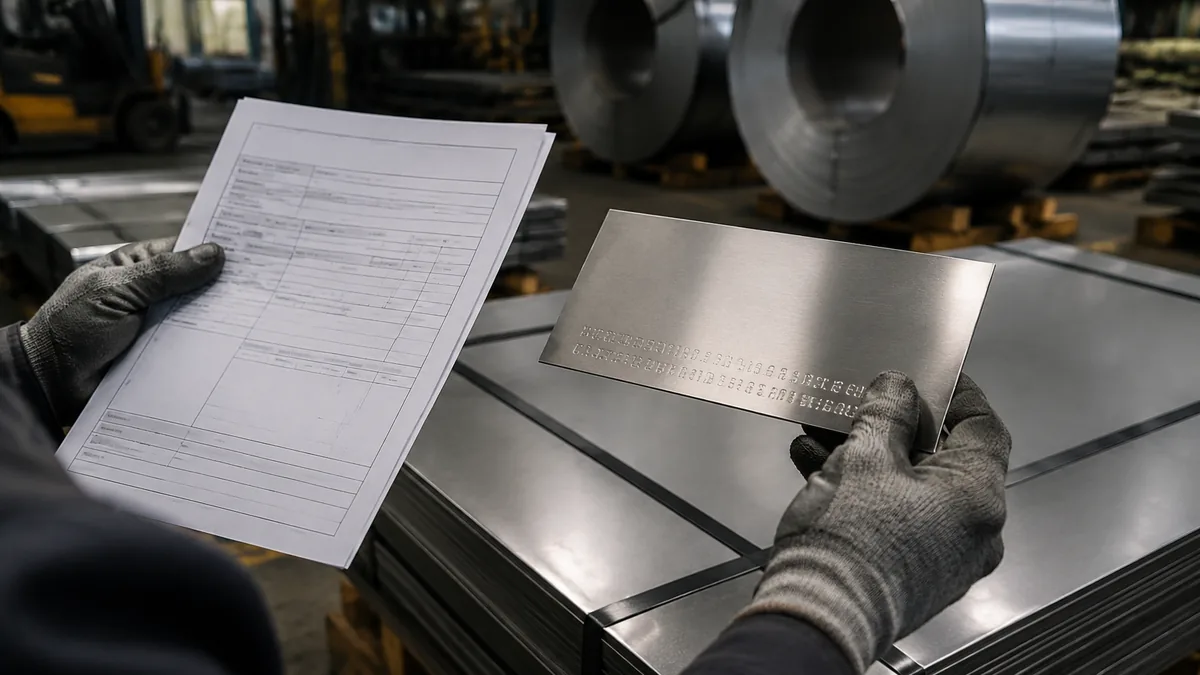
Use the certificate as one part of an agreed traceability and inspection plan. Do not assume that a document title creates tests that were never specified on the purchase order.
What “EN 10204 Type 3.1” means
EN 10204 describes inspection-document types. In practical purchasing terms:
- Type 2.1 / 2.2 documents provide a declaration of compliance, with non-specific inspection results included for Type 2.2.
- Type 3.1 reports specific inspection results and is validated by the manufacturer’s authorized inspection representative under the applicable document rules.
- Type 3.2 adds validation by the buyer’s representative or an agreed independent inspection representative when the contract requires it.
The required type must be stated and accepted before ordering. Also state the governing product standard, because the document type does not define the chemistry limits, mechanical requirements, sampling plan or supplementary tests for the product.
Build a document-to-material match
| Certificate field | Buyer check | Common mismatch to investigate |
|---|---|---|
| Manufacturer and certificate ID | Identify the issuing entity and document revision | Seller invoice presented as a mill inspection document |
| Purchase order and item | Match the buyer PO, line item and ordered quantity | Certificate belongs to another order or item |
| Product and grade | Match form, grade and any UNS/EN designation | Correct grade name but wrong product form or condition |
| Governing standard | Match the ordered product standard and applicable edition | A grade standard cited instead of the required product standard |
| Dimensions and finish | Match thickness, width, diameter, wall, length and surface as applicable | Commercial description omits the ordered tolerance or finish |
| Heat or lot identity | Trace the certificate to tags, stencils and packing records | Material identity cannot be followed through split bundles |
| Test results | Compare reported results with the applicable limits and ordered test scope | Result has no method, unit, condition or acceptance basis |
Product standards differ by form. For example, a flat-product order may cite ASTM A240, while pipe or bar orders may use ASTM A312 or ASTM A276. Confirm the exact standard and edition against the purchase order rather than checking only the grade name.
Seven checks before acceptance
- Confirm document scope. Identify whether the document is a declaration, non-specific report or specific inspection certificate.
- Match the order line. Product form, grade, standard, dimensions, tolerance, finish and delivery condition should agree with the PO.
- Trace identity. Heat or lot references should be carried consistently through the certificate, material marking and packing record.
- Check chemistry against the correct table. Use the ordered standard and grade, not an approximate internet equivalence.
- Check mechanical-property conditions. Compare results only when product form, thickness range, heat treatment and test orientation are applicable.
- Verify supplementary tests. PMI, corrosion testing, NDE, hydrostatic testing, roughness or third-party witness points appear only when ordered and supported by the accepted route.
- Review authorization and revision. Confirm the issuing party, authorized validation and any replacement or corrected certificate reference.
Grade pages for 304, 316L and 2205 provide a technical starting point, but the purchase order and governing standard remain the acceptance basis.
Red flags that require clarification
- Missing or inconsistent heat, lot, item or certificate identifiers
- Product descriptions that omit the ordered form, condition or dimensions
- “Typical” values where the order requires specific inspection results
- Units, methods or acceptance limits that cannot be tied to the standard
- Chemistry or mechanical results copied across unrelated items without an explained common heat or lot
- Material tags and packing records that do not preserve the document link
- A revised PDF supplied without a revision trail or reason for correction
These signs do not prove fraud by themselves. They mean the buyer should stop acceptance and request traceability evidence or agreed reinspection.
Put the requirement in the RFQ
Send the product form, grade, governing standard and edition, dimensions, delivery condition, inspection-document type, supplementary tests, witness points, marking and packing traceability with the RFQ. The available document route and inspection scope should be confirmed in the quotation before the order is accepted.
See our quality-control workflow or send the complete specification for an order-specific document review.
Use a repeatable receiving worksheet
Start with the purchase order and create one line for every bundle, coil, pipe heat, bar lot or fitting item. Record the item number, grade, product standard, dimensions, condition, finish, quantity and required inspection document. Then add the heat or lot number from the tag and compare it with the certificate. The comparison is strongest when the same identifier is visible on the packing list, package mark and certificate rather than typed only into an email.
For chemistry, check the units and the table that applies to the exact grade and product form. For mechanical properties, confirm the test direction, specimen condition, thickness range and heat treatment. A result without its method or acceptance limit is not enough to conclude compliance. If the order requires PMI, hydrostatic testing, ultrasonic testing, roughness or corrosion testing, look for the separately identified result and method; do not infer it from a Type 3.1 heading.
Revision, split lots and digital files
Certificates are sometimes corrected after a quantity is split into several bundles or after an inspection comment. Keep the first and replacement revision references, the reason for change and the person who authorized the replacement. A renamed PDF with no revision trail should be clarified before acceptance. Digital files should preserve searchable identifiers but must not replace a physical mark or agreed document-control process.
If a certificate covers several items, verify that the common heat or lot relationship is stated and that the mechanical results apply to each form, size and condition. Ask for a separate item schedule when the document layout could make a reader attach one result to the wrong product.
Put the acceptance rule in the RFQ
State the certificate category, issuing party, language, delivery format, traceability fields, supplementary tests, witness points and review deadline in the RFQ. Link the requirement to the governing product standard rather than using “MTC required” as a complete instruction. For an order-specific review, link the intended product page and the quality-control workflow with the final inquiry. Name the inspection document, heat identity and supplementary tests in the RFQ. We quote EN 10204 3.1 or the named document when that supply route supports it; original mill 3.1 is not assumed for every shipment.
Sources and application limits
This guide supports purchasing decisions. The ordered product standard, project specification and approved inspection plan control the final decision.
- EN 10204 inspection document categories
- ordered product standard testing clauses
- purchase-order inspection and traceability requirements
Technical content updated: Jul 29, 2026
Frequently Asked Questions
Does every stainless steel order include an EN 10204 3.1 inspection certificate?
No. State the required inspection document in the purchase order and confirm that the selected product standard, supply route and test plan can support it.
Does a Type 3.1 document prove that PMI or every supplementary test was performed?
No. The document reports the inspections included in its scope. PMI, corrosion, NDE or other supplementary tests must be ordered and identified separately.
What should a buyer match first on a stainless steel MTC?
Match the supplier order, product form, grade, governing standard, dimensions, delivery condition, heat or lot identity and reported tests to the material markings and packing records.
Send the product form, grade and quantity from this guide. We quote the matching stainless route.
Ready to quote your stainless specification?
Send product, grade and quantity. We quote the confirmed supply route.