
439 Stainless Steel (UNS S43035)
Ferritic (Ti-stabilized) · ASTM A240/A240M · Density 7.7 g/cm³
Type 439 (UNS S43035) is a titanium-stabilized ferritic stainless steel used for welded heat-exchanger tube, hot-water equipment, appliance parts and selected exhaust components. Its chromium level and stabilization distinguish it from 409L and 430, but substitution for an austenitic grade requires a fresh review of corrosion, forming, toughness, weld procedure and design code.
Quotation brief
Quote 439 When
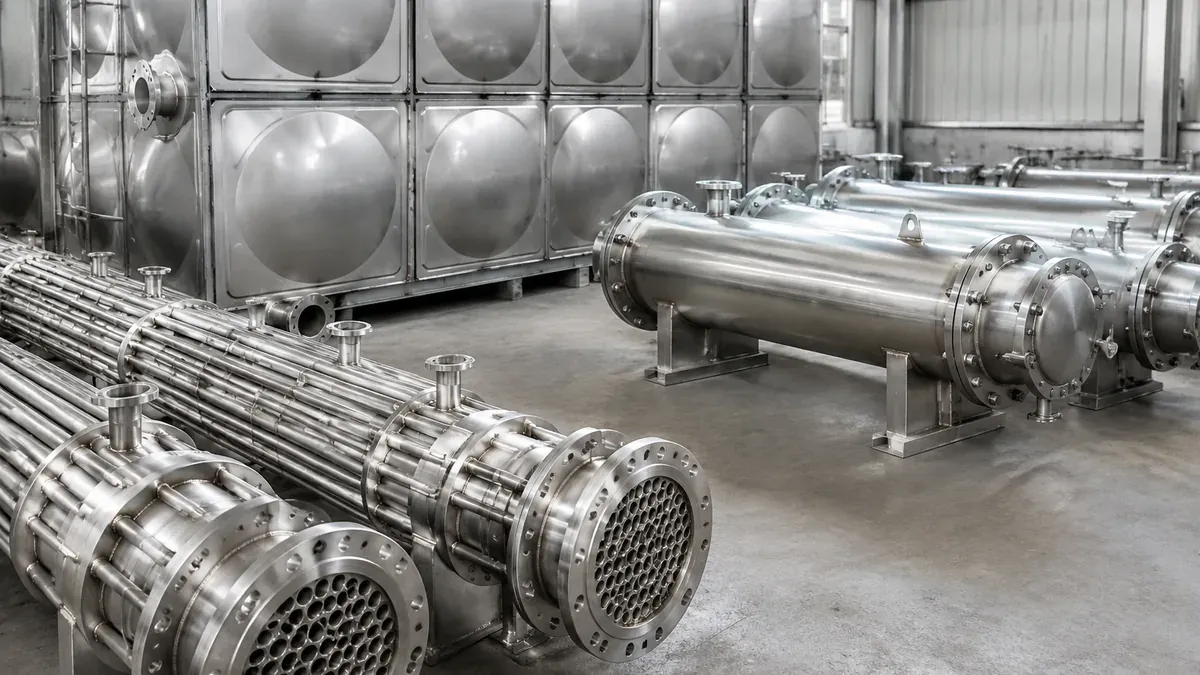
Quote 439 when a titanium-stabilized, higher-chromium ferritic sheet or welded tube is being designed for heat exchange, hot-water, appliance or exhaust duty. The grade can offer a different stress-corrosion, thermal-expansion and alloying profile from 304, but those differences require component redesign rather than a one-for-one substitution. Water chemistry, crevices, weld heat input, forming severity, impact requirements and the approved product standard must all align.
Best fit
- Welded condenser or heat-exchanger tube evaluated for known water chemistry, temperature, cleaning practice and joint configuration.
- Hot-water tanks, appliance components and formed panels designed around ferritic thermal expansion, magnetism and forming behavior.
- Selected exhaust parts requiring a stabilized higher-chromium ferritic route after metal-temperature and condensate review.
Limits to check
- 439 and 304 are not equivalent materials; forming, toughness, welding, thermal expansion and design-code assumptions must be recalculated.
- Absence of an intentional molybdenum range limits pitting margin in chloride crevices compared with molybdenum-bearing stainless grades.
- Titanium stabilization does not eliminate grain-growth, contamination or weld-surface risks and must not be described as unrestricted weld immunity.
Quoted product forms
Quoted product forms for 439 Stainless Steel (UNS S43035)
We quote 439 Stainless Steel as coil / strip, sheet / plate, pipe / tube against the named product standard.
- Traceability: heat or lot identity plus the inspection document named in the RFQ (EN 10204 3.1 when that route supports it).
- Processing: decoiling, cutting, polishing, shearing and beveling as ordered.
- Next step: send product form, size and quantity; we quote the supply route.
Chemical Composition (wt%)
| C | Mn | Si | Cr | Ni | Ti | N | P | S |
|---|---|---|---|---|---|---|---|---|
| ≤0.07 | ≤1.00 | ≤1.00 | 17.0–19.0 | ≤0.50 | 0.20+4×(C+N)–1.10 | ≤0.04 | ≤0.040 | ≤0.030 |
Single values are maximums unless a range is shown. Balance: Fe. Per ASTM A240/A240M.
Mechanical Properties
| Tensile strength | ≥415 MPa (60 ksi) |
|---|---|
| Yield strength (0.2%) | ≥205 MPa (30 ksi) |
| Elongation (50 mm) | ≥22% |
| Hardness | ≤89 HRB |
Room-temperature minimum values are summarized for annealed flat product under ASTM A240/A240M unless a condition is named in the property label; product form and thickness can change the requirement.
Physical Properties & Structure
| Density | 7.7 g/cm³ |
|---|---|
| Magnetic response | Magnetic because the room-temperature matrix is ferritic. |
| Microstructure | Ferritic (Ti-stabilized) |
Corrosion Resistance & Limits
- 439's chromium level supports general corrosion resistance in many hot-water and condensate duties, but it has no intentional molybdenum range. Chlorides, crevices, scale, stagnation and cleaning chemicals can still initiate localized attack.
- Ferritic 439 is less susceptible than common austenitic grades to one class of chloride stress-corrosion cracking, not immune to every cracking or corrosion mechanism. Weld residual stress, contamination, section and water chemistry remain part of qualification.
Fabrication & Heat Treatment
| Welding | Control heat input, interpass temperature, filler choice and shielding to limit grain growth and preserve joint toughness. Titanium stabilization reduces sensitization risk but the finished weld still needs procedure qualification, cleaning and service validation. |
|---|---|
| Forming | 439 sheet can be bent, roll formed and drawn, with lower work hardening but more directional forming behavior than 304. Blank orientation, lubrication, draw beads and bend radius should be proven for the actual coil and part geometry. |
| Machining | Rigid support and sharp tools help avoid burrs and smearing on thin ferritic sections. Control heat and iron contamination where machined ends will be welded into water or condensate service. |
| Heat treatment | 439 is not hardened by conventional heat treatment. Annealing parameters after cold work or welding must follow the product and fabrication route because grain size, flatness and surface oxide affect final performance. |
Equivalent Grades
The closest international equivalents of 439 Stainless Steel are 1.4510 (X3CrTi17) in the EN system, SUS430LX in the JIS system, 022Cr18Ti in the GB system.
These are common corresponding designations, not unconditional substitutes. Verify chemistry, mechanical properties, product standard, delivery condition, dimensions and project approval before changing designation.
| System | Designation |
|---|---|
| UNS | S43035 |
| EN | 1.4510 (X3CrTi17) |
| JIS | SUS430LX |
| GB | 022Cr18Ti |
Ordering Checks for 439
- State UNS S43035, governing product standard, product form, dimensions, thickness, finish, edge condition and delivery condition.
- Provide water or condensate chemistry, chloride range, temperature, stagnation, cleaning chemicals, crevice geometry and appearance criteria.
- Define forming direction and severity, weld process, heat input, filler, shielding, leak test and post-weld surface requirements.
- Request the required inspection certificate and verify chemistry, stabilization, mechanical properties, heat treatment, dimensions and traceability.
Reference Product Forms & Dimensional Ranges
Common reference product forms for 439 stainless steel: Coil / Strip, Sheet / Plate, Pipe / Tube.
| Finishes | 2B, 2D, No.4 |
|---|---|
| Sheet / coil thickness | 0.4–3.0 mm |
| Common widths | 1000 / 1219 mm |
Common surface and delivery options
- No.1, 2B, BA or mechanically polished finish when supported by the product route
- Annealed and pickled, descaled or polished tube finish as specified
These published ranges are engineering references, not a live-stock or production-capability promise. Send the required product form, dimensions, condition and finish; we quote the matching supply route.
Browse related product hubs:Sheet & plate,Coil & strip,Pipe & tube,Bar & rod.
Typical Applications
- Exhaust system hot-end components
- Heat exchangers and water heaters
- Kitchen sinks and appliance drums
- Solar water-heating panels
- Welded tube for condensers
Frequently Asked Questions
What is the difference between 439 and 430 stainless steel?
Both sit in the higher-chromium ferritic family, while 439 uses a tighter interstitial balance with titanium stabilization for welded applications. That does not make every 439 weld acceptable or every 430 weld unsuitable; product chemistry, thickness, heat input, filler, surface and service exposure decide.
Can 439 replace 304?
Only after redesign and approval. 439 and 304 differ in microstructure, thermal expansion, forming response, low-temperature toughness, weld practice and localized-corrosion behavior. Compare the actual water chemistry, temperature, geometry, code rules and fabrication trials instead of treating them as equivalents.
Is 439 magnetic?
Yes, the ferritic matrix is magnetic. Magnet response is a sorting clue rather than proof of grade or corrosion resistance; confirm designation by traceability and, when required, chemistry verification because several ferritic grades can show similar magnetic behavior.
Published by Tsingshan (Shandong) Iron & Steel Co., Ltd..Sources, update policy and technical limitations.
Quote request
Get a 439 Stainless Steel Quotation
Send the product, grade and quantity you already have. We will complete the specification and quote the supply route.