
254 SMO Stainless Steel (UNS S31254)
Super-austenitic (6Mo) · ASTM A240/A240M · Density 8 g/cm³
254 SMO (UNS S31254) is a 6% molybdenum super-austenitic stainless steel developed for chloride environments beyond the practical margin of 316L and some standard duplex duties. Its high calculated PREN supports screening for seawater handling, desalination and flue-gas cleaning equipment, but final selection still depends on temperature, crevices, deposits, fabrication and project approval.
Quotation brief
Quote 254 SMO When
Quote 254 SMO for severe chloride-bearing or acidic environments that need a highly alloyed austenitic material with strong pitting, crevice-corrosion and stress-corrosion-cracking resistance. It offers easier austenitic forming and welding than duplex alternatives in some designs, but a calculated PREN above 40 does not by itself approve seawater service; temperature, stagnation, crevices, weld consumables and surface condition remain decisive.
Best fit
- Desalination, seawater, scrubber and bleach-plant components where 316L and standard duplex corrosion margins are insufficient.
- Plate, sheet, pipe, tube and bar parts that need high ductility, austenitic toughness and a 6% molybdenum alloy route.
- Fabrications where super-duplex phase-balance controls are undesirable but the project can qualify high-alloy austenitic welding and cleaning.
Limits to check
- 254 SMO is not a universal substitute for titanium or super duplex in hot, stagnant, crevice-prone or highly concentrated brine service.
- High molybdenum and nitrogen content increase alloy surcharge, work hardening and consumable requirements; delivered cost must be quoted for the actual route.
- 254 SMO is a trade designation associated with UNS S31254; any substitution requires chemistry, product-standard, condition and project approval checks.
Quoted product forms
Quoted product forms for 254 SMO Stainless Steel (UNS S31254)
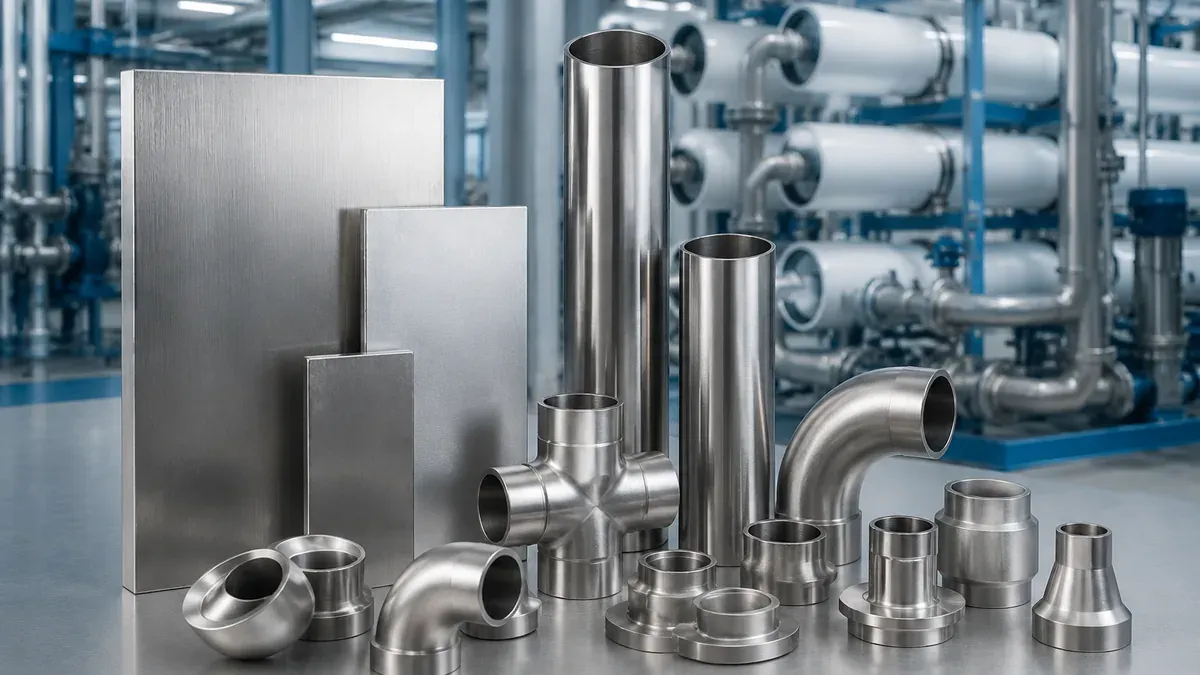
We quote 254 SMO Stainless Steel as sheet / plate, coil / strip, pipe / tube, bar against the named product standard.
- Traceability: heat or lot identity plus the inspection document named in the RFQ (EN 10204 3.1 when that route supports it).
- Processing: decoiling, cutting, polishing, shearing and beveling as ordered.
- Next step: send product form, size and quantity; we quote the supply route.
Chemical Composition (wt%)
| C | Mn | Si | Cr | Ni | Mo | N | Cu | P | S |
|---|---|---|---|---|---|---|---|---|---|
| ≤0.020 | ≤1.00 | ≤0.80 | 19.5–20.5 | 17.5–18.5 | 6.0–6.5 | 0.18–0.25 | 0.50–1.00 | ≤0.030 | ≤0.010 |
Single values are maximums unless a range is shown. Balance: Fe. Per ASTM A240/A240M.
Mechanical Properties
| Tensile strength | ≥650 MPa (94 ksi) |
|---|---|
| Yield strength (0.2%) | ≥300 MPa (44 ksi) |
| Elongation (50 mm) | ≥35% |
| Hardness | ≤223 HBW |
Room-temperature minimum values are summarized for annealed flat product under ASTM A240/A240M unless a condition is named in the property label; product form and thickness can change the requirement.
Physical Properties & Structure
| Density | 8 g/cm³ |
|---|---|
| Magnetic response | Essentially non-magnetic after solution annealing; cold work can introduce a measurable magnetic response. |
| Microstructure | Super-austenitic (6Mo) |
Corrosion Resistance & Limits
- General corrosion resistance comes from the chromium-rich passive film; nickel, molybdenum, nitrogen and copper change performance by grade.
- Check chlorides, temperature, crevices, deposits, process chemistry and cleaning conditions. A grade designation alone is not a service-life guarantee.
Fabrication & Heat Treatment
| Welding | Generally weldable with a qualified procedure and matching or over-alloyed filler where required; remove heat tint when corrosion service demands it. |
|---|---|
| Forming | Good ductility is typical, but rapid work hardening increases forming load and springback; bend radius and intermediate annealing depend on grade and reduction. |
| Machining | Use rigid tooling, positive feeds and controlled heat because the material work-hardens; free-machining grades require separate corrosion and welding review. |
| Heat treatment | Solution annealing and rapid cooling restore the intended condition where applicable. Austenitic grades are not hardened by conventional quench-and-temper treatment. |
Equivalent Grades
The closest international equivalents of 254 SMO Stainless Steel are 1.4547 (X1CrNiMoCuN20-18-7) in the EN system, 015Cr20Ni18Mo6CuN in the GB system.
These are common corresponding designations, not unconditional substitutes. Verify chemistry, mechanical properties, product standard, delivery condition, dimensions and project approval before changing designation.
| System | Designation |
|---|---|
| UNS | S31254 |
| EN | 1.4547 (X1CrNiMoCuN20-18-7) |
| GB | 015Cr20Ni18Mo6CuN |
Ordering Checks for 254 SMO
- Order by UNS S31254 or the approved EN designation together with the product standard, form, dimensions, delivery condition and finish.
- Provide chloride concentration, temperature, pH, oxidants, flow, stagnation, deposits, crevice geometry and cleaning conditions for corrosion review.
- Define matching or over-alloyed filler, heat-tint removal, passivation, PMI, NDE, corrosion testing and inspection certificates where required.
- Confirm the proposed heat and product route meet the ordered chemistry and mechanical requirements instead of relying only on a trade name.
Reference Product Forms & Dimensional Ranges
Common reference product forms for 254 smo stainless steel: Sheet / Plate, Coil / Strip, Pipe / Tube, Bar.
| Finishes | No.1, 2B |
|---|---|
| Sheet / coil thickness | 0.5–6.0 mm |
| Plate thickness | 6–50 mm |
Common surface and delivery options
- No.1, 2B, BA or mechanically polished finish when supported by the product route
- Annealed and pickled, descaled or polished tube finish as specified
- Hot rolled, peeled, bright drawn, ground or polished bar condition according to tolerance
These published ranges are engineering references, not a live-stock or production-capability promise. Send the required product form, dimensions, condition and finish; we quote the matching supply route.
Browse related product hubs:Sheet & plate,Coil & strip,Pipe & tube,Bar & rod.
Typical Applications
- Seawater piping, pumps and valves
- Desalination plant components
- Flue-gas desulfurization equipment
- Pulp bleach plant washers and towers
- Offshore oil and gas hardware
254 SMO Compared With Other Grades
Frequently Asked Questions
Is 254 SMO a standard grade or a trade name?
254 SMO is a trade name associated with UNS S31254 and EN 1.4547. Referencing the UNS number can broaden sourcing, but substitution still requires review of chemistry, product standard, condition, dimensions, mechanical properties and project approval.
How does 254 SMO compare with 2507 super duplex?
Both can have a calculated PREN above 40, but that index does not prove equal corrosion performance in every environment. 2507 offers higher specified strength and requires duplex phase-balance control; 254 SMO follows an austenitic fabrication route. Compare chloride conditions, crevices, temperature, toughness, code approval, product availability and the current delivered quotation.
Can 254 SMO replace titanium in seawater service?
It can be evaluated as an alternative in some piping, pump and plate heat-exchanger duties, but it is not a blanket substitute. Titanium may retain a wider margin in hot, stagnant or crevice-prone seawater, while fabrication route, code approval and the current delivered quotation can change the commercial decision.
Published by Tsingshan (Shandong) Iron & Steel Co., Ltd..Sources, update policy and technical limitations.
Quote request
Get a 254 SMO Stainless Steel Quotation
Send the product, grade and quantity you already have. We will complete the specification and quote the supply route.