
444 Stainless Steel (UNS S44400)
Ferritic (Mo-bearing) · ASTM A240/A240M · Density 7.75 g/cm³
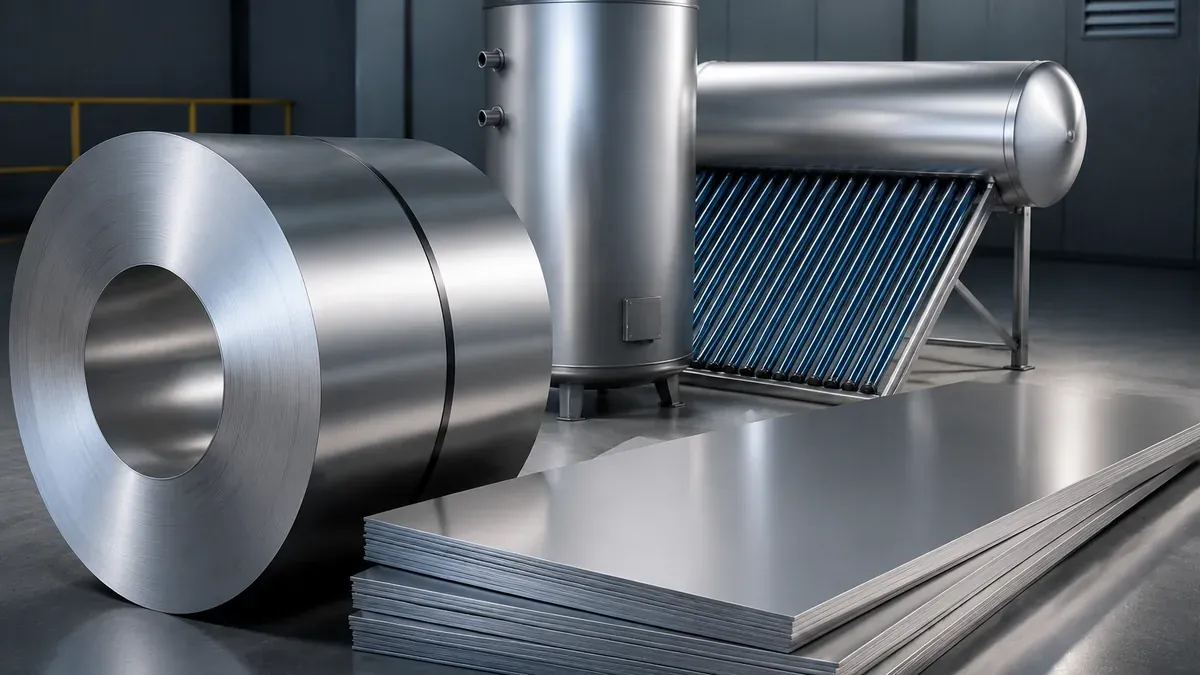
Type 444 (UNS S44400, EN 1.4521) is a ferritic stainless steel with 18% chromium and about 2% molybdenum, stabilized with titanium and niobium. Its pitting resistance approaches 316L while remaining immune to chloride stress-corrosion cracking, making it a nickel-free choice for hot-water tanks, solar collectors and heat exchangers.
Quotation brief
Quote 444 When
Quote 444 when a nickel-free ferritic sheet or tube grade needs molybdenum-assisted pitting resistance and strong resistance to chloride stress-corrosion cracking in hot-water service. Its stabilized ferritic structure can be valuable for tanks, solar collectors and heat exchangers, but gauge, weld design, surface finish, toughness and forming limits must be checked before it is compared with 316L.
Best fit
- Hot-water tanks, heaters and solar-thermal components where chloride stress-corrosion cracking is a primary concern.
- Thin-gauge sheet, coil and tube applications that need a stabilized ferritic grade with approximately 2% molybdenum.
- Equipment buyers seeking a nickel-free material route while retaining a cleanable stainless surface and documented heat traceability.
Limits to check
- 444 is not a universal replacement for 316L in thick welded sections, cryogenic service, severe drawing or applications requiring austenitic toughness.
- Ferritic grain growth in the heat-affected zone can reduce toughness, so joint design, heat input, filler and post-weld surface treatment need review.
- Published thin-gauge ranges are reference data, not a promise of live stock, and actual finish, width, straightness and tolerance must be quoted.
Quoted product forms
Quoted product forms for 444 Stainless Steel (UNS S44400)
We quote 444 Stainless Steel as coil / strip, sheet / plate, pipe / tube against the named product standard.
- Traceability: heat or lot identity plus the inspection document named in the RFQ (EN 10204 3.1 when that route supports it).
- Processing: decoiling, cutting, polishing, shearing and beveling as ordered.
- Next step: send product form, size and quantity; we quote the supply route.
Chemical Composition (wt%)
| C | Mn | Si | Cr | Mo | Ni | Ti+Nb | N | P | S |
|---|---|---|---|---|---|---|---|---|---|
| ≤0.025 | ≤1.00 | ≤1.00 | 17.5–19.5 | 1.75–2.50 | ≤1.00 | 0.20+4×(C+N)–0.80 | ≤0.035 | ≤0.040 | ≤0.030 |
Single values are maximums unless a range is shown. Balance: Fe. Per ASTM A240/A240M.
Mechanical Properties
| Tensile strength | ≥415 MPa (60 ksi) |
|---|---|
| Yield strength (0.2%) | ≥275 MPa (40 ksi) |
| Elongation (50 mm) | ≥20% |
| Hardness | ≤217 HBW |
Room-temperature minimum values are summarized for annealed flat product under ASTM A240/A240M unless a condition is named in the property label; product form and thickness can change the requirement.
Physical Properties & Structure
| Density | 7.75 g/cm³ |
|---|---|
| Magnetic response | Magnetic because the room-temperature matrix is ferritic. |
| Microstructure | Ferritic (Mo-bearing) |
Corrosion Resistance & Limits
- Ferritic grades resist chloride stress-corrosion cracking better than common austenitic grades, while pitting resistance still depends on chromium, molybdenum and exposure.
- Weld condition, section thickness, crevices, deposits and surface contamination can control service performance; validate the actual fabrication and environment.
Fabrication & Heat Treatment
| Welding | Control heat input, interpass temperature and joint design to limit grain growth and loss of toughness; stabilized grades improve but do not remove these controls. |
|---|---|
| Forming | Formability is useful in sheet gauges but lower than common austenitic grades, especially in heavy sections and severe draws. |
| Machining | Machining is generally straightforward with rigid tooling; avoid smearing, overheating and iron contamination of finished surfaces. |
| Heat treatment | Ferritic grades are not hardened by heat treatment. Annealing can restore ductility, but the temperature and cooling route must follow the product specification. |
Equivalent Grades
The closest international equivalents of 444 Stainless Steel are 1.4521 (X2CrMoTi18-2) in the EN system, SUS444 in the JIS system, 019Cr19Mo2NbTi in the GB system.
These are common corresponding designations, not unconditional substitutes. Verify chemistry, mechanical properties, product standard, delivery condition, dimensions and project approval before changing designation.
| System | Designation |
|---|---|
| UNS | S44400 |
| EN | 1.4521 (X2CrMoTi18-2) |
| JIS | SUS444 |
| GB | 019Cr19Mo2NbTi |
Ordering Checks for 444
- State UNS S44400 or the required EN/JIS/GB designation and the product form rather than requesting generic molybdenum ferritic stainless.
- Provide thickness, width or tube dimensions, temper, finish, edge, flatness and forming radius requirements for the ordered route.
- Describe water chemistry, chloride level, operating temperature, welds, cleaning chemicals and stagnation so pitting and SCC risks can be screened.
- Confirm stabilization chemistry, heat number, PMI or certificate requirements and any surface-defect or cosmetic acceptance criteria.
Reference Product Forms & Dimensional Ranges
Common reference product forms for 444 stainless steel: Coil / Strip, Sheet / Plate, Pipe / Tube.
| Finishes | 2B, 2D, BA |
|---|---|
| Sheet / coil thickness | 0.4–3.0 mm |
| Common widths | 1000 / 1219 mm |
Common surface and delivery options
- No.1, 2B, BA or mechanically polished finish when supported by the product route
- Annealed and pickled, descaled or polished tube finish as specified
These published ranges are engineering references, not a live-stock or production-capability promise. Send the required product form, dimensions, condition and finish; we quote the matching supply route.
Browse related product hubs:Sheet & plate,Coil & strip,Pipe & tube,Bar & rod.
Typical Applications
- Hot-water tanks and electric water heaters
- Solar thermal collectors
- Plate heat exchangers
- Food and dairy processing surfaces
- Coastal architectural panels
444 Compared With Other Grades
Frequently Asked Questions
How does 444 compare with 316L?
Pitting resistance is comparable — both alloys carry ~2% molybdenum and land near PREN 24–26. 444's advantages: immunity to chloride stress-corrosion cracking (a known 316L failure in hot water) and nickel-free, more stable pricing. 316L counters with easier deep drawing, better weld ductility in heavy sections, and availability in thick plate.
Why is 444 popular for hot water tanks?
Its ferritic structure avoids the austenitic chloride stress-corrosion-cracking mechanism, while molybdenum supports pitting resistance. That combination makes 444 a candidate for thin-gauge hot-water equipment, but water chemistry, temperature, weld design, crevices, forming limits and the current quotation still require project-specific review.
What are 444's limitations?
It is produced mainly in thin gauges (≤3 mm) because heavy ferritic sections lose toughness; welding needs care (matching filler, controlled heat input) and sub-zero impact toughness is limited. For thick structural or cryogenic duty choose an austenitic or duplex grade.
Published by Tsingshan (Shandong) Iron & Steel Co., Ltd..Sources, update policy and technical limitations.
Quote request
Get a 444 Stainless Steel Quotation
Send the product, grade and quantity you already have. We will complete the specification and quote the supply route.