
321 Stainless Steel (UNS S32100)
Austenitic (Ti-stabilized) · ASTM A240/A240M · Density 7.92 g/cm³
Type 321 (UNS S32100) is a titanium-stabilized austenitic stainless steel selected when fabrication or service can expose 18/8 material to a sensitizing thermal cycle. It is used for exhaust parts, expansion joints and heat-transfer components, but temperature capability must be established from the atmosphere, load, section and governing design code rather than the grade name alone.
Quotation brief
Quote 321 When
Quote 321 when an 18/8 austenitic component will be welded or held through a sensitizing thermal cycle and titanium stabilization is part of the approved material strategy. The selection is strongest for sheet, plate, tube or fabricated exhaust and expansion parts that need useful room-temperature ductility plus resistance to intergranular attack after the defined exposure. It is not a universal high-temperature or chloride-service upgrade from 304.
Best fit
- Welded exhaust, expansion-joint and bellows components whose approved design specifically calls for titanium-stabilized 18/8 stainless steel.
- Fabricated heat-transfer or heater parts that may pass through a sensitizing thermal cycle and later encounter an aqueous shutdown environment.
- Projects that name UNS S32100 and require traceable chemistry, solution-treated delivery and a documented welding procedure.
Limits to check
- 321 contains no intentional molybdenum range and must not be selected as a general solution for warm chloride pitting or crevice conditions.
- Published oxidation-temperature figures are reference data, not component ratings; atmosphere, load, creep duration and thermal cycling can govern first.
- Titanium stabilization does not validate the weld metal, surface condition or post-fabrication cleaning, all of which remain part of corrosion acceptance.
Quoted product forms
Quoted product forms for 321 Stainless Steel (UNS S32100)
We quote 321 Stainless Steel as sheet / plate, coil / strip, pipe / tube, bar against the named product standard.
- Traceability: heat or lot identity plus the inspection document named in the RFQ (EN 10204 3.1 when that route supports it).
- Processing: decoiling, cutting, polishing, shearing and beveling as ordered.
- Next step: send product form, size and quantity; we quote the supply route.
Chemical Composition (wt%)
| C | Mn | Si | Cr | Ni | Ti | P | S |
|---|---|---|---|---|---|---|---|
| ≤0.08 | ≤2.00 | ≤0.75 | 17.0–19.0 | 9.0–12.0 | 5×(C+N) min, ≤0.70 | ≤0.045 | ≤0.030 |
Single values are maximums unless a range is shown. Balance: Fe. Per ASTM A240/A240M.
Mechanical Properties
| Tensile strength | ≥515 MPa (75 ksi) |
|---|---|
| Yield strength (0.2%) | ≥205 MPa (30 ksi) |
| Elongation (50 mm) | ≥40% |
| Hardness | ≤217 HBW |
Room-temperature minimum values are summarized for annealed flat product under ASTM A240/A240M unless a condition is named in the property label; product form and thickness can change the requirement.
Physical Properties & Structure
| Density | 7.92 g/cm³ |
|---|---|
| Magnetic response | Essentially non-magnetic after solution annealing; cold work can introduce a measurable magnetic response. |
| Microstructure | Austenitic (Ti-stabilized) |
Corrosion Resistance & Limits
- 321 has an 18/8 chromium-nickel base and no intentional molybdenum range, so it should not be treated as a chloride-resistance upgrade from 304. Pitting, crevice attack and stress-corrosion risk still depend on chloride level, temperature, deposits and tensile stress.
- Titanium stabilization addresses sensitization risk only when the delivered chemistry and thermal history satisfy the specification. Heat tint, embedded iron, crevices and contaminated weld surfaces can still initiate corrosion and must be controlled.
Fabrication & Heat Treatment
| Welding | Use a qualified austenitic welding procedure and specify filler by the joint design and service requirement. Control purge, heat input and interpass practice, then remove heat tint when the corrosion environment requires a clean passive surface. |
|---|---|
| Forming | Annealed 321 can be formed by practices used for austenitic sheet, while work hardening raises forming load and springback as reduction increases. Tooling, bend radius and any intermediate anneal must suit thickness and grain direction. |
| Machining | Maintain positive feed with rigid tooling so the cut stays below the work-hardened layer. Avoid dwell and excessive heat, and separate titanium-stabilized material from free-machining grades when corrosion and welding are part of acceptance. |
| Heat treatment | 321 is supplied in a solution-treated condition under the applicable product specification and is not strengthened by conventional quench-and-temper treatment. Any stabilization or re-solution treatment must follow an approved procedure for the product form. |
Equivalent Grades
The closest international equivalents of 321 Stainless Steel are 1.4541 (X6CrNiTi18-10) in the EN system, SUS321 in the JIS system, 06Cr18Ni11Ti in the GB system.
These are common corresponding designations, not unconditional substitutes. Verify chemistry, mechanical properties, product standard, delivery condition, dimensions and project approval before changing designation.
| System | Designation |
|---|---|
| UNS | S32100 |
| EN | 1.4541 (X6CrNiTi18-10) |
| JIS | SUS321 |
| GB | 06Cr18Ni11Ti |
Ordering Checks for 321
- State UNS S32100, the governing product standard, product form, dimensions, thickness, delivery condition and required surface finish.
- Define operating temperature range, time at temperature, atmosphere, thermal-cycle frequency and whether aqueous corrosion occurs during shutdown.
- Provide the welding code, joint configuration, filler requirement, purge and cleaning criteria instead of relying on the base grade alone.
- Request the required inspection document and verify heat number, chemistry, tensile properties, heat treatment and any supplementary tests against the order.
Reference Product Forms & Dimensional Ranges
Common reference product forms for 321 stainless steel: Sheet / Plate, Coil / Strip, Pipe / Tube, Bar.
| Finishes | No.1, 2B |
|---|---|
| Sheet / coil thickness | 0.5–6.0 mm |
| Plate thickness | 6–60 mm |
Common surface and delivery options
- No.1, 2B, BA or mechanically polished finish when supported by the product route
- Annealed and pickled, descaled or polished tube finish as specified
- Hot rolled, peeled, bright drawn, ground or polished bar condition according to tolerance
These published ranges are engineering references, not a live-stock or production-capability promise. Send the required product form, dimensions, condition and finish; we quote the matching supply route.
Browse related product hubs:Sheet & plate,Coil & strip,Pipe & tube,Bar & rod.
Typical Applications
- Exhaust manifolds and flexible pipe
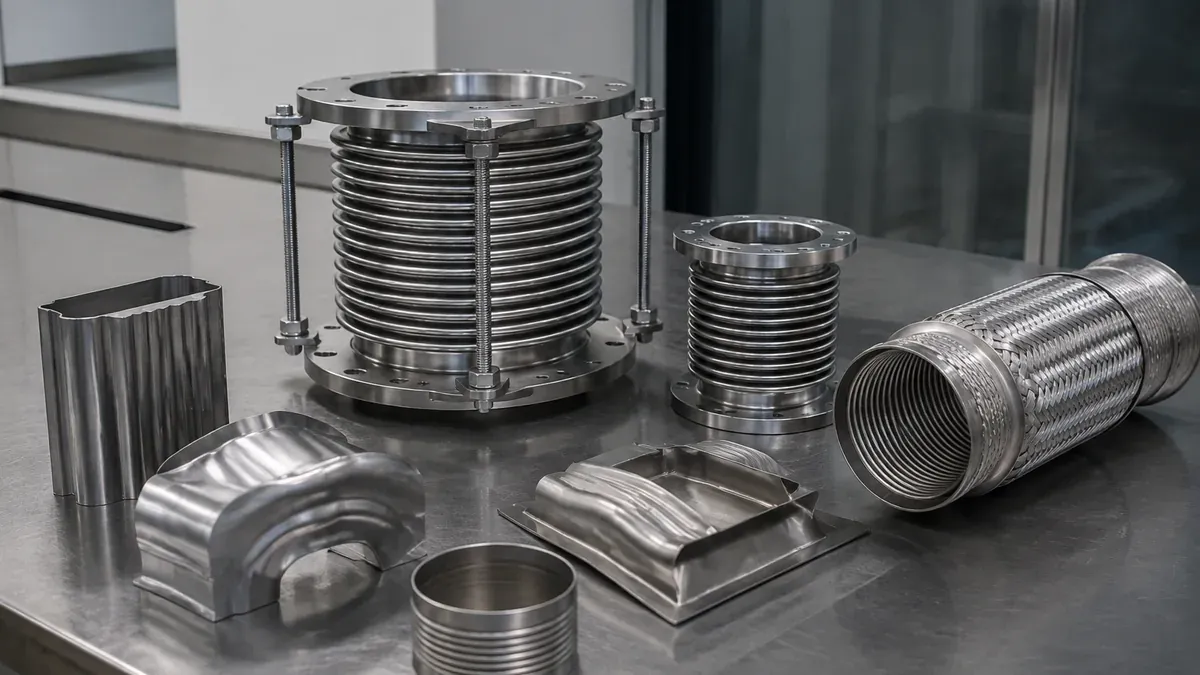
- Expansion joints and bellows
- Aircraft and heater components
- Heat exchangers
321 Compared With Other Grades
Frequently Asked Questions
Why choose 321 over 304 for high temperature?
321 uses titanium stabilization to reduce the risk of chromium-carbide sensitization during certain welding and elevated-temperature cycles. That distinction can matter when the component must retain aqueous corrosion resistance after exposure, but the delivered chemistry, heat treatment, weld procedure and service cycle still require review.
What is the maximum service temperature of 321?
There is no single guaranteed maximum temperature for every 321 component. Oxidation, design stress, creep exposure, atmosphere, thermal cycling and section thickness can set different limits; use the applicable design code and qualified material data for the actual duty.
Is 321 harder to weld than 304?
321 is commonly welded by austenitic procedures, but filler selection, heat input, purge quality and post-weld cleaning belong in the qualified welding specification. The base-metal designation alone does not establish the weld metal's stabilization or corrosion performance.
Published by Tsingshan (Shandong) Iron & Steel Co., Ltd..Sources, update policy and technical limitations.
Quote request
Get a 321 Stainless Steel Quotation
Send the product, grade and quantity you already have. We will complete the specification and quote the supply route.