
301 Stainless Steel (UNS S30100)
Austenitic (high work-hardening) · ASTM A240/A240M, A666 · Density 7.9 g/cm³
Type 301 (UNS S30100) is an austenitic stainless steel selected for its strong work-hardening response. It is supplied annealed or in controlled rolled tempers for springs, clips, belts and structural skins, with strength, ductility, bend direction and magnetic response governed by the ordered condition rather than the grade name alone.
Quotation brief
Quote 301 When
Quote 301 when controlled cold-work strength is central to the part and the drawing can state a recognized rolled temper rather than requesting the grade alone. It is relevant to spring strip, clips, constant-force parts, belts and structural skins where bend direction, springback, fatigue loading and magnetic response are understood. The same work-hardening response that creates strength also reduces forming margin and can complicate welding and corrosion evaluation.
Best fit
- Spring strip, clips and washers ordered to a defined ASTM A666 temper, thickness, strength range and forming direction.
- Structural skins, belts and formed parts whose design uses cold-work strength and has validated bend radius, springback and fatigue loading.
- Projects requiring traceable UNS S30100 chemistry and condition-specific tensile, yield, elongation and dimensional documentation.
Limits to check
- Annealed, quarter-hard, half-hard and full-hard 301 are not interchangeable because strength, elongation, forming margin and magnetic response differ.
- Welding can locally remove cold-work strength and change distortion or residual stress, so the joint cannot inherit strip properties by assumption.
- 301 should not be represented as a corrosion equivalent to 304 in wet or chloride-bearing service without exposure-specific evidence.
Quoted product forms
Quoted product forms for 301 Stainless Steel (UNS S30100)
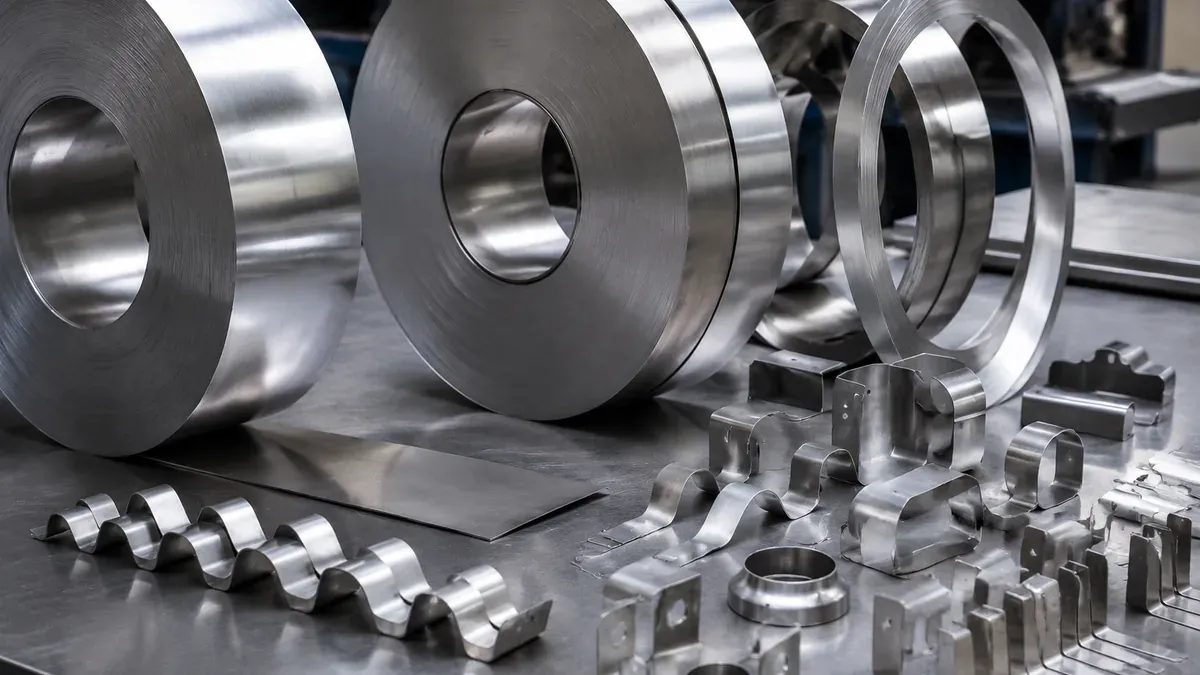
We quote 301 Stainless Steel as coil / strip, sheet / plate against the named product standard.
- Traceability: heat or lot identity plus the inspection document named in the RFQ (EN 10204 3.1 when that route supports it).
- Processing: decoiling, cutting, polishing, shearing and beveling as ordered.
- Next step: send product form, size and quantity; we quote the supply route.
Chemical Composition (wt%)
| C | Mn | Si | Cr | Ni | N | P | S |
|---|---|---|---|---|---|---|---|
| ≤0.15 | ≤2.00 | ≤1.00 | 16.0–18.0 | 6.0–8.0 | ≤0.10 | ≤0.045 | ≤0.030 |
Single values are maximums unless a range is shown. Balance: Fe. Per ASTM A240/A240M, A666.
Mechanical Properties
| Tensile strength (annealed) | ≥515 MPa (75 ksi) |
|---|---|
| Yield strength (annealed) | ≥205 MPa (30 ksi) |
| Elongation (annealed) | ≥40% |
| Tensile (1/2H temper) | ≥1035 MPa (150 ksi) |
| Tensile (full hard) | ≥1275 MPa (185 ksi) |
Room-temperature minimum values are summarized for annealed flat product under ASTM A240/A240M, A666 unless a condition is named in the property label; product form and thickness can change the requirement.
Properties by Condition
301 Annealed
Starting condition before cold rolling; rarely used in service — the grade exists to be hardened.
| Tensile strength | ≥515 MPa (75 ksi) |
|---|---|
| Yield strength (0.2%) | ≥205 MPa (30 ksi) |
| Elongation | ≥40% |
301 1/4 Hard (ASTM A666)
First rolled temper — structural panels and formed parts that still need meaningful bending.
| Tensile strength | ≥860 MPa (125 ksi) |
|---|---|
| Yield strength (0.2%) | ≥515 MPa (75 ksi) |
| Elongation | ≥25% (≥0.76 mm strip) |
301 1/2 Hard (ASTM A666)
The rail and bus body-panel temper: high strength with enough ductility for gentle forming.
| Tensile strength | ≥1035 MPa (150 ksi) |
|---|---|
| Yield strength (0.2%) | ≥760 MPa (110 ksi) |
| Elongation | ≥15% (≥0.76 mm strip) |
301 3/4 Hard (ASTM A666)
Spring territory — clips, washers and contacts formed with generous radii along the rolling direction.
| Tensile strength | ≥1205 MPa (175 ksi) |
|---|---|
| Yield strength (0.2%) | ≥930 MPa (135 ksi) |
| Elongation | ≥10% (≥0.76 mm strip) |
301 Full Hard (ASTM A666)
Maximum rolled strength for flat springs and constant-force applications; bending is limited to large radii.
| Tensile strength | ≥1275 MPa (185 ksi) |
|---|---|
| Yield strength (0.2%) | ≥965 MPa (140 ksi) |
| Elongation | ≥8% (≥0.76 mm strip) |
Physical Properties & Structure
| Density | 7.9 g/cm³ |
|---|---|
| Magnetic response | Essentially non-magnetic after solution annealing; cold work can introduce a measurable magnetic response. |
| Microstructure | Austenitic (high work-hardening) |
Corrosion Resistance & Limits
- General corrosion resistance comes from the chromium-rich passive film; nickel, molybdenum, nitrogen and copper change performance by grade.
- Check chlorides, temperature, crevices, deposits, process chemistry and cleaning conditions. A grade designation alone is not a service-life guarantee.
Fabrication & Heat Treatment
| Welding | Generally weldable with a qualified procedure and matching or over-alloyed filler where required; remove heat tint when corrosion service demands it. |
|---|---|
| Forming | Good ductility is typical, but rapid work hardening increases forming load and springback; bend radius and intermediate annealing depend on grade and reduction. |
| Machining | Use rigid tooling, positive feeds and controlled heat because the material work-hardens; free-machining grades require separate corrosion and welding review. |
| Heat treatment | Solution annealing and rapid cooling restore the intended condition where applicable. Austenitic grades are not hardened by conventional quench-and-temper treatment. |
Equivalent Grades
The closest international equivalents of 301 Stainless Steel are 1.4310 (X10CrNi18-8) in the EN system, SUS301 in the JIS system, 12Cr17Ni7 in the GB system.
These are common corresponding designations, not unconditional substitutes. Verify chemistry, mechanical properties, product standard, delivery condition, dimensions and project approval before changing designation.
| System | Designation |
|---|---|
| UNS | S30100 |
| EN | 1.4310 (X10CrNi18-8) |
| JIS | SUS301 |
| GB | 12Cr17Ni7 |
Ordering Checks for 301
- State UNS S30100, ASTM A666 or the governing product standard, exact temper, thickness, width, edge and surface finish.
- Specify tensile or hardness range, elongation, flatness, camber, coil set and any fatigue or spring-force acceptance required by the drawing.
- Define rolling and bend direction, minimum radius, forming sequence, joining method and whether local heat will alter the required temper.
- Request inspection documentation that identifies heat chemistry, ordered temper, mechanical test orientation, dimensions and coil or lot traceability.
Reference Product Forms & Dimensional Ranges
Common reference product forms for 301 stainless steel: Coil / Strip, Sheet / Plate.
| Conditions | Annealed, 1/4H, 1/2H, 3/4H, FH cold-rolled tempers |
|---|---|
| Coil / strip thickness | 0.1–3.0 mm |
| Finishes | 2B, BA |
Common surface and delivery options
- No.1, 2B, BA or mechanically polished finish when supported by the product route
These published ranges are engineering references, not a live-stock or production-capability promise. Send the required product form, dimensions, condition and finish; we quote the matching supply route.
Browse related product hubs:Sheet & plate,Coil & strip,Pipe & tube,Bar & rod.
Typical Applications
- Springs, clips and washers
- Metro, rail and bus body panels
- Conveyor and transmission belts
- Structural trim requiring high strength
- Antenna and battery contacts
Frequently Asked Questions
What is the difference between 301 and 304 stainless steel?
301 carries less chromium and nickel, which makes its austenite less stable: it transforms to martensite under cold work and gains strength much faster than 304. Choose 301 when you need rolled-temper strength (springs, structural skins); choose 304 for better corrosion resistance and deep drawing.
What do 1/4H, 1/2H and FH tempers mean for 301?
They are cold-rolled temper designations per ASTM A666: quarter hard (tensile ≥860 MPa), half hard (≥1035 MPa), three-quarter hard (≥1205 MPa) and full hard (≥1275 MPa). Higher tempers trade ductility for strength, so forming radius and bend orientation must be planned accordingly.
Is 301 stainless steel magnetic?
Annealed 301 is nearly non-magnetic, but cold-rolled tempers contain strain-induced martensite and respond clearly to a magnet. This is expected behavior for the grade, not a sign of substitution or poor quality.
Published by Tsingshan (Shandong) Iron & Steel Co., Ltd..Sources, update policy and technical limitations.
Quote request
Get a 301 Stainless Steel Quotation
Send the product, grade and quantity you already have. We will complete the specification and quote the supply route.