
Stainless Steel Pipe Fittings
Order butt-weld, socket-weld, threaded and sanitary stainless fittings by type, grade, NPS, schedule, end and dimensional standard for export projects.
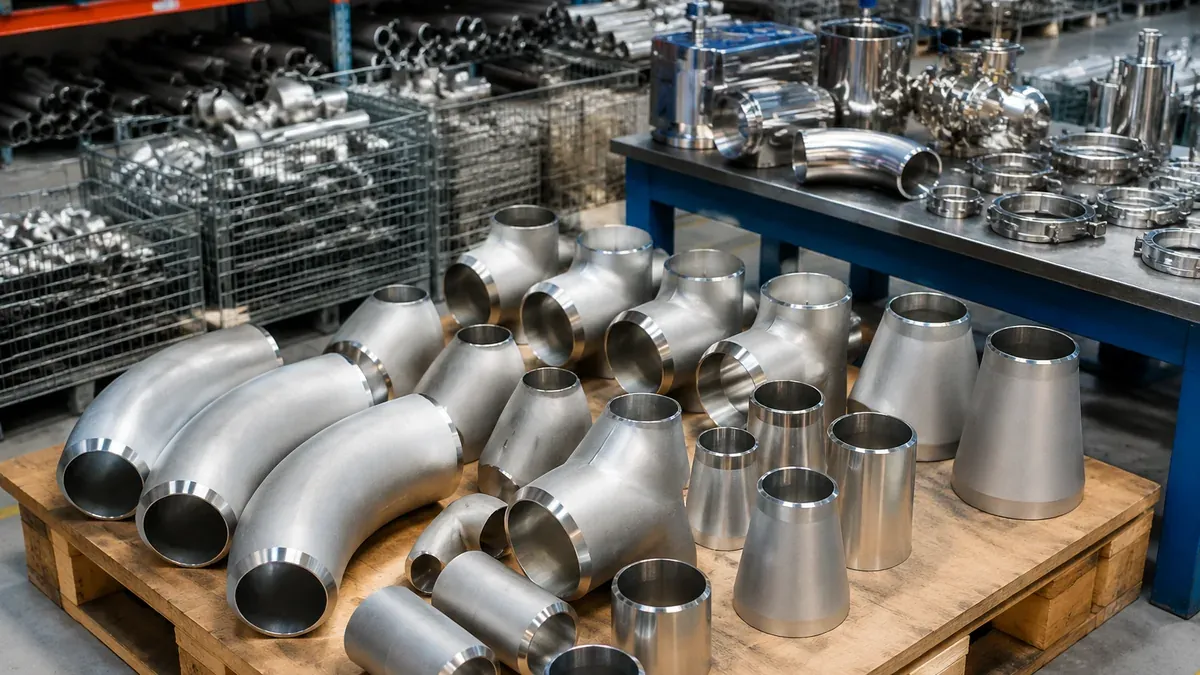
Fitting orders must combine the material standard, dimensional standard, connection, size and wall rather than naming a grade and fitting type alone. Butt-weld elbows, tees, reducers, caps and stub ends use a different ordering system from socket-weld or threaded couplings and unions. Sanitary elbows, tees and reducers follow connection-specific tube geometry and surface requirements. Name the family and fitting type first, then state the material product standard and the dimensional standard separately so neither role is assumed.
Pressure fitting dimensions normally begin with NPS and schedule or matching wall. Reducers and branch fittings need every end size and wall, concentric or eccentric orientation where applicable, angle and center-to-end geometry. Butt-weld bevels, socket dimensions and threads must match the connected piping specification. For sanitary fittings, give tube OD and wall, connection style, dimensional series and any gasket-facing geometry. A general request for a “316L tee” leaves the connection, size system, wall and acceptance basis unresolved. When the connected tube route is hygienic, align the fitting freeze lines with the ASTM A270 vs A269 guide and the food-equipment application page rather than copying pressure-fitting shorthand.
Send inspection document type, item marking, quantity per line, package constraints and destination in the RFQ. We quote bevel, thread or sanitary-face protection and keep type, size, schedule, grade and heat segregated in the packing list for Middle East and Southeast Asia sea routes.
A quotable fitting line also names heat treatment, PMI or other examination, marking format and whether the item is supplied as a loose fitting or as part of a piping-class package. Socket-weld and threaded fittings still need NPS, class or wall, thread or socket standard, and the matching pipe specification. Sanitary items still need the governing hygienic dimensional series, internal finish, gasket or clamp face, and whether product-contact surfaces are pickled, mechanically polished or electropolished. Freeze certificate and line wording with the purchase-order wording examples and RFQ checklist, then submit through the contact / RFQ page. The quotation confirms the fitting family, connected piping class and inspection documents against that complete description, not a grade-and-type nickname.
What to send for a quotation
- Which fitting type, connection system and dimensional standard apply?
- What NPS, schedule or tube OD and wall must the fitting match?
- Which material product standard and heat treatment govern acceptance?
- What marking, examination, PMI and document package must accompany the order?
- What destination port and face/bevel protection apply for sea shipment?
Product form matrix
Choose the product form first. We quote the matching purchase standard and dimensional description for that form.
| Product form | Reference standards | How to state dimensions | Common uses |
|---|---|---|---|
| Butt-weld fitting | ASTM A403/A403M; ASME B16.9 | Fitting type by NPS and schedule with end preparation and dimensional standard. | process piping, pressure systems, fabricated spools |
| Sanitary fitting | ASTM A270/A270M; Ordered sanitary dimensional system | Fitting type by tube OD, wall, connection geometry and internal surface requirement. | food processing, pharmaceutical equipment, hygienic systems |
| Socket-weld / threaded fitting | ASTM A182 / project piping class; ASME B16.11 where applicable | Fitting type by NPS, class or wall, thread or socket standard and matching pipe specification. | utility piping, instrument take-offs, small-bore process lines |
How to choose
- Match butt-weld, socket-weld, threaded or sanitary ends to the connected piping system.
- Separate material product standard from the dimensional fitting standard.
- Confirm schedule or wall at every connected end, especially for reducers and branch fittings.
- Define internal finish and cleanability for sanitary service before sourcing.
Dimensions and tolerances
Pressure fittings are commonly ordered by type, NPS, schedule and ASME dimensions, while sanitary fittings use tube OD, wall and connection-specific geometry with surface criteria. Reducers and branch fittings need every end size and wall stated.
Send the ordered sizes and any tighter project tolerances. We quote the matching pipe fittings route against the governing dimensional system.
Processing and finishing
- Define butt-weld bevels, socket bores, threads or sanitary connection faces so machining and end preparation match the connected pipe or tube system.
- State pickled, passivated, mechanically polished or electropolished requirements with internal-surface acceptance where product cleanliness is relevant.
- Identify any spool fabrication, welding, branch modification or special marking that changes the standard fitting and requires drawing-based review.
Pickled & PassivatedElectropolishedNo.4Stainless Steel Welding and Custom FabricationStainless Steel Polishing and Surface FinishingCustom Packaging and Export Loading
Inspection and documents
- Verify fitting geometry, center-to-end dimensions, wall, end preparation and marking.
- Confirm material heat treatment and ordered examination or testing documentation.
- Check internal surface and connection dimensions for sanitary fittings.
- Name PMI or heat-verification hold points when piping classes mix 304/316L/duplex lots.
Packing and handling risks
RISK 01
Bevels, threads and sanitary sealing faces can be damaged without individual protection.
RISK 02
Mixed types, schedules and sizes require clear item and package identification.
RISK 03
Clean fittings can be contaminated by unsuitable wrapping or open package storage on humid MENA/SEA routes.
Detailed stainless steel products
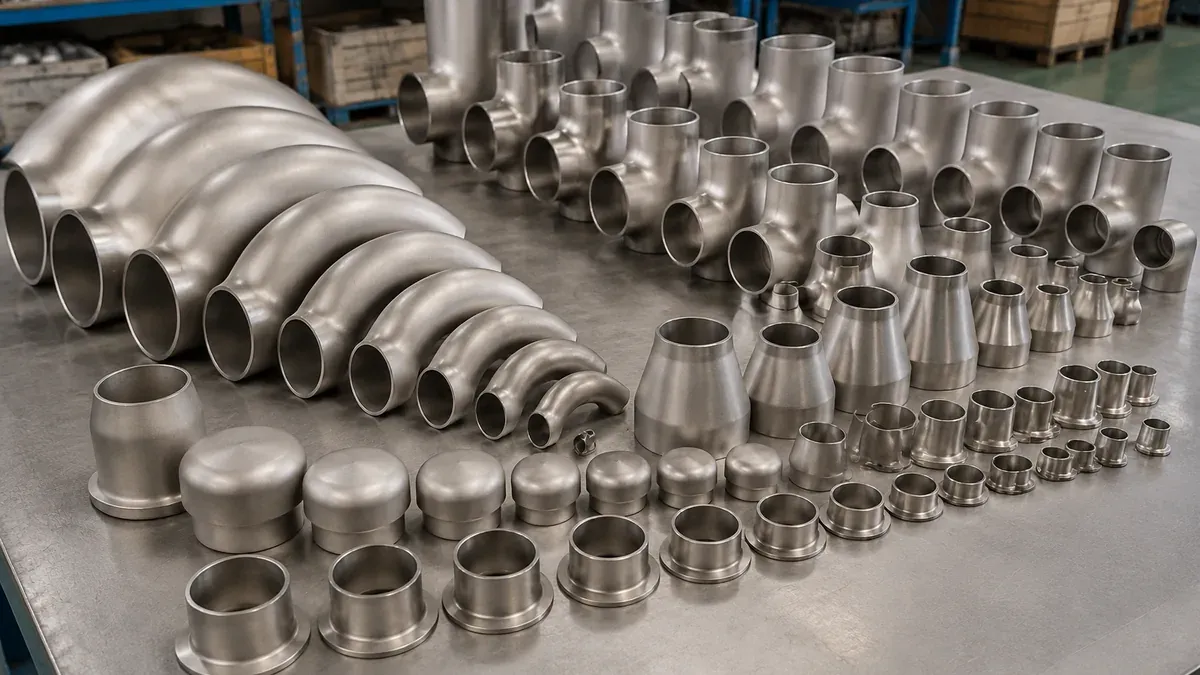
316L Stainless Steel Butt-Weld Fittings
316L stainless steel butt-weld elbows, tees, reducers, caps and stub ends to ASTM A403 and ASME B16.9 for chemical, marine and process piping.
View details →
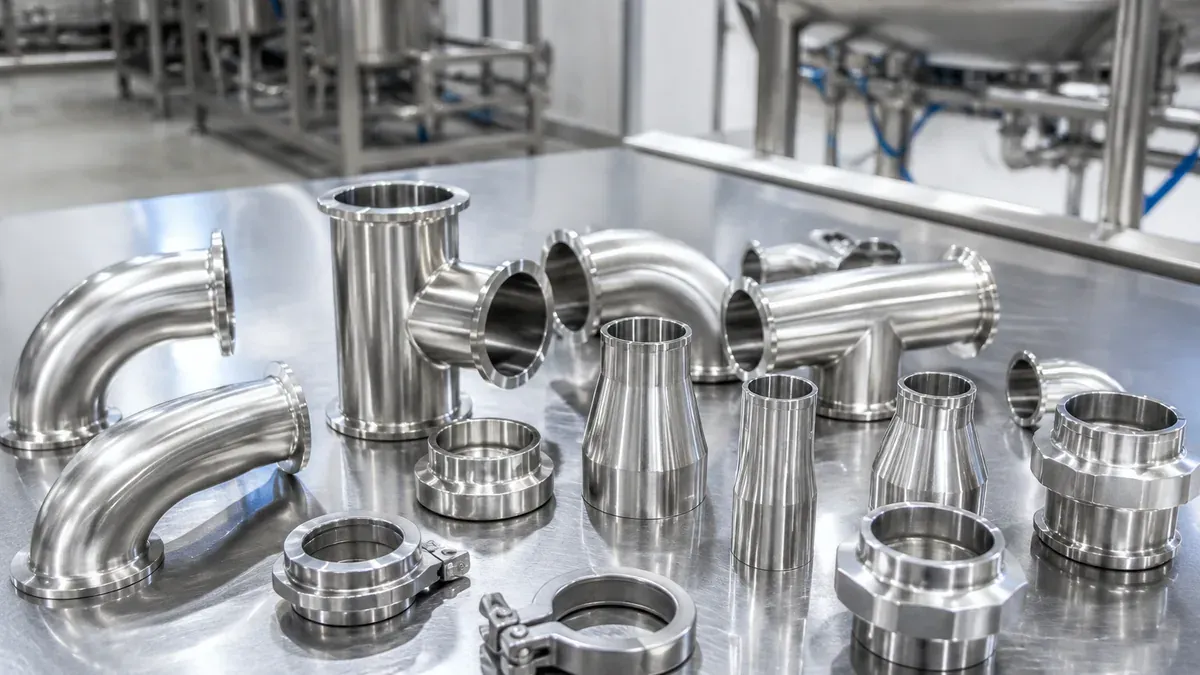
304L Stainless Steel Sanitary Fittings
304L and 316L stainless sanitary elbows, tees, reducers, ferrules and unions with controlled internal finish for food, beverage and hygienic utility systems.
View details →
Related grades, standards and applications
Published standards
Application guides
Frequently asked questions
Which standards belong in a butt-weld fitting RFQ?
State both the material product standard and the dimensional fitting standard, together with grade, type, NPS and schedule.
How should a reducer with different end schedules be ordered?
Define each end size and wall or schedule, reducer geometry, length standard and any transition or bore requirement.
What distinguishes sanitary fittings from pressure fittings?
Sanitary fittings use connection-specific dimensions and internal finish or cleanability criteria that are not defined by pressure fitting terminology alone. Align tube OD/wall and hygienic series with the A270 (or project) tubing route.
Which fitting surfaces need protection during shipping?
Protect bevels, threads, socket bores, sealing faces and sanitary ends according to the connection and cleanliness requirement, especially for sea shipment to Gulf and Southeast Asia ports.
What document and identity checks belong on export fitting RFQs?
Freeze heat marking, MTC / EN 10204 type, dimensional report scope and any PMI hold points so receiving can match each fitting to the piping class — see the site PMI checklist and purchase-order wording examples.
Category RFQ checklist
Send the following details by size and line item. We quote the matching route, inspection plan, packing method and delivery window.
- 01Fitting type and quantity
- 02Grade and material product standard
- 03Dimensional standard
- 04NPS, schedule, OD or wall (every end for reducers/branches)
- 05End connection and preparation
- 06Heat treatment and surface condition
- 07Examination, marking, PMI and documents
- 08Protection, packing and destination port
Need a Pipe Fittings quotation?
Send product, grade and quantity. We quote the confirmed supply route.