
303 Stainless Steel (UNS S30300)
Austenitic (free-machining) · ASTM A582 · Density 7.93 g/cm³
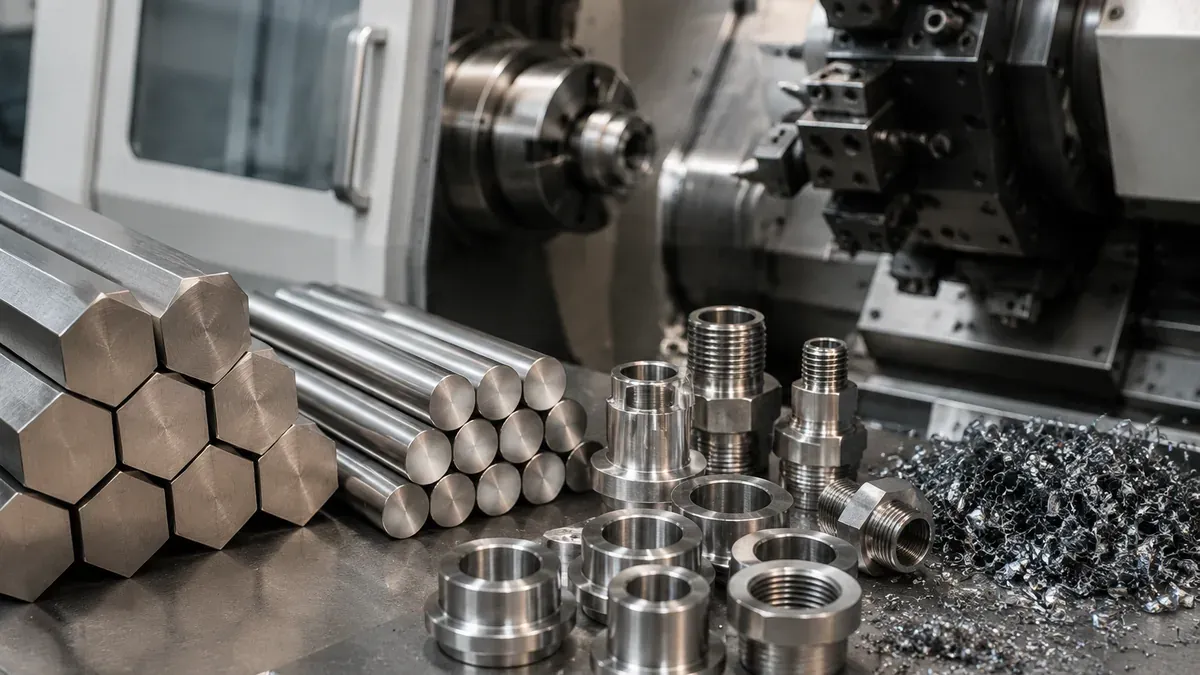
Type 303 (UNS S30300) is a sulfur-modified austenitic stainless steel developed for controlled chip breaking in machined bar components. The inclusion population can improve production machining, but it also changes corrosion, transverse ductility, hot-work and welding behavior, so 303 should be ordered for a defined machining route rather than treated as interchangeable with 304.
Quotation brief
Quote 303 When
Quote 303 when a machined bar component benefits from sulfur-assisted chip breaking and the service does not require the welding, severe forming or wet-corrosion margin associated with other austenitic grades. It is relevant to turned fittings, bushings, couplings, shafts and screw-machine parts when the drawing defines section, tolerance, surface and final exposure. Machinability is a process outcome, not a fixed speed multiplier, and must be qualified on the delivered lot and machine route.
Best fit
- High-volume turned or milled bar components whose cycle, chip control, dimensional tolerance and final surface are validated on the supplied condition.
- Dry or mildly exposed mechanical parts that do not require a welded joint, severe cold heading or high-transverse-ductility fabrication route.
- Orders naming UNS S30300 under ASTM A582 with heat traceability, bar condition, section tolerance and inspection requirements.
Limits to check
- Sulfur-modified inclusions reduce welding reliability and can lower pitting resistance compared with 304 in wet, chloride or acidic conditions.
- A generic machining-rate claim cannot be guaranteed because bar condition, machine rigidity, tool, coolant, feed and geometry govern the result.
- Typical mechanical-property values do not replace ordered acceptance requirements for a specific bar section, condition or finished component.
Quoted product forms
Quoted product forms for 303 Stainless Steel (UNS S30300)
We quote 303 Stainless Steel as bar against the named product standard.
- Traceability: heat or lot identity plus the inspection document named in the RFQ (EN 10204 3.1 when that route supports it).
- Processing: decoiling, cutting, polishing, shearing and beveling as ordered.
- Next step: send product form, size and quantity; we quote the supply route.
Chemical Composition (wt%)
| C | Mn | Si | Cr | Ni | P | S | Mo |
|---|---|---|---|---|---|---|---|
| ≤0.15 | ≤2.00 | ≤1.00 | 17.0–19.0 | 8.0–10.0 | ≤0.20 | ≥0.15 | ≤0.60 (optional) |
Single values are maximums unless a range is shown. Balance: Fe. Per ASTM A582.
Mechanical Properties
| Tensile strength (annealed, typical) | ≈620 MPa |
|---|---|
| Yield strength (0.2%, typical) | ≈240 MPa |
| Elongation (50 mm, typical) | ≈50% |
| Hardness | ≤262 HBW |
Room-temperature values are summarized for the product form and condition represented by ASTM A582; confirm section size, delivery condition and current governing edition before ordering.
Physical Properties & Structure
| Density | 7.93 g/cm³ |
|---|---|
| Magnetic response | Essentially non-magnetic after solution annealing; cold work can introduce a measurable magnetic response. |
| Microstructure | Austenitic (free-machining) |
Corrosion Resistance & Limits
- General corrosion resistance comes from the chromium-rich passive film; nickel, molybdenum, nitrogen and copper change performance by grade.
- Check chlorides, temperature, crevices, deposits, process chemistry and cleaning conditions. A grade designation alone is not a service-life guarantee.
Fabrication & Heat Treatment
| Welding | Generally weldable with a qualified procedure and matching or over-alloyed filler where required; remove heat tint when corrosion service demands it. |
|---|---|
| Forming | Good ductility is typical, but rapid work hardening increases forming load and springback; bend radius and intermediate annealing depend on grade and reduction. |
| Machining | Use rigid tooling, positive feeds and controlled heat because the material work-hardens; free-machining grades require separate corrosion and welding review. |
| Heat treatment | Solution annealing and rapid cooling restore the intended condition where applicable. Austenitic grades are not hardened by conventional quench-and-temper treatment. |
Equivalent Grades
The closest international equivalents of 303 Stainless Steel are 1.4305 (X8CrNiS18-9) in the EN system, SUS303 in the JIS system, Y12Cr18Ni9 in the GB system.
These are common corresponding designations, not unconditional substitutes. Verify chemistry, mechanical properties, product standard, delivery condition, dimensions and project approval before changing designation.
| System | Designation |
|---|---|
| UNS | S30300 |
| EN | 1.4305 (X8CrNiS18-9) |
| JIS | SUS303 |
| GB | Y12Cr18Ni9 |
Ordering Checks for 303
- State UNS S30300, ASTM A582 edition, round or hex form, diameter or across-flats size, length and delivery condition.
- Define dimensional tolerance, straightness, surface condition, decarburization or defect limits, machining allowance and final finish requirement.
- Describe the turning, drilling, threading or milling sequence plus any cross-hole, forming, welding, passivation or product-contact requirement.
- Request the required inspection document and verify heat chemistry, bar condition, dimensions, traceability and any supplementary test named on the order.
Reference Product Forms & Dimensional Ranges
Common reference product forms for 303 stainless steel: Bar.
| Bar diameter | 3–150 mm |
|---|---|
| Condition | Annealed, cold drawn; smooth turned or polished on request |
| Length | 3 m / 6 m fixed lengths |
Common surface and delivery options
- Hot rolled, peeled, bright drawn, ground or polished bar condition according to tolerance
These published ranges are engineering references, not a live-stock or production-capability promise. Send the required product form, dimensions, condition and finish; we quote the matching supply route.
Browse related product hubs:Sheet & plate,Coil & strip,Pipe & tube,Bar & rod.
Typical Applications
- Precision turned components
- Fittings, bushings and couplings
- Valve and pump internals
- Screw-machine products and fasteners
- Gears and shafts
303 Products We Export
303 Compared With Other Grades
Frequently Asked Questions
Can 303 stainless steel be welded?
Welding is not recommended. The same sulfur that makes 303 machinable causes hot cracking in the weld and heat-affected zone. If a machined part must also be welded, switch to 304L and accept the slower machining, or redesign the joint mechanically.
Is 303 as corrosion resistant as 304?
Not quite. The manganese sulfide inclusions act as initiation sites for pitting, so 303 gives up some resistance, most noticeably in wet, chloride or acidic service. Indoors and in dry mechanical service the difference is rarely significant.
When should I choose 303 over 304?
Choose 303 when machining time dominates part cost — high-volume turned fittings, bushings and valve bodies made on screw machines. Choose 304 whenever the part is welded, heavily cold formed, or exposed to chlorides or product-contact hygiene requirements.
Published by Tsingshan (Shandong) Iron & Steel Co., Ltd..Sources, update policy and technical limitations.
Quote request
Get a 303 Stainless Steel Quotation
Send the product, grade and quantity you already have. We will complete the specification and quote the supply route.