
430 Stainless Steel (UNS S43000)
Ferritic · ASTM A240/A240M · Density 7.7 g/cm³
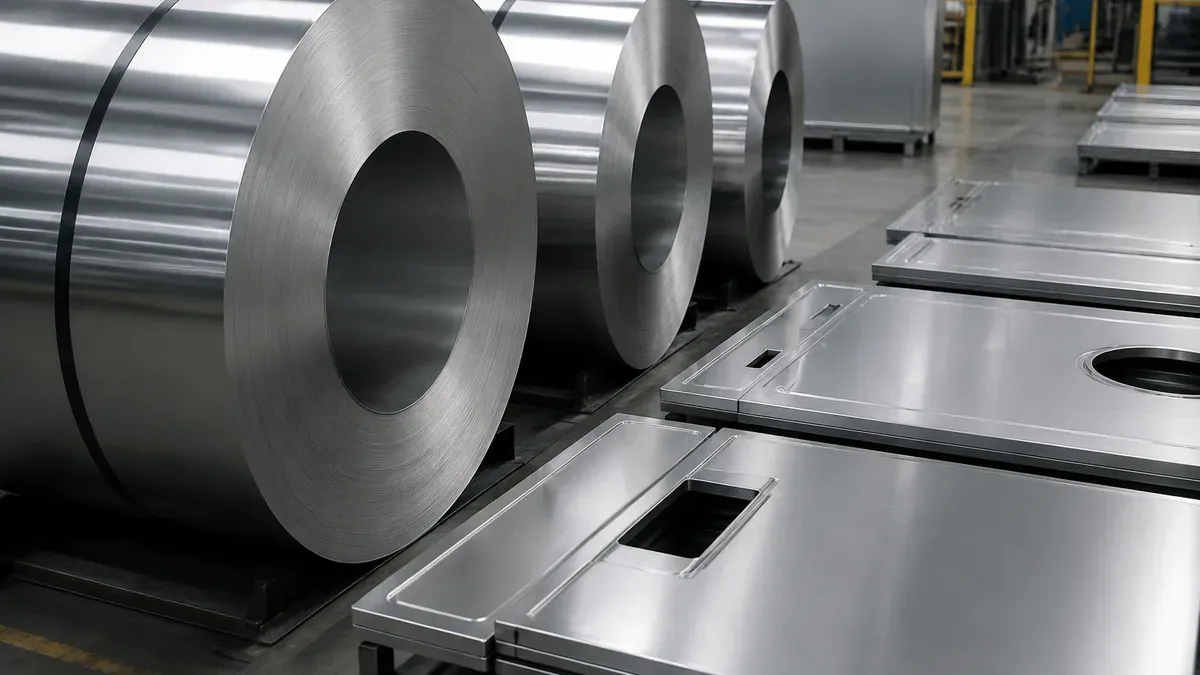
Type 430 (UNS S43000 / EN 1.4016, X6Cr17) is a ~17% chromium ferritic stainless steel with no deliberate nickel addition (ASTM A240 caps Ni at 0.75%), so cost is lower and more stable than 304. Annealed sheet and coil in BA or 2B are the usual supply for magnetic appliance panels, induction-compatible cookware layers, decorative trim and indoor architectural faces. It is not a marine or chloride-primary substitute for 304, and not automatic for heavy welded fabrication. Buyers searching “430 / 1.4016 / S43000” are naming the same ferritic family under ASTM, UNS and EN aliases — this page is the working data sheet and RFQ checklist for that grade.
Quotation brief
Quote 430 When
Quote 430 when the RFQ names magnetic ferritic sheet or coil for dry indoor appliance skins, induction-compatible cookware layers, decorative trim or light architectural faces, and the buyer accepts a ~17% Cr stainless without deliberate nickel alloying instead of 304 after reviewing corrosion, cleaning and appearance. Buyers often search the triple alias “430 / 1.4016 / S43000”: these resolve to the same ferritic family, but ASTM A240 (S43000, C ≤0.12%) and EN 10088-2 (1.4016, C ≤0.08%) are not identical tables, so state which standard governs or ask for dual certification. Use 7.7 g/cm³ for weight estimates (about 22.9 kg for a 1219 × 2438 × 1.0 mm sheet), and remember 430 expands less and conducts heat better than 304 — useful for appliance panels, but it forms and welds less forgivingly. BA and 2B are the usual decorative faces; annealed flat product under ASTM A240 is the normal starting condition. For welded or hot-wet parts consider stabilized 439 or 441; for wet, coastal or chloride duty move to 304 or better. In Gulf and Southeast Asia programs, packing and port storage decide surface condition on arrival as much as the grade does.
Best fit
- Annealed sheet and coil orders naming UNS S43000 or EN 1.4016 for magnetic appliance skins, range hoods, backsplashes, refrigerator and dishwasher panels and indoor trim.
- Induction-compatible magnetic layers and bases in cookware and small-appliance programs where the forming severity has been trialled on the ordered gauge.
- Cost-sensitive decorative flat products for Middle East and Southeast Asia appliance and trim programs with agreed BA/2B appearance, film and seaworthy packing.
Limits to check
- Coastal salt, persistent wetting and chloride cleaners can stain or pit earlier than on 304; do not specify 430 for marine or chloride-primary service without exposure evidence.
- Weld HAZ grain growth can reduce toughness as thickness and restraint increase — for welded parts consider stabilized 439/441 and qualify any procedure; this page is not a WPS.
- Lower room-temperature formability than common austenitics makes severe deep drawing and complex stretch forming less forgiving than 304 or annealed 201.
- Prolonged exposure around 400–540 °C risks 475 °C embrittlement, so 430 is not a default choice for hot structural duty without engineering review.
Quoted product forms
Quoted product forms for 430 Stainless Steel (UNS S43000)
We quote 430 Stainless Steel as sheet / plate, coil / strip against the named product standard.
- Traceability: heat or lot identity plus the inspection document named in the RFQ (EN 10204 3.1 when that route supports it).
- Processing: decoiling, cutting, polishing, shearing and beveling as ordered.
- Next step: send product form, size and quantity; we quote the supply route.
Chemical Composition (wt%)
| C | Mn | Si | Cr | Ni | P | S |
|---|---|---|---|---|---|---|
| ≤0.12 | ≤1.00 | ≤1.00 | 16.0–18.0 | ≤0.75 | ≤0.040 | ≤0.030 |
Single values are maximums unless a range is shown. Balance: Fe. Per ASTM A240/A240M.
Mechanical Properties
| Tensile strength | ≥450 MPa (65 ksi) |
|---|---|
| Yield strength (0.2%) | ≥205 MPa (30 ksi) |
| Elongation (50 mm) | ≥22% |
| Hardness | ≤183 HBW / ≤89 HRBW |
Room-temperature minimum values are summarized for annealed flat product under ASTM A240/A240M unless a condition is named in the property label; product form and thickness can change the requirement. Density, modulus, thermal expansion and conductivity are engineering-typical values for weight and design estimates, not MTC acceptance limits. EN 10088-2 1.4016 orders are accepted against the EN chemistry and mechanical tables, which are not identical to A240.
Physical Properties & Structure
| Density | 7.7 g/cm³ (≈7,700 kg/m³) — engineering typical for weight estimates, not an MTC limit |
|---|---|
| Elastic modulus | ≈200 GPa (typical, room temperature) |
| Thermal expansion (20–100 °C) | ≈10.4 × 10⁻⁶ /K (typical) — lower than ≈17 × 10⁻⁶ /K for 304 |
| Thermal conductivity (100 °C) | ≈26 W/m·K (typical) — higher than 304 |
| Magnetic response | Magnetic in the usual annealed condition because the room-temperature matrix is ferritic. |
| Microstructure | Ferritic (chromium stainless; no deliberate nickel addition) |
Corrosion Resistance & Limits
- 430 forms a chromium-rich passive film suited to dry indoor atmospheres and many decorative appliance faces, but coastal exposure, persistent wetting and chloride cleaners can stain or pit sooner than on common austenitic grades such as 304.
- Ferritic grades generally resist chloride stress-corrosion cracking better than common austenitics, while pitting and crevice attack still depend on chromium level, surface finish, deposits and drainage — do not treat 430 as marine or chloride-primary service material.
- Against 201, corrosion ranking still depends on the actual humidity, salt and cleaning chemistry; against 304, annealed 430 is usually chosen for magnetic decorative indoor duty rather than as a corrosion upgrade. Validate fabrication and environment rather than relying on the grade name alone.
- Export coil and sheet shipped to Gulf and Southeast Asian ports can tea-stain from container condensation and humid quayside storage before fabrication even starts; specify sealed, desiccated or VCI-wrapped packing and prompt unpacking rather than blaming the grade after arrival.
Fabrication & Heat Treatment
| Welding | Control heat input, interpass temperature and joint design to limit grain growth and loss of toughness in the HAZ; thin decorative sheet is often spot-, seam- or TIG-welded after trials. Where the qualified procedure allows, an austenitic filler is sometimes used to improve weld ductility, and for welded parts a stabilized ferritic such as 439 or 441 is often the better RFQ choice. Do not treat this page as a WPS — qualify the procedure for the ordered gauge and duty. |
|---|---|
| Forming | Annealed sheet and coil form adequately for bends and moderate stampings, but ductility and stretch formability are lower than common austenitic grades such as 304 or 201. Prove bend radius, draw severity and springback on the actual gauge. |
| Machining | Machining is generally straightforward with rigid tooling; avoid smearing, overheating and iron contamination of finished decorative surfaces that will remain visible in BA or 2B. |
| Heat treatment | Ferritic 430 is not hardened by conventional quench-and-temper treatment. Annealing can restore ductility after cold work, but temperature and cooling must follow the product specification. Avoid prolonged service or slow cooling in roughly the 400–540 °C range, where ferritic chromium steels are prone to ‘475 °C embrittlement’; do not invent contractual heat-treat cycles here. |
Equivalent Grades
The closest international equivalents of 430 Stainless Steel are 1.4016 (X6Cr17) in the EN system, SUS430 in the JIS system, 10Cr17 in the GB system.
These are common corresponding designations, not unconditional substitutes. Verify chemistry, mechanical properties, product standard, delivery condition, dimensions and project approval before changing designation.
| System | Designation |
|---|---|
| UNS | S43000 |
| EN | 1.4016 (X6Cr17) |
| JIS | SUS430 |
| GB | 10Cr17 |
Ordering Checks for 430
- State 430 with UNS S43000 or EN 1.4016 (X6Cr17), the governing standard and edition (ASTM A240/A240M or EN 10088-2), and whether dual certification to the tighter limits of both is required.
- Give product form (sheet, coil, slit strip), thickness, width, length or coil, thickness and flatness tolerance, edge condition and annealed condition; add coil ID, max coil weight and decoiler limits.
- Define indoor vs outdoor exposure, humidity, chlorides, cleaning chemicals, welding and forming severity, and whether magnetism is required or merely acceptable, before choosing 430 versus 439/441, 201 or 304.
- Specify finish (BA, 2B, No.4, hairline), critical face, protective film type, grain direction and any gloss or sample criteria for visible appliance or trim parts.
- Name the inspection document (heat-linked MTC / EN 10204 3.1), PMI hold points for mixed ferritic lots, destination port and seaworthy packing (sealed/VCI wrap, desiccant, skids) for humid Gulf or SEA transit.
Reference Product Forms & Dimensional Ranges
Common reference product forms for 430 stainless steel: Sheet / Plate, Coil / Strip.
| Finishes | 2B, BA, No.4, hairline (decorative BA/2B common for appliance faces) |
|---|---|
| Sheet / coil thickness | 0.2–3.0 mm typical strip-mill window — confirm ordered gauge |
| Slit strip width | as narrow as ~20 mm when the mill route supports it |
| Forms emphasis | Sheet and coil/strip are the primary commercial forms for this grade page |
| Weight estimate | kg per sheet ≈ length (m) × width (m) × thickness (mm) × 7.7 — e.g. 1219 × 2438 × 1.0 mm ≈ 22.9 kg; invoice weight follows actual scale or theoretical basis agreed on the PO |
| Coil packing | Coil ID, max coil weight and outer diameter follow the mill route — state your decoiler/crane limit and container loading before quotation |
Common surface and delivery options
- No.1, 2B, BA or mechanically polished finish when supported by the product route
- BA and 2B are the common decorative faces for appliance panels and indoor trim
- Protective film, critical face, grain direction and agreed surface sample for visible parts
These published ranges are engineering references, not a live-stock or production-capability promise. Send the required product form, dimensions, condition and finish; we quote the matching supply route.
Browse related product hubs:Sheet & plate,Coil & strip,Pipe & tube,Bar & rod.
Typical Applications
- Appliance panels, skins and housings (magnetic decorative faces)
- Kitchen counters, backsplashes and range hoods for indoor duty
- Indoor architectural and automotive trim
- Light-gauge stamped or roll-formed decorative components after forming review
- Magnetic, induction-compatible outer layers and bases in cookware and small-appliance programs after forming review
430 Products We Export
430 Compared With Other Grades
Related buyer guides:
Frequently Asked Questions
What do 430, EN 1.4016 and UNS S43000 mean — are they the same steel?
They name the same ~17% Cr ferritic family: UNS S43000 is the ASTM/UNS designation for Type 430, EN 1.4016 (X6Cr17) is the European number and SUS430 is the JIS label. They are close cross-references, not identical specifications — for example EN 10088-2 caps carbon for 1.4016 at 0.08% while ASTM A240 allows up to 0.12% for S43000. If you need dual certification, say so on the RFQ so the heat meets the tighter limit of both, and verify heat chemistry on the MTC (or by PMI) before releasing mixed lots.
430 stainless steel data sheet: density and key properties?
Engineering-typical density is 7.7 g/cm³ (about 7,700 kg/m³), slightly lower than 304 at about 7.9. For annealed flat product under ASTM A240/A240M, Type 430 minimums are tensile ≥450 MPa (65 ksi), 0.2% yield ≥205 MPa (30 ksi) and elongation ≥22%, with hardness ≤183 HBW (≤89 HRBW). Typical modulus is about 200 GPa and thermal expansion about 10.4 × 10⁻⁶/K. For weight, kg ≈ length (m) × width (m) × thickness (mm) × 7.7 — a 1219 × 2438 × 1.0 mm sheet is about 22.9 kg. Acceptance still follows the contracted edition and MTC.
Is 430 stainless steel magnetic, and does that matter for induction cookware?
Yes — 430 is ferritic, so it is strongly magnetic in the usual annealed sheet and coil condition. That is why it is used for magnetic appliance fronts and as an induction-compatible layer or base in cookware programs. Magnetism alone does not prove grade identity or corrosion performance: a magnet cannot separate 430 from 409L, 439 or cold-worked 201. Verify the heat chemistry and designation on the inspection document or by PMI.
430 vs 304 vs 201 — when is 430 the better RFQ choice?
Choose 430 when the duty is dry indoor or mildly corrosive decorative or appliance sheet, a magnetic substrate is acceptable or required, and avoiding nickel cost swings matters. Choose 304 for outdoor wetting, frequent wet cleaning, food-contact equipment that is washed hard, coastal air or welded parts that need austenitic toughness. 201 stays austenitic and non-magnetic when annealed, forms more easily than 430, but has its own corrosion limits. Neither 430 nor 201 replaces 304 for marine or chloride-primary exposure — see the 430 vs 304 comparison for the pairwise decision.
What is “430L”, and should I order 439 or 441 instead of 430?
“430L” is a trade label for low-carbon 430, not an ASTM A240 UNS designation, so its meaning varies by supplier. If low carbon matters, write the carbon maximum (or EN 1.4016 with its 0.08% C cap) on the PO instead of relying on the label. When parts are welded or see hot or wet cycling — exhaust, burners, sinks — the titanium/niobium-stabilized ferritics 439 (S43035) and 441 (1.4509) are often the better RFQ choice than 430; compare grade pages before freezing the specification.
What should a 430 coil or sheet RFQ to the Middle East or Southeast Asia include?
Freeze grade identity (430 / UNS S43000 or EN 1.4016, plus dual-cert if needed), ASTM A240 or EN 10088-2 edition, thickness, width, length or coil, thickness and flatness tolerance, edge (mill or slit), finish (2B, BA, No.4, hairline), protective film and critical face. Add coil ID and max coil weight, annealed condition, EN 10204 3.1 MTC, any PMI hold point, destination port and seaworthy packing (sealed or VCI wrap, desiccant, wooden skids) for humid Gulf or SEA transit. Send the list to our contact page for a heat-linked quotation.
Published by Tsingshan (Shandong) Iron & Steel Co., Ltd..Sources, update policy and technical limitations.
Quote request
Get a 430 Stainless Steel Quotation
Leave your name and a WhatsApp number or email. Grade and quantity help, but are not required. Sales will reply within one business day.