
201 Stainless Steel (UNS S20100)
Austenitic (Cr-Mn) · ASTM A240/A240M · Density 7.81 g/cm³
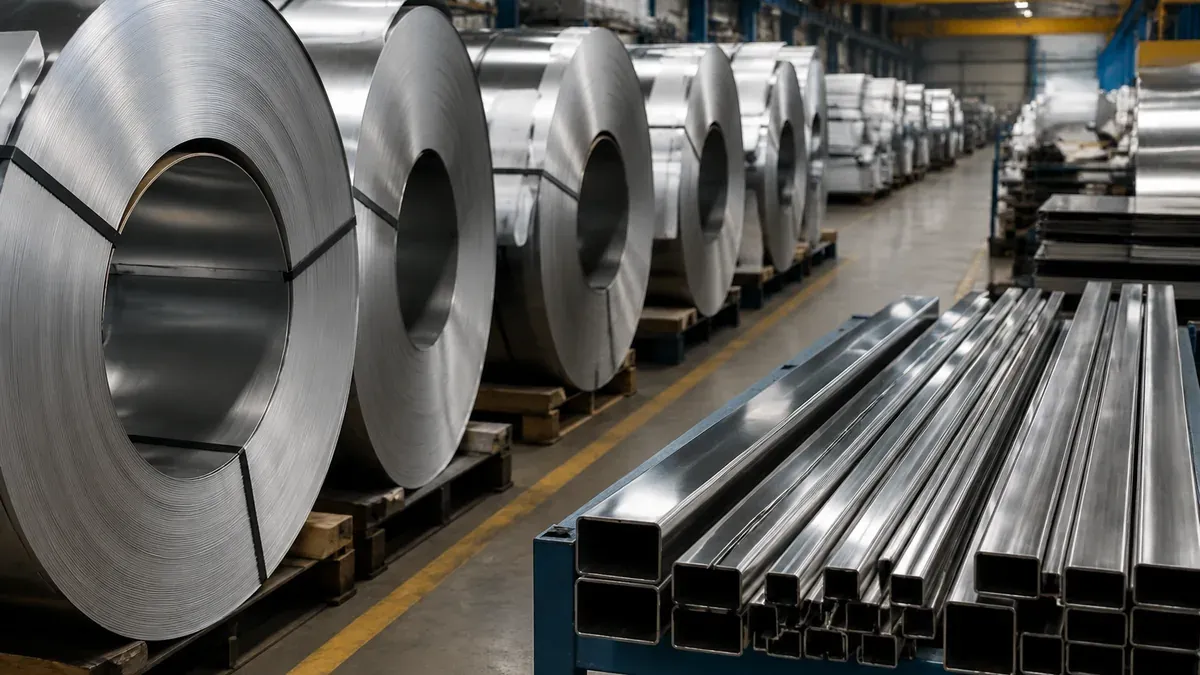
Type 201 (UNS S20100 / EN 1.4372) is a chromium-manganese austenitic stainless steel specified as a lower-nickel alternative to 304 for sheet, coil, strip and decorative tube. Annealed flat product offers high work-hardening strength and formability at lower nickel cost; corrosion resistance is usually adequate indoors but is not a like-for-like substitute for 304 outdoors or in wet chloride service. 201LN (UNS S20153) is a related low-C, N-controlled designation — order it only when the RFQ names that chemistry.
Quotation brief
Quote 201 When
Quote 201 when the RFQ names sheet, coil, strip or decorative tube for indoor or otherwise controlled exposure, and the buyer accepts a lower-nickel chromium-manganese austenitic in place of 304 after reviewing corrosion, cleaning and appearance. Name UNS S20100 or EN 1.4372 explicitly; treat 201LN (UNS S20153) as a related low-carbon, nitrogen-controlled grade that is not an automatic substitute. Use density ~7.81 g/cm3 only as an engineering weight estimate — not an MTC acceptance limit — and freeze annealed versus named cold-rolled temper on strip-mill sheet and coil so strength and springback match the ordered route. Annealed flat product is the usual starting condition for forming; copper-bearing J-series variants must be ordered explicitly. Treat 201 as a cost-and-service tradeoff for Gulf and Southeast Asian buyers indoor appliance, furniture tube and decorative programs — not a universal outdoor or chloride substitute for 304. For pairwise grade choice see /compare/201-vs-304/; for sheet RFQ wording see the 201 sheet RFQ guide; send locked fields to /contact/.
Best fit
- Annealed sheet, coil and strip-mill orders that name UNS S20100 or EN 1.4372 for indoor appliance panels, decorative tube and architectural trim.
- Cost-sensitive formed components where higher annealed strength and rapid work hardening are acceptable after tooling trials on the actual gauge.
- Export programs to Middle East and Southeast Asia destinations that accept 201 for controlled indoor duty with agreed finish, packing and MTC route.
Limits to check
- Humidity, salt deposits, acidic cleaners and outdoor wetting can stain or pit earlier than on 304; do not specify 201 as a corrosion equivalent without exposure evidence.
- Commercial J1/J2/J3 labels and 201LN (S20153) are not interchangeable with generic 201; chemistry and forming behavior must match the ordered designation.
- Rapid work hardening raises forming load and springback versus soft 304 assumptions, and cold-rolled strip or sheet must not be accepted to annealed minima by default.
Quoted product forms
Quoted product forms for 201 Stainless Steel (UNS S20100)
We quote 201 Stainless Steel as sheet / plate, coil / strip, pipe / tube, bar against the named product standard.
- Traceability: heat or lot identity plus the inspection document named in the RFQ (EN 10204 3.1 when that route supports it).
- Processing: decoiling, cutting, polishing, shearing and beveling as ordered.
- Next step: send product form, size and quantity; we quote the supply route.
Chemical Composition (wt%)
| C | Mn | Si | Cr | Ni | N | P | S |
|---|---|---|---|---|---|---|---|
| ≤0.15 | 5.5–7.5 | ≤1.00 | 16.0–18.0 | 3.5–5.5 | ≤0.25 | ≤0.060 | ≤0.030 |
Single values are maximums unless a range is shown. Balance: Fe. Per ASTM A240/A240M.
Mechanical Properties
| Tensile strength | ≥655 MPa (95 ksi) |
|---|---|
| Yield strength (0.2%) | ≥260 MPa (38 ksi) |
| Elongation (50 mm) | ≥40% |
| Hardness | ≤241 HBW |
Room-temperature minimum values are summarized for annealed flat product under ASTM A240/A240M unless a condition is named in the property label; product form and thickness can change the requirement. Density is an engineering typical for weight estimates, not an MTC limit. Hardness and strength for cold-rolled strip or sheet follow the ordered temper table — do not assume annealed minima after intentional cold reduction.
Properties by Condition
201 Annealed (standard flat-product supply)
The usual mill condition for ASTM A240 sheet, plate, coil and strip — maximum ductility for bending, drawing and general fabrication before intentional cold work.
| Tensile strength | ≥655 MPa (95 ksi) |
|---|---|
| Yield strength (0.2%) | ≥260 MPa (38 ksi) |
| Elongation | ≥40% |
| Hardness | ≤241 HBW |
201 Cold-rolled strip / coil (buyer-specified temper)
Strip-mill routes may deliver light cold reduction for stiffness or gauge control. Strength, elongation and springback then follow the ordered temper table and thickness — do not assume annealed values still apply.
| Tensile / yield | Per ordered temper table and thickness (not annealed minima) |
|---|---|
| Elongation | Reduced versus annealed; confirm on the purchase standard |
| Ordering note | State temper, hardness or strength window with width, edge and finish |
Physical Properties & Structure
| Density | 7.81 g/cm3 (engineering typical for weight estimates; not an MTC acceptance limit) |
|---|---|
| Magnetic response | Essentially non-magnetic after solution annealing; cold work can introduce a measurable magnetic response. |
| Microstructure | Austenitic (Cr-Mn) |
Corrosion Resistance & Limits
- 201 forms a chromium-rich passive film like other austenitics, but its lower nickel and higher manganese/nitrogen balance usually give less margin than 304 in humidity, salt deposits, acidic cleaners or outdoor wetting.
- Against ferritic 430, annealed 201 typically forms and welds more like an austenitic grade and stays essentially non-magnetic until cold worked, yet neither grade replaces 304 where chlorides, continuous wetness or frequent chemical cleaning dominate.
- Check chlorides, temperature, crevices, deposits, process chemistry and cleaning conditions. A grade designation alone is not a service-life guarantee.
Fabrication & Heat Treatment
| Welding | Generally weldable with a qualified procedure and matching or over-alloyed filler where required; remove heat tint when corrosion service demands it. Do not assume weld zones retain cold-worked strip strength. |
|---|---|
| Forming | Annealed sheet and strip draw and bend well, but 201 work-hardens rapidly — tooling load, springback, bend radius and any intermediate anneal must be proven on the actual gauge and reduction route. |
| Machining | Use rigid tooling, positive feeds and controlled heat because the material work-hardens; free-machining grades require separate corrosion and welding review. |
| Heat treatment | Solution annealing and rapid cooling restore the intended annealed condition after heavy cold work where applicable. Austenitic 201 is not hardened by conventional quench-and-temper treatment. |
Equivalent Grades
The closest international equivalents of 201 Stainless Steel are 1.4372 (X12CrMnNiN17-7-5) — primary European cross-reference for Type 201 / S20100 in the EN system, SUS201 in the JIS system, 12Cr17Mn6Ni5N in the GB system, 201LN / UNS S20153 (related low-C, N-controlled grade — not automatic substitute for S20100 / 1.4372) in the Related system, 201 / Type 201 (Cr-Mn austenitic nickname — freeze UNS or EN on the PO) in the Commercial system.
These are common corresponding designations, not unconditional substitutes. Verify chemistry, mechanical properties, product standard, delivery condition, dimensions and project approval before changing designation.
| System | Designation |
|---|---|
| UNS | S20100 |
| EN | 1.4372 (X12CrMnNiN17-7-5) — primary European cross-reference for Type 201 / S20100 |
| JIS | SUS201 |
| GB | 12Cr17Mn6Ni5N |
| Related | 201LN / UNS S20153 (related low-C, N-controlled grade — not automatic substitute for S20100 / 1.4372) |
| Commercial | 201 / Type 201 (Cr-Mn austenitic nickname — freeze UNS or EN on the PO) |
Ordering Checks for 201
- State UNS S20100 or EN 1.4372 (and 201LN / S20153 only when that chemistry is required), product form (sheet/coil/strip or decorative tube), ASTM A240 or governing edition, thickness, width, edge and annealed or named cold-rolled temper.
- For cold-rolled sheet or strip lines, freeze temper or hardness window, springback assumptions and whether annealed minima still apply — do not substitute annealed A240 values after intentional cold reduction.
- Define indoor vs outdoor exposure, humidity, chlorides, cleaning chemicals, drainage and appearance acceptance before proposing 201 as an alternative to 304 or 430.
- Request heat-specific MTC / EN 10204 3.1, destination port, packing method and lot traceability — route locked fields through /contact/.
Reference Product Forms & Dimensional Ranges
Common reference product forms for 201 stainless steel: Sheet / Plate, Coil / Strip, Pipe / Tube, Bar.
| Finishes | 2B, BA, No.4, hairline, mirror |
|---|---|
| Sheet / coil thickness | 0.2–3.0 mm |
| Strip mill supply | Annealed or cold-rolled strip/coil to ordered width, edge and temper |
| Common copper variants | J1 / J2 / J3 trade descriptions available when the heat chemistry is agreed |
| Annealed flat product | Usual ASTM A240 starting condition for forming sheet, coil and strip |
| Cold-rolled temper | Order named temper/hardness when stiffness or gauge control is required — not annealed by default |
Common surface and delivery options
- No.1, 2B, BA or mechanically polished finish when supported by the product route
- Annealed and pickled coil/strip or polished tube finish as specified
- Protective film, critical face and agreed surface sample for visible architectural or appliance parts
These published ranges are engineering references, not a live-stock or production-capability promise. Send the required product form, dimensions, condition and finish; we quote the matching supply route.
Browse related product hubs:Sheet & plate,Coil & strip,Pipe & tube,Bar & rod.
Typical Applications
- Decorative and furniture tube
- Appliance housings and indoor panels
- Kitchenware and formed sinks for validated indoor duty
- Indoor architectural trim and railings
- Strip-mill coil for stamped or roll-formed components
201 Products We Export
201 Compared With Other Grades
Related buyer guides:
Frequently Asked Questions
What is the density of 201 stainless steel?
Engineering tables commonly list about 7.81 g/cm3 for Type 201 (UNS S20100). Treat that as a weight-estimate value for coil and sheet calculations, not an MTC acceptance limit. If mass, shipping weight or piece count is contractual, confirm the project datasheet and weigh critical lots rather than relying on a grade-page summary alone.
What is the difference between 201 and 304 stainless steel?
201 replaces most of the nickel in 304 with manganese and nitrogen, cutting nickel cost and raising annealed strength, but usually lowering corrosion margin. Indoors and in dry service 201 can perform well in sheet, coil and decorative tube; for outdoor, coastal or frequently wet applications 304 is the safer default. Pairwise commercial selection belongs on the dedicated 201 vs 304 compare page when you are choosing between two grades for one duty.
How do EN 1.4372, UNS S20100 and 201LN relate to Type 201?
UNS S20100 is the ASTM designation for Type 201; EN 1.4372 (X12CrMnNiN17-7-5) is the primary European cross-reference buyers search alongside 201 stainless steel. 201LN (UNS S20153) is a related low-carbon, nitrogen-controlled chromium-manganese grade — not an automatic substitute for S20100. Confirm the ordered designation, product standard and heat chemistry before approving an alternate, and verify alloy identity with PMI when mixed lots are a risk.
What does annealed vs cold-rolled mean for 201 sheet, coil and strip?
Annealed 201 is the soft, solution-treated flat-product condition summarized under ASTM A240 for sheet, plate, coil and strip — highest ductility for bending and drawing. Strip-mill cold-rolled sheet or coil may carry a named temper or hardness window for stiffness and gauge control; do not accept cold-reduced material to annealed minima. State temper, thickness, width, edge and finish on the RFQ, and prove springback on the actual gauge before production.
Is 201 stainless steel food grade?
Do not treat 201 as a default food-contact grade the way 304 often is. Some kitchenware and indoor articles use 201 after the manufacturer validates surface condition, cleaning chemicals and applicable food-contact rules. If hygiene, chlorides or chemical cleaning dominate, specify 304/304L or another approved alloy and the required certificate route.
What should an export buyer freeze on a 201 RFQ?
Freeze UNS S20100 or EN 1.4372 (and 201LN / S20153 only when that chemistry is required), product form (sheet/coil/strip or decorative tube), ASTM A240 or the governing edition, annealed vs named cold-rolled temper, thickness/width/edge, finish and critical face, indoor vs outdoor exposure assumptions, heat-specific MTC / EN 10204 3.1, destination port and packing. Send the locked pack through /contact/ rather than accepting a grade nickname alone.
Published by Tsingshan (Shandong) Iron & Steel Co., Ltd..Sources, update policy and technical limitations.
Quote request
Get a 201 Stainless Steel Quotation
Leave your name and a WhatsApp number or email. Grade and quantity help, but are not required. Sales will reply within one business day.