
409L Stainless Steel (UNS S40910)
Ferritic (Ti-stabilized) · ASTM A240/A240M · Density 7.7 g/cm³
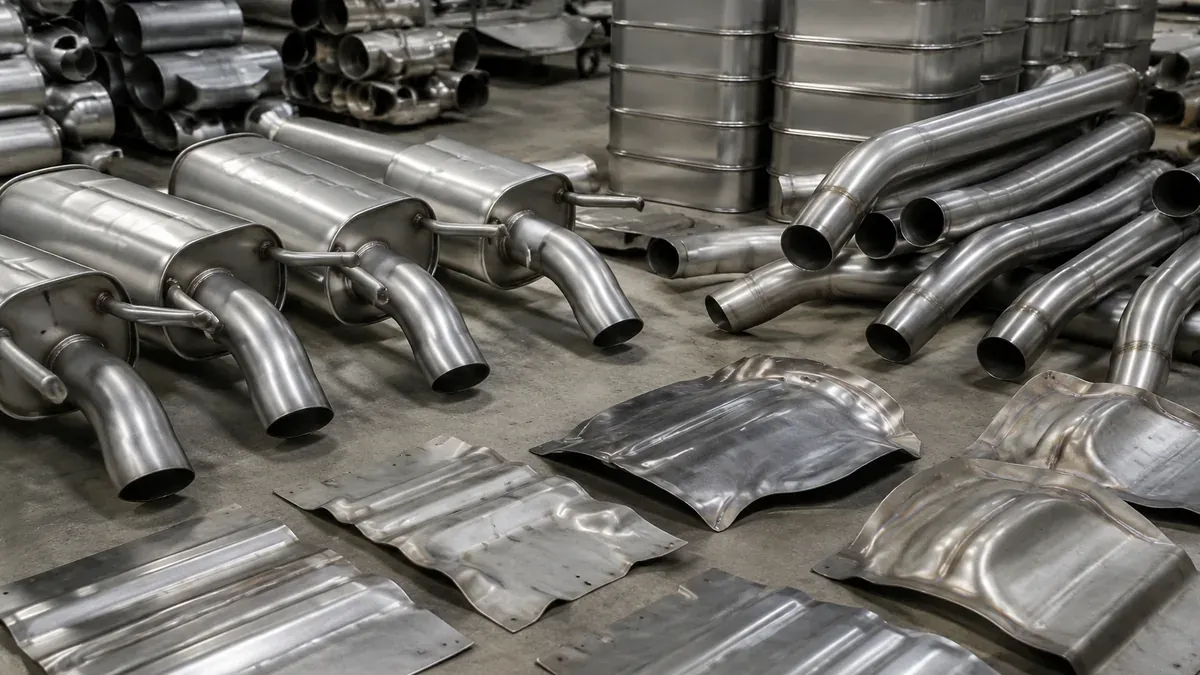
409L (UNS S40910) is a low-carbon, titanium-stabilized ferritic stainless steel widely considered for automotive exhaust tubing, muffler shells, catalytic-converter housings and heat shields. Its low chromium level makes discoloration possible, while actual corrosion and temperature performance depend on condensate chemistry, road salts, welds, section and thermal cycle.
Quotation brief
Quote 409L When
Quote 409L when a stabilized ferritic sheet or tube is being engineered for exhaust cold-end or intermediate components and cosmetic brightness is not the primary acceptance criterion. Its useful case combines thin-gauge formability, weldability and resistance to exhaust condensate under a defined duty. Selection must account for metal temperature, acidic water, road salts, wet-dry cycles, weld geometry and required section life; it cannot rely on a fixed life multiple over another material.
Best fit
- Automotive exhaust tubing, muffler shells and converter housings with documented condensate, salt exposure and thermal-cycle requirements.
- Stamped heat shields and flue components where ferritic magnetic behavior and possible surface discoloration are acceptable to the drawing.
- Thin-gauge welded fabrications ordered as UNS S40910 with controlled chemistry, dimensions, surface and heat traceability.
Limits to check
- Visible brown staining can occur and must be separated from unacceptable penetration by a project-specific appearance and thickness criterion.
- Lower chromium provides less oxidation and staining margin than higher-alloy ferritic grades, especially as metal temperature and deposits increase.
- Nominal exhaust temperature does not rate a component; local hot spots, cycling, load, welds and gas-versus-metal temperature remain design inputs.
Quoted product forms
Quoted product forms for 409L Stainless Steel (UNS S40910)
We quote 409L Stainless Steel as coil / strip, sheet / plate, pipe / tube against the named product standard.
- Traceability: heat or lot identity plus the inspection document named in the RFQ (EN 10204 3.1 when that route supports it).
- Processing: decoiling, cutting, polishing, shearing and beveling as ordered.
- Next step: send product form, size and quantity; we quote the supply route.
Chemical Composition (wt%)
| C | Mn | Si | Cr | Ni | Ti | P | S |
|---|---|---|---|---|---|---|---|
| ≤0.030 | ≤1.00 | ≤1.00 | 10.5–11.7 | ≤0.50 | 6×(C+N)–0.50 | ≤0.045 | ≤0.030 |
Single values are maximums unless a range is shown. Balance: Fe. Per ASTM A240/A240M.
Mechanical Properties
| Tensile strength | ≥380 MPa (55 ksi) |
|---|---|
| Yield strength (0.2%) | ≥170 MPa (25 ksi) |
| Elongation (50 mm) | ≥20% |
| Hardness | ≤179 HBW |
Room-temperature minimum values are summarized for annealed flat product under ASTM A240/A240M unless a condition is named in the property label; product form and thickness can change the requirement.
Physical Properties & Structure
| Density | 7.7 g/cm³ |
|---|---|
| Magnetic response | Magnetic because the room-temperature matrix is ferritic. |
| Microstructure | Ferritic (Ti-stabilized) |
Corrosion Resistance & Limits
- 409L's low chromium range provides limited cosmetic staining resistance compared with 430 or 439. Exhaust condensate acidity, de-icing salt, deposits, wet-dry cycling and crevices can control attack, especially near cold-end welds and retained moisture.
- The ferritic structure has a different chloride stress-corrosion response from common austenitic grades, but this does not prevent pitting or general section loss. Acceptance must define allowable staining, penetration and remaining thickness for the component.
Fabrication & Heat Treatment
| Welding | Thin exhaust sheet and tube require controlled heat input, fit-up and shielding to limit grain growth, burn-through and oxide contamination. Titanium stabilization supports weld performance but does not replace procedure qualification or corrosion cleaning. |
|---|---|
| Forming | 409L is commonly roll formed, stamped and bent in thin gauges, with tooling and blank orientation selected for ferritic anisotropy and springback. Severe draws, edge stretch and formed weld seams require trial validation. |
| Machining | Use sharp tools, rigid support and controlled cutting heat, particularly on thin-wall tube and stamped shells. Prevent carbon-steel pickup on surfaces that will be welded or exposed to condensate. |
| Heat treatment | 409L is not hardened by conventional heat treatment. Any annealing after cold work must follow the ordered product route because temperature, dwell and cooling affect grain size, flatness and subsequent weld behavior. |
Equivalent Grades
The closest international equivalents of 409L Stainless Steel are 1.4512 (X2CrTi12) in the EN system, SUH409L in the JIS system, 022Cr11Ti in the GB system.
These are common corresponding designations, not unconditional substitutes. Verify chemistry, mechanical properties, product standard, delivery condition, dimensions and project approval before changing designation.
| System | Designation |
|---|---|
| UNS | S40910 |
| EN | 1.4512 (X2CrTi12) |
| JIS | SUH409L |
| GB | 022Cr11Ti |
Ordering Checks for 409L
- State UNS S40910, governing product standard, coil or tube route, thickness, dimensions, finish, edge condition and delivery condition.
- Define component location, normal and peak metal temperature, thermal cycles, condensate chemistry, de-icing salt and expected wet-dry exposure.
- Provide forming limits, weld process, joint geometry, shielding, leak test, dimensional fixtures and surface-cleaning requirements.
- Specify the inspection document, heat traceability, chemistry and mechanical verification, tolerances and any corrosion or cyclic test required by the drawing.
Reference Product Forms & Dimensional Ranges
Common reference product forms for 409l stainless steel: Coil / Strip, Sheet / Plate, Pipe / Tube.
| Finishes | No.1, 2B, 2D |
|---|---|
| Sheet / coil thickness | 0.4–3.0 mm |
| Common widths | 1000 / 1219 / 1500 mm |
Common surface and delivery options
- No.1, 2B, BA or mechanically polished finish when supported by the product route
- Annealed and pickled, descaled or polished tube finish as specified
These published ranges are engineering references, not a live-stock or production-capability promise. Send the required product form, dimensions, condition and finish; we quote the matching supply route.
Browse related product hubs:Sheet & plate,Coil & strip,Pipe & tube,Bar & rod.
Typical Applications
- Automotive exhaust pipes and mufflers
- Catalytic converter shells
- Heat shields
- Agricultural equipment panels
- Chimney and flue liners
409L Compared With Other Grades
Frequently Asked Questions
Will 409L stainless steel rust?
Yes, surface staining or a brown patina can appear because 409L has a lower chromium range than decorative ferritic grades. Whether that staining is only cosmetic or indicates unacceptable section loss depends on condensate, chlorides, temperature, cleaning and the inspection criterion for the actual component.
What is the difference between 409 and 430 stainless steel?
430 has a higher chromium range and is commonly chosen where appearance and general staining resistance matter. 409L has a lower carbon limit with titanium stabilization and is often specified for formed, welded exhaust parts. Neither designation can replace the other without checking chemistry, formability, weld procedure and environment.
What temperature can 409L handle?
There is no universal component limit. The designer must distinguish gas and metal temperature, then consider oxidation, condensate, thermal cycling, stress, section thickness and weld geometry. Hot-end parts may require a higher-chromium stabilized ferritic grade after a service-specific comparison.
Published by Tsingshan (Shandong) Iron & Steel Co., Ltd..Sources, update policy and technical limitations.
Quote request
Get a 409L Stainless Steel Quotation
Send the product, grade and quantity you already have. We will complete the specification and quote the supply route.