
304 Stainless Steel Angle and Channel
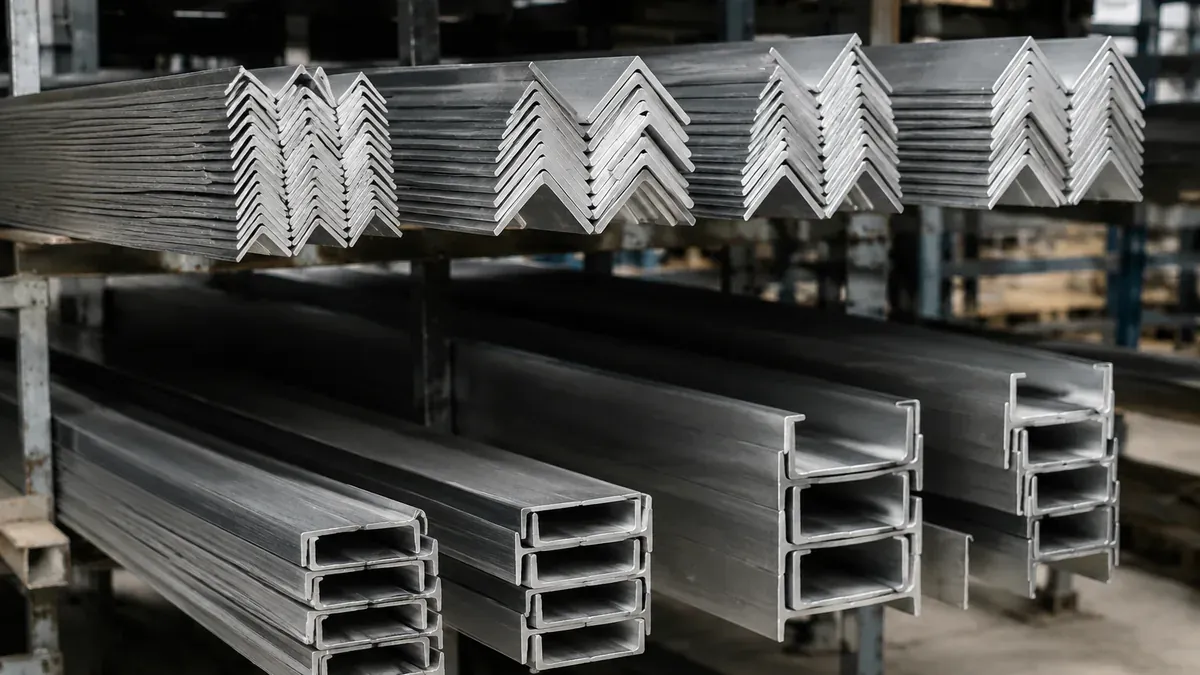
304 stainless steel angle and channel are quoted as open sections by grade, equal or unequal leg × thickness, or drawing-controlled channel. Common inquiry range: mill length or cut-to-length. Send the rolled, formed or laser-welded route with the RFQ.
Supply routes
- Qualified partner-mill sourcing
- Stock coordination
- In-house production or processing
Where this product solves the job
- Equipment frames, supports, guards and architectural assemblies where the design names a 304 or 304L open section.
- Equal or unequal angles selected from an accepted dimensional table with the route and tolerance basis identified.
- Drawing-specific channels whose formed or welded route, functional datums, visible faces and weld acceptance are defined.
When we recommend another route
- Load-bearing design based only on a catalog weight or nominal section name without project engineering and route confirmation.
- Orders that treat rolled, cold-formed and laser-welded channels as geometrically identical or automatically interchangeable.
- Decorative work that states only No.4 or brushed finish without identifying visible faces, grain direction and reference sample.
Standards we quote against
Send the product standard, edition and any dimensional or finish standard with the RFQ. We quote the ordered combination, not a generic grade name.
Ordered product standards: ASTM A276/A276M · EN 10088
What to send so we can quote the right route
- Identify equal angle, unequal angle, U channel, C channel or drawing-specific section and name the governing material or profile standard.
- State leg, web, flange, thickness, inside radius, toe or edge geometry, weld location and the dimensions that control fit-up.
- Define hot-rolled, cold-formed, press-brake or laser-welded route where the design restricts section geometry or appearance.
- Give length, cut tolerance, straightness, camber, twist and squareness criteria with datums and measurement lengths.
- Mark visible faces, finish and grain direction, permitted weld blending, film, holes or cuts, inspection documents and packing orientation.
Specifications
| Grades | 304 / 304L |
|---|---|
| Forms | Equal angle, unequal angle and channel |
| Production route | Hot rolled, cold formed or laser welded |
| Dimensions | Standard sections or drawing-specific profiles |
| Length | Common inquiry range: Mill length or cut to order. |
| Surface | Pickled, blasted, ground or brushed |
| Inspection | Tests required by the purchased standard plus PMI, NDE or other checks named in the RFQ |
| Commercial basis | Quantity, MOQ, production route and delivery schedule are quoted for the ordered specification. |
Dimensions and Tolerances
| Length | Common inquiry range: mill length or cut-to-length. |
|---|---|
| Other | Common inquiry range: equal or unequal angle and channel by leg × thickness, or the drawing-controlled section. |
| Order basis | Governing product and dimensional standard, delivery condition and any drawing-specific limits. |
| Special tolerances | Send special tolerances in the RFQ; we quote the accepted production route. |
Published ranges are technical references, not a live-stock or production-capability promise. We confirm the ordered size range, MOQ and delivery schedule in the quotation.
Edge or end condition
- Edge, end or facing condition as ordered from the product form, standard and fabrication need.
Testing and inspection
- Tests required by the purchased product standard.
- PMI, NDE, corrosion, roughness or other supplementary inspection quoted when the RFQ names method, lot scope and acceptance.
Order documents
- Heat identity with EN 10204 3.1, or the inspection document named in the RFQ, against mill, stock or partner-mill route.
- Supplementary reports linked to the ordered test plan.
Export packaging
- Open sections supported to limit twist; visible faces film-protected when ordered.
- Packing orientation stated in the quotation.
Quote the section route
A rolled angle, brake-formed channel and laser-welded channel may share outer dimensions while differing at radii, toes, welds and thickness transitions. Send functional datums and the route with the RFQ. Browse the stainless profiles category to separate standard sections from drawing-led profiles.
Quote the dimensions that control assembly
Send leg, web and flange size with inside radius, straightness, twist, cut squareness and hole location. Include gauge lengths and reference faces so manufacturing and incoming inspection use the same coordinate system.
Quote export handling for open sections
Send distributed support, nested separators and drainage planning for long profiles. For decorative work, mark the visible face and grain orientation. Any cutting, drilling or welding in the order keeps the required heat, bundle or part identification.
Common ordering mistakes
- Selecting a section from a carbon-steel table and assuming stainless radius, thickness, mass and dimensional route are identical.
- Omitting the inside corner radius even though it controls mating parts, bolt clearance and the overall envelope.
- Applying profile-wide tight tolerances without datums or functional priorities, making the drawing difficult to manufacture and inspect.
- Calling every U-shaped profile channel while leaving the buyer and producer to infer flange orientation, taper and weld construction.
Handling and transport risks
- Long open sections can twist, bow or rack when lifted from one end or supported at too few points.
- Nested angles and channels can trap water, debris or abrasive particles that stain or scratch visible faces in transit.
- Unprotected toes, corners and cut ends can be dented, changing fit-up even when the main section remains straight.
- Brushed grain and blended weld areas can be mismatched when pieces are bundled without face and orientation identification.
Technical content updated: 2026-07-31
Published by Tsingshan (Shandong) Iron & Steel Co., Ltd..Sources, update policy and technical limitations.
Typical Applications
Related technical resources
Published standards
Applicable standards
ASTM A276/A276M · EN 10088
What to Include in Your RFQ
Send the known values first. We use them to quote the ordered option, inspection plan and delivery route.
- Grade and governing standard
- 304, 304L; ASTM A276/A276M, EN 10088. State the exact ordered combination.
- Dimensions and tolerances
- Provide length, other and identify which order basis, special tolerances requirements govern acceptance.
- Finish, processing and edge or end condition
- No.4; Stainless Steel Cut-to-Length and Leveling, Stainless Steel Laser Cutting, Stainless Steel Bending and Forming, Stainless Steel Polishing and Surface Finishing; Edge, end or facing condition as ordered from the product form, standard and fabrication need..
- Inspection, documents and packing
- Testing: Tests required by the purchased product standard.; PMI, NDE, corrosion, roughness or other supplementary inspection quoted when the RFQ names method, lot scope and acceptance. Documents: Heat identity with EN 10204 3.1, or the inspection document named in the RFQ, against mill, stock or partner-mill route.; Supplementary reports linked to the ordered test plan. Packing: Open sections supported to limit twist; visible faces film-protected when ordered.; Packing orientation stated in the quotation.
- Quantity, destination and requested delivery window
- Send quantity per size, unit, destination city or port, trade term and requested delivery window so we can quote the supply and freight route.
Product RFQ Example
RFQ example: 304L unequal angle to the attached revision-controlled drawing, 75 x 50 x 6 mm nominal legs and thickness with stated inside radius, press-brake or welded route subject to drawing review, fixed lengths with straightness and twist measured from named datums, No.4 finish on the marked outer face with longitudinal grain and protective film, cut-end tolerance, ordered inspection document, supported export bundle and destination; we quote the matching route and delivery window.
Frequently Asked Questions
What distinguishes equal and unequal stainless angle in an RFQ?
State both leg dimensions in a fixed order, thickness, inside radius, toe geometry, length and the faces used as measurement datums. Do not rely on the product name to show which leg controls installation.
Can a laser-welded channel replace a rolled channel of the same nominal size?
Only after the design reviews weld location, radii, flange and web geometry, tolerances, residual distortion, surface and structural requirements. Nominal outer dimensions alone do not establish interchangeability.
Which drawing details are needed for a custom stainless channel?
Provide web, flange and return dimensions, thickness, inside radii, welds, datums, straightness, twist, length, cut features, visible faces and finish. Mark critical and reference dimensions separately.
How should No.4 finish be specified on an angle or channel?
Identify every visible face, grain direction, reference appearance, permitted weld blending, protective film and inspection lighting. The finish name alone does not define appearance around corners and weld zones.
Is a theoretical section weight an acceptance value?
It is useful for estimating, but purchasing and design should use the approved geometry, thickness tolerances, route and project calculation. Do not use a generic table value as proof of delivered section dimensions or load capacity.
Quote request
Get a Stainless Steel Quote
Send the product, grade and quantity you already have. We will complete the specification and quote the supply route.