
309S Stainless Steel (UNS S30908)
Austenitic (heat-resisting) · ASTM A240/A240M · Density 7.9 g/cm³
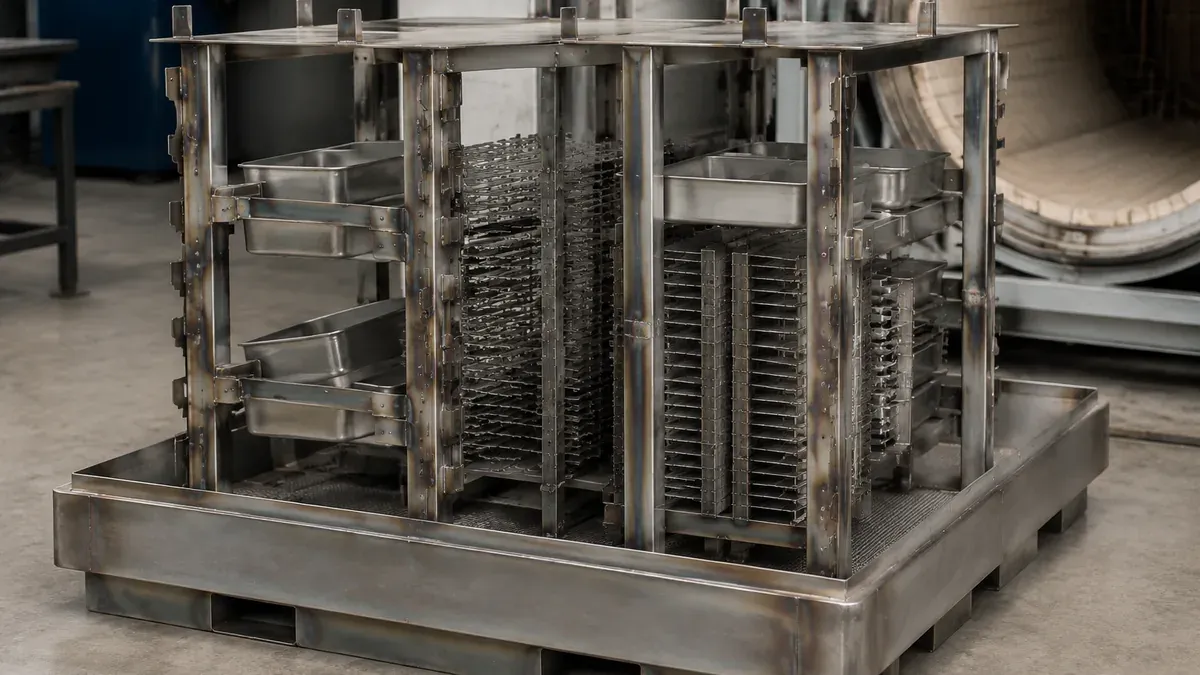
309S (UNS S30908) is a heat-resisting austenitic stainless steel with more chromium and nickel than 304 and less than 310S. It is considered for furnace internals, heat-treatment fixtures and combustion equipment when the designer has defined the metal temperature, atmosphere, load and thermal cycle; the grade name alone is not a temperature rating.
Quotation brief
Quote 309S When
Quote 309S when a heat-resisting austenitic grade above the 304 alloy level is being evaluated for oxidizing furnace internals, combustion parts or heat-treatment fixtures. The design case must define metal temperature rather than gas temperature, exposure time, oxygen potential, contaminants, applied load and cycling. 309S can occupy a useful alloy position below 310S, but only a service-specific comparison can establish whether its oxidation and structural margins are sufficient.
Best fit
- Furnace liners, trays and support parts operating in a characterized oxidizing atmosphere with documented metal-temperature and cycle data.
- Combustion and heat-treatment fabrications where a higher chromium-nickel level than 304 is required but 310S is not automatically specified.
- Projects ordering UNS S30908 flat product with traceable chemistry, solution-treated condition and defined weld and dimensional requirements.
Limits to check
- Published scaling temperatures are test or supplier references, not guaranteed equipment ratings for unknown gas chemistry, stress or cycle frequency.
- Carburizing, sulfidizing, reducing and molten-deposit environments can change the selection and require data beyond general dry-air oxidation guidance.
- The grade has no intentional molybdenum range and should not be represented as a solution for wet chloride pitting or crevice corrosion.
Quoted product forms
Quoted product forms for 309S Stainless Steel (UNS S30908)
We quote 309S Stainless Steel as sheet / plate, coil / strip, pipe / tube, bar against the named product standard.
- Traceability: heat or lot identity plus the inspection document named in the RFQ (EN 10204 3.1 when that route supports it).
- Processing: decoiling, cutting, polishing, shearing and beveling as ordered.
- Next step: send product form, size and quantity; we quote the supply route.
Chemical Composition (wt%)
| C | Mn | Si | Cr | Ni | P | S |
|---|---|---|---|---|---|---|
| ≤0.08 | ≤2.00 | ≤0.75 | 22.0–24.0 | 12.0–15.0 | ≤0.045 | ≤0.030 |
Single values are maximums unless a range is shown. Balance: Fe. Per ASTM A240/A240M.
Mechanical Properties
| Tensile strength | ≥515 MPa (75 ksi) |
|---|---|
| Yield strength (0.2%) | ≥205 MPa (30 ksi) |
| Elongation (50 mm) | ≥40% |
| Hardness | ≤217 HBW |
Room-temperature minimum values are summarized for annealed flat product under ASTM A240/A240M unless a condition is named in the property label; product form and thickness can change the requirement.
Physical Properties & Structure
| Density | 7.9 g/cm³ |
|---|---|
| Magnetic response | Essentially non-magnetic after solution annealing; cold work can introduce a measurable magnetic response. |
| Microstructure | Austenitic (heat-resisting) |
Corrosion Resistance & Limits
- 309S relies on chromium-rich scale in oxidizing hot gases, but scale growth and adhesion change with oxygen potential, temperature gradient and cycling. Sulfur compounds, carbon activity, ash or salt deposits can alter the damage mechanism and alloy ranking.
- This grade is not a wet-chloride upgrade from 304 because it has no intentional molybdenum range. Condensation during startup or shutdown can expose welds, crevices and heat-tinted areas to localized corrosion that dry-air oxidation data does not address.
Fabrication & Heat Treatment
| Welding | Use a qualified procedure that controls filler composition, dilution, heat input and joint restraint for cyclic hot service. Remove surface contamination and specify weld profile because notches and local section changes can concentrate thermal strain. |
|---|---|
| Forming | Annealed 309S is ductile but work hardens during forming and generally needs more force than 304. Bend allowance, springback, tooling cleanliness and any intermediate anneal must be established for the actual gauge and reduction. |
| Machining | Rigid setups, sharp tools and positive feed help prevent rubbing into a hardened surface. Cutting data should control heat and preserve the machining allowance needed for weld preparation and thermal-expansion features. |
| Heat treatment | Solution treatment establishes the intended austenitic condition; conventional heat treatment does not harden 309S. Any post-fabrication thermal cycle must be reviewed for grain growth, sensitization, distortion and final surface condition. |
Equivalent Grades
The closest international equivalents of 309S Stainless Steel are 1.4833 (X12CrNi23-13) in the EN system, SUS309S in the JIS system, 06Cr23Ni13 in the GB system.
These are common corresponding designations, not unconditional substitutes. Verify chemistry, mechanical properties, product standard, delivery condition, dimensions and project approval before changing designation.
| System | Designation |
|---|---|
| UNS | S30908 |
| EN | 1.4833 (X12CrNi23-13) |
| JIS | SUS309S |
| GB | 06Cr23Ni13 |
Ordering Checks for 309S
- State UNS S30908, governing product standard, form, thickness, dimensions, solution-treated condition and required finish.
- Define normal and maximum metal temperature, dwell time, atmosphere composition, oxygen potential, thermal cycles and expected deposits.
- Provide design code, load case, allowable deformation, welding procedure, filler requirement and any post-fabrication cleaning criteria.
- Specify inspection documentation, heat traceability, chemistry and mechanical verification, dimensional tolerances and supplementary examination.
Reference Product Forms & Dimensional Ranges
Common reference product forms for 309s stainless steel: Sheet / Plate, Coil / Strip, Pipe / Tube, Bar.
| Finishes | No.1, 2B |
|---|---|
| Sheet / coil thickness | 0.5–6.0 mm |
| Plate thickness | 6–50 mm |
Common surface and delivery options
- No.1, 2B, BA or mechanically polished finish when supported by the product route
- Annealed and pickled, descaled or polished tube finish as specified
- Hot rolled, peeled, bright drawn, ground or polished bar condition according to tolerance
These published ranges are engineering references, not a live-stock or production-capability promise. Send the required product form, dimensions, condition and finish; we quote the matching supply route.
Browse related product hubs:Sheet & plate,Coil & strip,Pipe & tube,Bar & rod.
Typical Applications
- Furnace parts and radiant tubes
- Heat-treatment baskets and trays
- Kiln and boiler linings
- Combustion chambers and burner parts
- Transition joints between stainless and carbon steel
309S Compared With Other Grades
Frequently Asked Questions
What is the maximum service temperature of 309S?
No single temperature applies to every 309S component. Dry air, combustion products, sulfur, carbon activity, thermal cycling, design stress and time at temperature can produce different limits, so the equipment code and qualified elevated-temperature data must set the rating.
What is the difference between 309 and 309S?
309S is the lower-carbon designation in the 309 family. Carbon limit affects the ordered chemistry and can matter to fabrication and sensitization control, but the two names are not interchangeable; state the exact UNS or standard grade and verify it on the inspection document.
309S vs 310S — which should I buy?
310S has higher chromium and nickel ranges, which can provide additional oxidation margin in some hot oxidizing environments. Selection cannot be reduced to a fixed temperature step: compare atmosphere, metal temperature, cycling, creep load, fabrication and the current delivered quotation for the specified product form.
Published by Tsingshan (Shandong) Iron & Steel Co., Ltd..Sources, update policy and technical limitations.
Quote request
Get a 309S Stainless Steel Quotation
Send the product, grade and quantity you already have. We will complete the specification and quote the supply route.