
317L Stainless Steel (UNS S31703)
Austenitic (high-Mo, low carbon) · ASTM A240/A240M · Density 7.98 g/cm³
317L (UNS S31703) is a low-carbon austenitic stainless steel with 3–4% molybdenum — one full step above 316L in pitting and crevice corrosion resistance. It is specified where 316L shows attack but duplex or 6Mo grades would be overkill: flue-gas desulfurization scrubbers, pulp bleach plants and process equipment handling hot acidic, chloride-bearing liquors.
Quotation brief
Quote 317L When
Quote 317L when 316L is marginal in chloride-bearing, acidic or oxidizing process service but the design does not require the strength or chloride margin of duplex or 6Mo alloys. Its low carbon and higher molybdenum support welded process equipment, scrubbers and pulp systems, yet actual concentration, temperature, deposits, weld condition and cleaning chemistry still determine whether the grade is adequate.
Best fit
- Flue-gas desulfurization, pulp bleaching and chemical process equipment where 316L corrosion margin is too narrow.
- Welded vessels, columns, tubing and fabricated parts that need a low-carbon austenitic route with increased molybdenum.
- Projects that can document the process chemistry and compare 317L against 2205, 254 SMO or other alternatives without assuming direct equivalence.
Limits to check
- 317L does not guarantee resistance to every hot chloride, crevice, acid or oxidizing liquor; corrosion testing and engineering approval may still be required.
- It retains austenitic work hardening and lower yield strength than duplex grades, which affects forming, machining and section-efficiency decisions.
- 317L and 317 are not interchangeable procurement labels unless carbon, strength, product standard, delivery condition and MTC requirements are all met.
Quoted product forms
Quoted product forms for 317L Stainless Steel (UNS S31703)
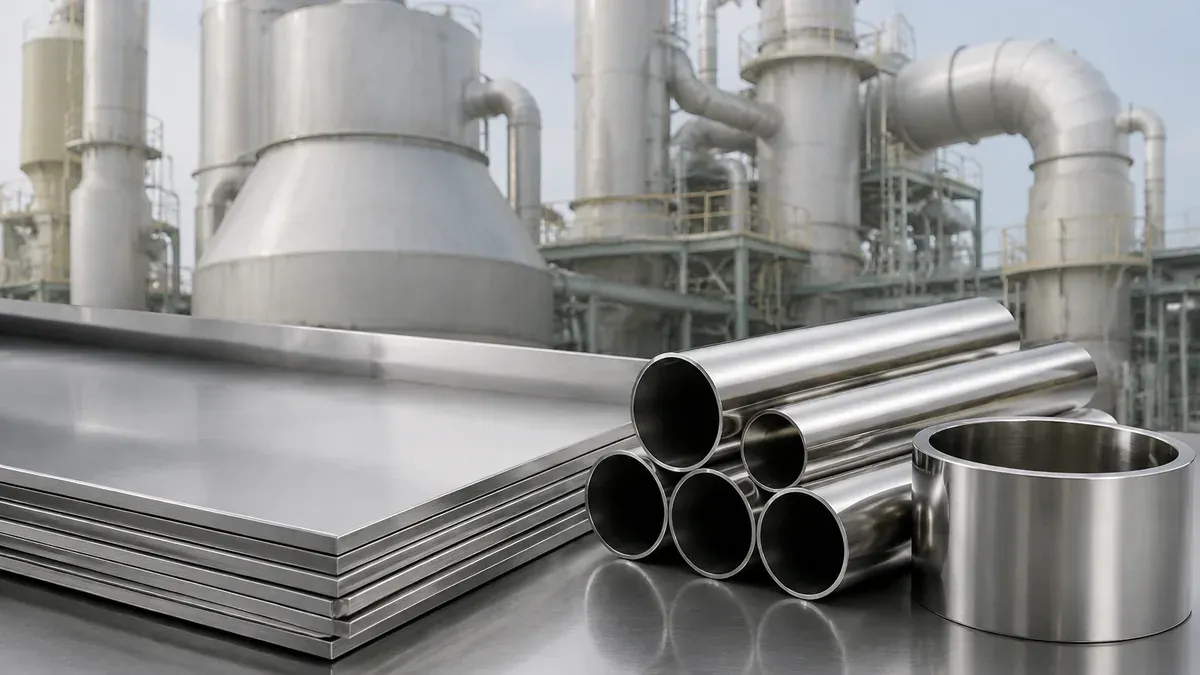
We quote 317L Stainless Steel as sheet / plate, coil / strip, pipe / tube, bar against the named product standard.
- Traceability: heat or lot identity plus the inspection document named in the RFQ (EN 10204 3.1 when that route supports it).
- Processing: decoiling, cutting, polishing, shearing and beveling as ordered.
- Next step: send product form, size and quantity; we quote the supply route.
Chemical Composition (wt%)
| C | Mn | Si | Cr | Ni | Mo | P | S | N |
|---|---|---|---|---|---|---|---|---|
| ≤0.030 | ≤2.00 | ≤0.75 | 18.0–20.0 | 11.0–15.0 | 3.0–4.0 | ≤0.045 | ≤0.030 | ≤0.10 |
Single values are maximums unless a range is shown. Balance: Fe. Per ASTM A240/A240M.
Mechanical Properties
| Tensile strength | ≥515 MPa (75 ksi) |
|---|---|
| Yield strength (0.2%) | ≥205 MPa (30 ksi) |
| Elongation (50 mm) | ≥40% |
| Hardness | ≤217 HBW |
Room-temperature minimum values are summarized for annealed flat product under ASTM A240/A240M unless a condition is named in the property label; product form and thickness can change the requirement.
Physical Properties & Structure
| Density | 7.98 g/cm³ |
|---|---|
| Magnetic response | Essentially non-magnetic after solution annealing; cold work can introduce a measurable magnetic response. |
| Microstructure | Austenitic (high-Mo, low carbon) |
Corrosion Resistance & Limits
- General corrosion resistance comes from the chromium-rich passive film; nickel, molybdenum, nitrogen and copper change performance by grade.
- Check chlorides, temperature, crevices, deposits, process chemistry and cleaning conditions. A grade designation alone is not a service-life guarantee.
Fabrication & Heat Treatment
| Welding | Generally weldable with a qualified procedure and matching or over-alloyed filler where required; remove heat tint when corrosion service demands it. |
|---|---|
| Forming | Good ductility is typical, but rapid work hardening increases forming load and springback; bend radius and intermediate annealing depend on grade and reduction. |
| Machining | Use rigid tooling, positive feeds and controlled heat because the material work-hardens; free-machining grades require separate corrosion and welding review. |
| Heat treatment | Solution annealing and rapid cooling restore the intended condition where applicable. Austenitic grades are not hardened by conventional quench-and-temper treatment. |
Equivalent Grades
The closest international equivalents of 317L Stainless Steel are 1.4438 (X2CrNiMo18-15-4) in the EN system, SUS317L in the JIS system, 022Cr19Ni13Mo3 in the GB system.
These are common corresponding designations, not unconditional substitutes. Verify chemistry, mechanical properties, product standard, delivery condition, dimensions and project approval before changing designation.
| System | Designation |
|---|---|
| UNS | S31703 |
| EN | 1.4438 (X2CrNiMo18-15-4) |
| JIS | SUS317L |
| GB | 022Cr19Ni13Mo3 |
Ordering Checks for 317L
- State UNS S31703 or the required EN/JIS/GB designation, product form, dimensions, thickness and finish.
- Provide process chemistry, chloride and acid concentrations, operating and cleaning temperatures, flow, deposits and shutdown conditions.
- Define weld, surface-cleaning, passivation, PMI, MTC, NDE and supplementary corrosion-test requirements when they are part of the project specification.
- Ask the supplier to identify the proposed 317L route and confirm low-carbon chemistry, heat number and ordered product standard on the certificate.
Reference Product Forms & Dimensional Ranges
Common reference product forms for 317l stainless steel: Sheet / Plate, Coil / Strip, Pipe / Tube, Bar.
| Finishes | No.1, 2B, BA |
|---|---|
| Sheet / coil thickness | 0.5–6.0 mm |
| Plate thickness | 6–60 mm |
Common surface and delivery options
- No.1, 2B, BA or mechanically polished finish when supported by the product route
- Annealed and pickled, descaled or polished tube finish as specified
- Hot rolled, peeled, bright drawn, ground or polished bar condition according to tolerance
These published ranges are engineering references, not a live-stock or production-capability promise. Send the required product form, dimensions, condition and finish; we quote the matching supply route.
Browse related product hubs:Sheet & plate,Coil & strip,Pipe & tube,Bar & rod.
Typical Applications
- Flue-gas desulfurization (FGD) scrubbers
- Pulp and paper bleach washers
- Chemical process vessels and columns
- Condenser and heat-exchanger tubing
- Textile dyeing and finishing equipment
317L Compared With Other Grades
Frequently Asked Questions
How much better is 317L than 316L?
The additional molybdenum raises the calculated PREN relative to 316L and can provide more pitting and crevice-corrosion margin. PREN is only a screening tool, not a service-life prediction; chloride level, temperature, pH, deposits, crevices, weld condition and process-specific corrosion data still control selection.
Is 317L usually dual-certified like 304/304L?
Dual certification is possible when the heat meets both 317 and 317L requirements. For welded process equipment, order the required L designation and confirm both chemistry and mechanical requirements on the MTC.
When should I move from 317L up to duplex or 6Mo grades?
When the project corrosion review shows insufficient margin for 317L, compare a duplex grade such as 2205 and a 6%-molybdenum austenitic grade such as S31254. The decision must include chloride concentration, temperature, crevices, fabrication, strength, code approval, product form and current quotation rather than a fixed cost hierarchy.
Published by Tsingshan (Shandong) Iron & Steel Co., Ltd..Sources, update policy and technical limitations.
Quote request
Get a 317L Stainless Steel Quotation
Send the product, grade and quantity you already have. We will complete the specification and quote the supply route.