
440C Stainless Steel (UNS S44004)
Martensitic (high-carbon) · ASTM A276 · Density 7.75 g/cm³
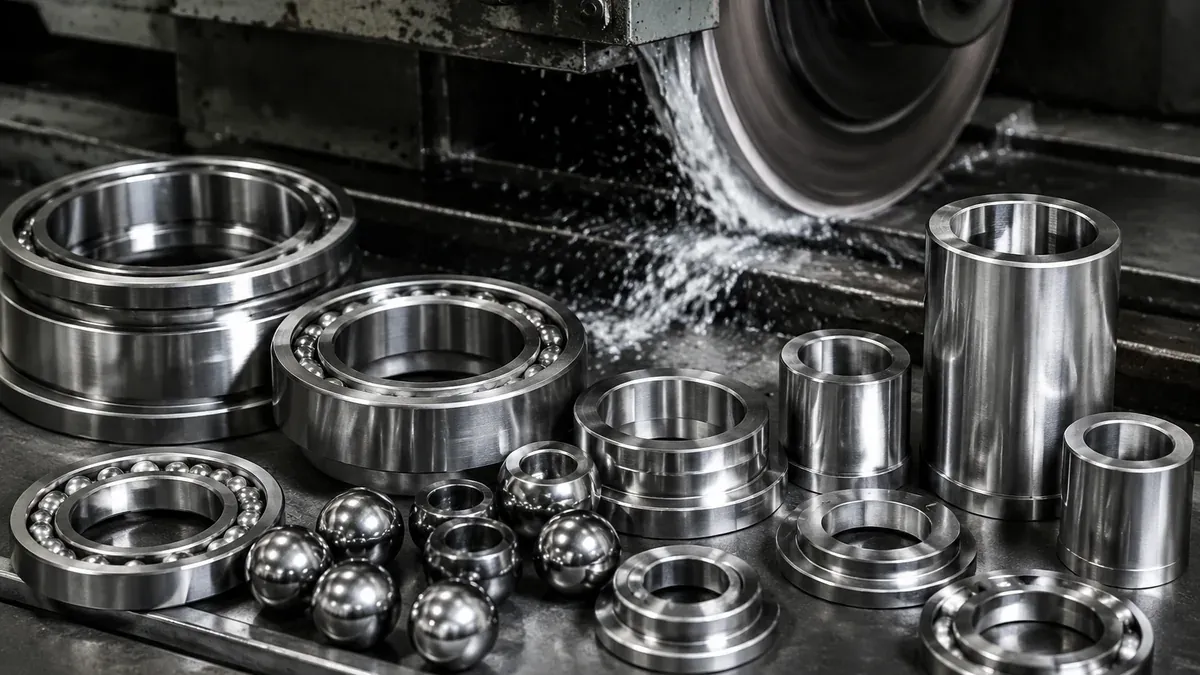
440C (UNS S44004) is a high-carbon martensitic stainless steel selected for hardened bearing, valve, wear and cutting components. Its carbide population, austenitizing route, quench, temper, retained austenite, section size and final grinding all influence hardness, dimensional stability, toughness and corrosion response.
Quotation brief
Quote 440C When
Quote 440C when a hardened stainless component needs high wear resistance and the design can control carbide structure, heat treatment, grinding and service environment. It is considered for bearing races, valve seats, wear sleeves, pump parts and blades, but the grade name does not set one universal hardness or corrosion result. Toughness, dimensional stability, retained austenite, surface finish and lubrication must be specified with the component.
Best fit
- Bearing, valve and wear components with a qualified austenitize, quench, temper and dimensional-stabilization route.
- Blades and cutting parts where the drawing balances hardness, edge geometry, toughness, grinding damage and cleaning exposure.
- Orders naming UNS S44004 under ASTM A276 with traceable bar condition, section, heat treatment and final inspection requirements.
Limits to check
- High carbon and carbide formation can reduce corrosion margin and toughness compared with lower-carbon austenitic stainless grades.
- A nominal 58–60 HRC reference cannot guarantee the finished part because section, quench, temper, retained austenite and test location matter.
- Wet chloride, marine, sterilization or welded service may require another approved material or a separate component validation program.
Quoted product forms
Quoted product forms for 440C Stainless Steel (UNS S44004)
We quote 440C Stainless Steel as bar against the named product standard.
- Traceability: heat or lot identity plus the inspection document named in the RFQ (EN 10204 3.1 when that route supports it).
- Processing: decoiling, cutting, polishing, shearing and beveling as ordered.
- Next step: send product form, size and quantity; we quote the supply route.
Chemical Composition (wt%)
| C | Mn | Si | Cr | Mo | P | S |
|---|---|---|---|---|---|---|
| 0.95–1.20 | ≤1.00 | ≤1.00 | 16.0–18.0 | ≤0.75 | ≤0.040 | ≤0.030 |
Single values are maximums unless a range is shown. Balance: Fe. Per ASTM A276.
Mechanical Properties
| Hardness (annealed) | ≤269 HBW |
|---|---|
| Hardness (hardened & tempered) | 58–60 HRC |
| Tensile strength (hardened, typical) | ≈1970 MPa |
| Tensile strength (annealed, typical) | ≈760 MPa |
Room-temperature values are summarized for the product form and condition represented by ASTM A276; confirm section size, delivery condition and current governing edition before ordering.
Physical Properties & Structure
| Density | 7.75 g/cm³ |
|---|---|
| Magnetic response | Magnetic in annealed and hardened conditions. |
| Microstructure | Martensitic (high-carbon) |
Corrosion Resistance & Limits
- 440C's high carbon and chromium-carbide population can reduce the chromium available to the passive film; corrosion response therefore depends strongly on heat treatment, polish, cleaning and contamination control.
- Bearings, valve seats and cutting tools see different wetting, contact, crevice and lubricant conditions, so salt, chloride, food or sterilization claims require a component-specific acceptance plan.
Fabrication & Heat Treatment
| Welding | Welding is generally avoided for finished 440C components; any repair requires a specialist procedure that controls preheat, filler, cracking, post-weld heat treatment and final requalification. |
|---|---|
| Forming | Substantial forming belongs in the annealed condition and must allow for high carbon, limited ductility, springback and distortion during hardening. |
| Machining | Machine annealed or softened stock with stable tooling and generous allowance for heat-treatment movement; final hardness normally requires grinding or other controlled finishing. |
| Heat treatment | Austenitizing, quench, temper, retained austenite and dimensional stabilization must be qualified together because hardness, toughness, wear and corrosion are linked to the thermal route. |
Equivalent Grades
The closest international equivalents of 440C Stainless Steel are 1.4125 (X105CrMo17) in the EN system, SUS440C in the JIS system, 102Cr17Mo in the GB system.
These are common corresponding designations, not unconditional substitutes. Verify chemistry, mechanical properties, product standard, delivery condition, dimensions and project approval before changing designation.
| System | Designation |
|---|---|
| UNS | S44004 |
| EN | 1.4125 (X105CrMo17) |
| JIS | SUS440C |
| GB | 102Cr17Mo |
Ordering Checks for 440C
- State UNS S44004, ASTM A276 edition, bar shape and section, annealed or hardened condition, straightness, tolerance and surface finish.
- Define target hardness, toughness, dimensional-change allowance, retained-austenite limit, grinding stock and final geometry.
- Provide load, speed, lubricant, contact stress, cleaning chemistry, corrosion exposure and any repair or welding restriction.
- Request inspection documentation for chemistry, supplied condition, heat-treatment chart, hardness, dimensions, surface and heat traceability.
Reference Product Forms & Dimensional Ranges
Common reference product forms for 440c stainless steel: Bar.
| Bar diameter | 3–200 mm |
|---|---|
| Condition | Annealed; hardening & tempering on request |
| Precision | h9 / h11 ground bar available |
Common surface and delivery options
- Hot rolled, peeled, bright drawn, ground or polished bar condition according to tolerance
These published ranges are engineering references, not a live-stock or production-capability promise. Send the required product form, dimensions, condition and finish; we quote the matching supply route.
Browse related product hubs:Sheet & plate,Coil & strip,Pipe & tube,Bar & rod.
Typical Applications
- Rolling-element bearings and races
- Valve seats, balls and needles
- Pump shafts and wear sleeves
- Knife blades and cutting tools
- Surgical and dental instruments
440C Compared With Other Grades
Frequently Asked Questions
What hardness can 440C reach after heat treatment?
Austenitizing at 1010–1065 °C, oil or air quenching, and low-temperature tempering around 160–200 °C gives 58 HRC minimum, typically 58–60 HRC. Higher tempering temperatures trade hardness for toughness but drop corrosion resistance and should stay below 425 °C.
Will 440C rust?
It is the least corrosion resistant of the popular stainless grades because most of its chromium is tied up in carbides. It performs well dry, oiled or in mild atmospheres, but pits in salt spray and prolonged wet exposure — passivation after grinding noticeably improves it.
How does 440C compare with D2 tool steel?
Both grades use carbide-forming chemistry and a qualified hardening route, but their chromium, carbide population, toughness, edge behavior and corrosion response differ. Choose from the required edge, section, environment, grinding and cleaning criteria rather than assuming one is universally better.
Published by Tsingshan (Shandong) Iron & Steel Co., Ltd..Sources, update policy and technical limitations.
Quote request
Get a 440C Stainless Steel Quotation
Send the product, grade and quantity you already have. We will complete the specification and quote the supply route.