
17-4 PH Stainless Steel (UNS S17400)
Precipitation hardening (martensitic) · ASTM A564/A564M · Density 7.75 g/cm³
17-4 PH (UNS S17400, AISI 630) is a martensitic precipitation-hardening stainless steel supplied in solution-treated or specified aged conditions. H900, H1025, H1075 and H1150 represent different strength, hardness, ductility, toughness and corrosion tradeoffs, so the ageing condition is part of the material designation and purchase order.
Quotation brief
Quote 17-4 PH When
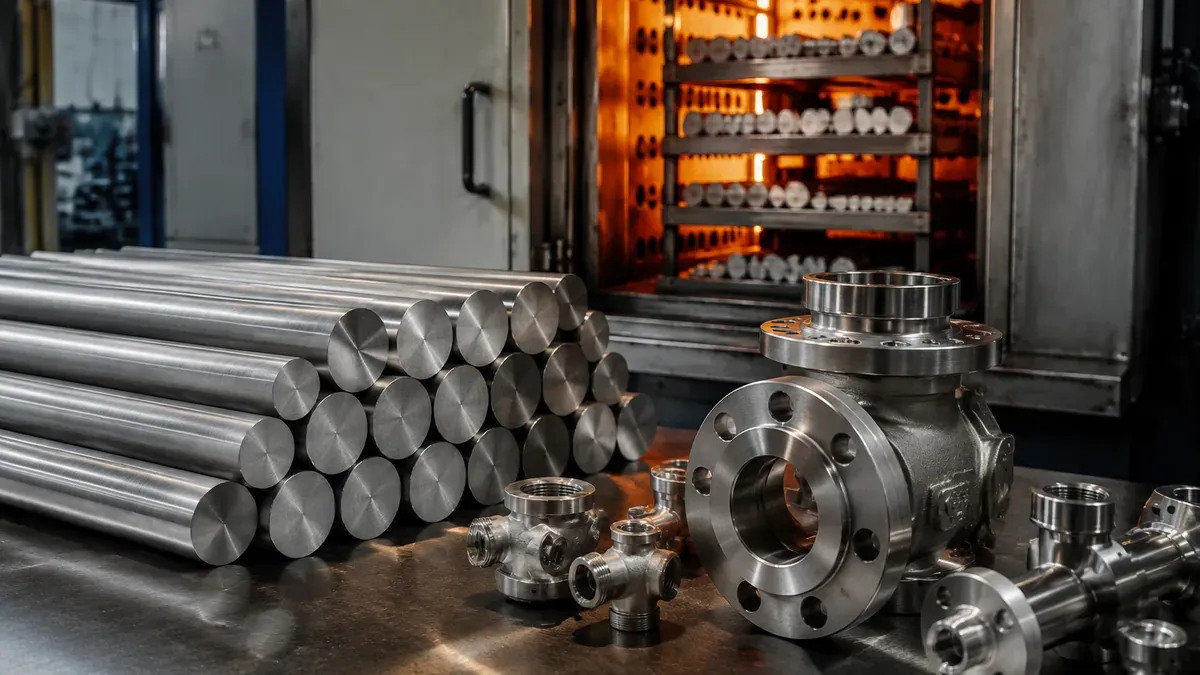
Quote 17-4 PH when a high-strength stainless component can be designed, fabricated and inspected around a named solution-and-ageing condition. H900, H1025, H1075 and H1150 are not cosmetic suffixes: they change strength, hardness, ductility, toughness, stress-corrosion behavior and machining sequence. The grade is relevant to shafts, valve parts, aerospace fittings and tooling only when section, heat treatment, environment and final dimensions are controlled together.
Best fit
- Shafts, valve stems and mechanical parts requiring a documented balance of strength, hardness, toughness and dimensional stability.
- Aerospace, energy or tooling components whose drawing names the exact H condition and applicable inspection or heat-treatment qualification.
- Orders for UNS S17400 bar or flat product with traceable solution treatment, ageing condition, section and mechanical-test results.
Limits to check
- Condition A, H900 and over-aged conditions are not interchangeable because their strength, ductility, toughness and corrosion response differ.
- 17-4 PH is not a direct substitute for 316 in chloride service or for another high-strength alloy without design-code and environment review.
- Welding, machining and final ageing can change joint properties and dimensions, so the complete manufacturing sequence must be approved.
Quoted product forms
Quoted product forms for 17-4 PH Stainless Steel (UNS S17400)
We quote 17-4 PH Stainless Steel as bar, sheet / plate against the named product standard.
- Traceability: heat or lot identity plus the inspection document named in the RFQ (EN 10204 3.1 when that route supports it).
- Processing: decoiling, cutting, polishing, shearing and beveling as ordered.
- Next step: send product form, size and quantity; we quote the supply route.
Chemical Composition (wt%)
| C | Mn | Si | Cr | Ni | Cu | Nb | P | S |
|---|---|---|---|---|---|---|---|---|
| ≤0.07 | ≤1.00 | ≤1.00 | 15.0–17.5 | 3.0–5.0 | 3.0–5.0 | 0.15–0.45 | ≤0.040 | ≤0.030 |
Single values are maximums unless a range is shown. Balance: Fe. Per ASTM A564/A564M.
Mechanical Properties
| Tensile strength (H900) | ≥1310 MPa (190 ksi) |
|---|---|
| Yield strength (H900) | ≥1170 MPa (170 ksi) |
| Elongation (H900) | ≥10% |
| Tensile strength (H1150) | ≥930 MPa (135 ksi) |
| Hardness (Condition A) | ≤363 HBW |
Room-temperature bar values are identified by H900 or H1150 ageing condition in the property labels; section size and the current ASTM A564/A564M requirements must be confirmed.
Physical Properties & Structure
| Density | 7.75 g/cm³ |
|---|---|
| Magnetic response | Magnetic because the matrix is martensitic after the specified heat-treatment route. |
| Microstructure | Precipitation hardening (martensitic) |
Corrosion Resistance & Limits
- 17-4 PH can approach 304-type atmospheric behavior in selected conditions, but copper precipitation, ageing condition, stress and surface state make the comparison component-specific.
- Chlorides, crevices, sustained stress and peak-aged conditions require particular review; the grade is not an automatic replacement for 316 in marine or process exposure.
Fabrication & Heat Treatment
| Welding | Weld from an approved starting condition with a qualified procedure, then apply the specified solution or ageing route when the joint requires restored strength, toughness and corrosion behavior. |
|---|---|
| Forming | Forming is normally planned in condition A and must allow for high springback, limited reduction, anisotropy and dimensional movement during the final ageing treatment. |
| Machining | Choose condition A or an over-aged machining condition according to tool life and dimensional plan, leaving allowance for the final ageing and finishing sequence. |
| Heat treatment | Condition A followed by the exact H900, H1025, H1075, H1150 or other approved ageing treatment controls the strength-toughness balance and must be traceable. |
Equivalent Grades
The closest international equivalents of 17-4 PH Stainless Steel are 1.4542 (X5CrNiCuNb16-4) in the EN system, SUS630 in the JIS system, 05Cr17Ni4Cu4Nb in the GB system.
These are common corresponding designations, not unconditional substitutes. Verify chemistry, mechanical properties, product standard, delivery condition, dimensions and project approval before changing designation.
| System | Designation |
|---|---|
| UNS | S17400 |
| EN | 1.4542 (X5CrNiCuNb16-4) |
| JIS | SUS630 |
| GB | 05Cr17Ni4Cu4Nb |
Ordering Checks for 17-4 PH
- State UNS S17400, ASTM A564/A564M or the governing product standard, product form, section and exact delivery or H condition.
- Specify tensile, yield, elongation, hardness, toughness or impact requirements with section limits and test orientation where applicable.
- Define machining, forming, welding, solution treatment, ageing, straightening, grinding and final dimensional sequence on the drawing.
- Request inspection documentation and heat-treatment records linking chemistry, solution condition, ageing cycle, mechanical tests and final traceability.
Reference Product Forms & Dimensional Ranges
Common reference product forms for 17-4 ph stainless steel: Bar, Sheet / Plate.
| Conditions | A (solution annealed); H900 / H1025 / H1150 ageing on request |
|---|---|
| Bar diameter | 6–300 mm |
| Plate thickness | 8–100 mm |
Common surface and delivery options
- No.1, 2B, BA or mechanically polished finish when supported by the product route
- Hot rolled, peeled, bright drawn, ground or polished bar condition according to tolerance
These published ranges are engineering references, not a live-stock or production-capability promise. Send the required product form, dimensions, condition and finish; we quote the matching supply route.
Browse related product hubs:Sheet & plate,Coil & strip,Pipe & tube,Bar & rod.
Typical Applications
- Pump and compressor shafts
- Valve stems and internals
- Aerospace and defense fittings
- Mold cavities and tooling
- High-strength marine hardware
17-4 PH Products We Export
17-4 PH Compared With Other Grades
Frequently Asked Questions
What do the H900 and H1150 conditions mean?
The number is the ageing temperature in degrees Fahrenheit. H900 (482 °C for 1 h) gives maximum hardness and strength; H1025 and H1150 age hotter and longer, sacrificing strength for markedly better toughness, ductility and chloride stress-corrosion resistance. Machining is usually done in condition A or H1150.
Is 17-4 PH weldable?
17-4 PH can be welded under a qualified procedure, commonly from condition A, but filler, restraint, section, preheat decision and post-weld solution or ageing treatment depend on the joint and required properties. The base grade alone does not establish joint strength.
How does 17-4 PH corrosion resistance compare with 304?
17-4 PH can approach 304-type atmospheric behavior in suitable conditions, but ageing condition, stress, surface, crevices and chlorides change the comparison. It is not a direct substitute for 304 or 316; the responsible engineer must approve the condition and environment together.
Published by Tsingshan (Shandong) Iron & Steel Co., Ltd..Sources, update policy and technical limitations.
Quote request
Get a 17-4 PH Stainless Steel Quotation
Send the product, grade and quantity you already have. We will complete the specification and quote the supply route.