
2507 Stainless Steel (UNS S32750)
Super-duplex (austenitic-ferritic) · ASTM A240/A240M, A789/A790 · Density 7.8 g/cm³
2507 (UNS S32750) is a super-duplex stainless steel with 25% chromium, 7% nickel, 4% molybdenum and 0.28% nitrogen. With PREN above 40 and minimum yield strength of 550 MPa, it withstands hot seawater, brines and sour service that defeat 316L and standard duplex 2205, and is a staple of offshore oil & gas and desalination plants.
Quotation brief
Quote 2507 When
Quote 2507 when hot chloride water, seawater, brine or sour-service exposure demands more pitting and stress-corrosion-cracking margin than 316L or standard 2205 can provide, and the project can control duplex fabrication. Its high strength can reduce section size, but PREN is a screening index rather than a design guarantee; temperature, crevices, weld phase balance, toughness and code qualification must be evaluated together.
Best fit
- Offshore, seawater-lift, firewater and desalination components with hot or concentrated chloride exposure.
- Pressure-containing or structural parts where duplex strength and chloride-cracking resistance are both needed.
- Piping, plate, tube and bar specifications that can apply a qualified super-duplex weld, heat-treatment and inspection procedure.
Limits to check
- 2507 is not a drop-in replacement for 2205 or 316L; forming load, weld consumables, heat input and phase balance require a controlled fabrication route.
- Long exposure at elevated temperature can precipitate harmful phases, while low-temperature toughness depends on product, condition, thickness and qualification.
- PREN above 40 does not remove crevice, deposit, erosion, sour-service or microbiologically influenced corrosion risks in the actual system.
Quoted product forms
Quoted product forms for 2507 Stainless Steel (UNS S32750)
We quote 2507 Stainless Steel as sheet / plate, pipe / tube, bar against the named product standard.
- Traceability: heat or lot identity plus the inspection document named in the RFQ (EN 10204 3.1 when that route supports it).
- Processing: decoiling, cutting, polishing, shearing and beveling as ordered.
- Next step: send product form, size and quantity; we quote the supply route.
Chemical Composition (wt%)
| C | Mn | Si | Cr | Ni | Mo | N | P | S |
|---|---|---|---|---|---|---|---|---|
| ≤0.030 | ≤1.20 | ≤0.80 | 24.0–26.0 | 6.0–8.0 | 3.0–5.0 | 0.24–0.32 | ≤0.035 | ≤0.020 |
Single values are maximums unless a range is shown. Balance: Fe. Per ASTM A240/A240M, A789/A790.
Mechanical Properties
| Tensile strength | ≥795 MPa (116 ksi) |
|---|---|
| Yield strength (0.2%) | ≥550 MPa (80 ksi) |
| Elongation (50 mm) | ≥15% |
| Hardness | ≤310 HBW |
| PREN | ≥40 |
Room-temperature minimum values are summarized for annealed flat product under ASTM A240/A240M, A789/A790 unless a condition is named in the property label; product form and thickness can change the requirement.
Physical Properties & Structure
| Density | 7.8 g/cm³ |
|---|---|
| Magnetic response | Magnetic because the microstructure contains a substantial ferrite fraction. |
| Microstructure | Super-duplex (austenitic-ferritic) |
Corrosion Resistance & Limits
- The mixed austenitic-ferritic structure provides high strength and improved resistance to chloride pitting and stress-corrosion cracking relative to 304/316-type grades.
- PREN is only a screening index. Temperature, crevices, weld phase balance, heat tint, deposits and actual solution chemistry still govern suitability.
Fabrication & Heat Treatment
| Welding | Use a qualified duplex procedure with controlled heat input, interpass temperature and filler to maintain phase balance, toughness and corrosion resistance. |
|---|---|
| Forming | Higher yield strength increases forming load and springback. Severe cold work may require solution annealing under a qualified route. |
| Machining | Use rigid equipment, positive feeds and lower cutting speed than common austenitic grades because high strength and work hardening raise cutting load. |
| Heat treatment | Solution anneal and rapid cooling are used to restore the specified duplex structure. Local stress relief can form harmful intermetallic phases and is not a generic remedy. |
Equivalent Grades
The closest international equivalents of 2507 Stainless Steel are 1.4410 (X2CrNiMoN25-7-4) in the EN system, 022Cr25Ni7Mo4N in the GB system.
These are common corresponding designations, not unconditional substitutes. Verify chemistry, mechanical properties, product standard, delivery condition, dimensions and project approval before changing designation.
| System | Designation |
|---|---|
| UNS | S32750 |
| EN | 1.4410 (X2CrNiMoN25-7-4) |
| GB | 022Cr25Ni7Mo4N |
Ordering Checks for 2507
- State UNS S32750 or the approved EN designation, product standard, product form, dimensions and delivery condition.
- Provide chloride concentration, temperature profile, flow, crevice geometry, sour-service exposure and design-code requirements for material review.
- Define solution-annealing, rapid-cooling, ferrite-phase, hardness, impact, PMI, hydrostatic and NDE requirements where applicable.
- Request a weld and inspection document plan that identifies consumable, heat input, interpass control, heat number and final material certificate.
Reference Product Forms & Dimensional Ranges
Common reference product forms for 2507 stainless steel: Sheet / Plate, Pipe / Tube, Bar.
| Finishes | No.1, 2B |
|---|---|
| Plate thickness | 3–50 mm |
| Bar diameter | 10–200 mm |
Common surface and delivery options
- No.1, 2B, BA or mechanically polished finish when supported by the product route
- Annealed and pickled, descaled or polished tube finish as specified
- Hot rolled, peeled, bright drawn, ground or polished bar condition according to tolerance
These published ranges are engineering references, not a live-stock or production-capability promise. Send the required product form, dimensions, condition and finish; we quote the matching supply route.
Browse related product hubs:Sheet & plate,Coil & strip,Pipe & tube,Bar & rod.
Typical Applications
- Offshore oil and gas flowlines and manifolds
- Seawater lift and firewater systems
- Desalination high-pressure sections
- Scrubbers and chemical tankers
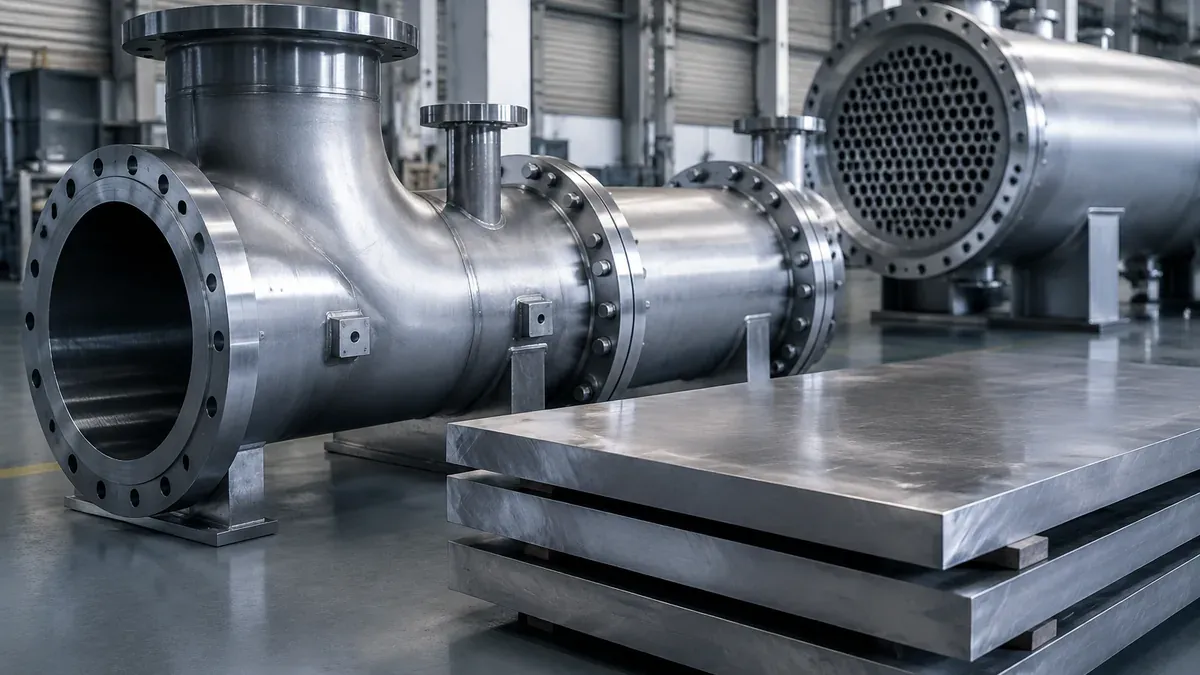
- Heat exchangers in hot brines
2507 Compared With Other Grades
Frequently Asked Questions
What is the difference between 2507 and 2205 duplex?
2507 raises chromium, molybdenum and nitrogen to push PREN above 40 (2205 sits around 34–38) and lifts the stated minimum yield strength. It provides more chloride margin than 2205 but has a narrower fabrication window; compare the service conditions and current delivered quotation rather than assuming a fixed premium.
What does PREN over 40 mean?
PREN (Pitting Resistance Equivalent Number = %Cr + 3.3×%Mo + 16×%N) estimates resistance to chloride pitting. Alloys above 40 are classed as seawater-resistant 'super' grades, suitable for hot chloride brines and crevice-prone joints. 2507's typical PREN is 41–43.
What is the service temperature range of 2507?
Design codes generally allow −50 °C to about +250 °C. Extended exposure above ~300 °C precipitates embrittling sigma phase in the ferrite, so super-duplex is never used for furnace or high-temperature duty despite its strength.
Published by Tsingshan (Shandong) Iron & Steel Co., Ltd..Sources, update policy and technical limitations.
Quote request
Get a 2507 Stainless Steel Quotation
Send the product, grade and quantity you already have. We will complete the specification and quote the supply route.