
Grade quotation brief
201 vs 304 Stainless Steel
Quote 201 when indoor decorative or appliance duty, forming route and appearance are already proven for that chemistry. Quote 304 when outdoor, humid, salted or demanding forming duty needs the chromium-nickel route. This comparison does not establish a fixed price advantage, outdoor life or unconditional substitution.
Quote 201 for controlled indoor decorative or appliance duty after humidity, salts, cleaning, drainage, forming and appearance are defined. Quote 304 where service or fabrication needs a wider validated chromium-nickel margin. Require heat traceability and the ordered inspection document; do not approve substitution from appearance.
Unsure whether 201 or 304 matches the operating temperature and chemistry? Send the service conditions with the RFQ. We quote the approved designation, product form and test plan.
Request a Quote
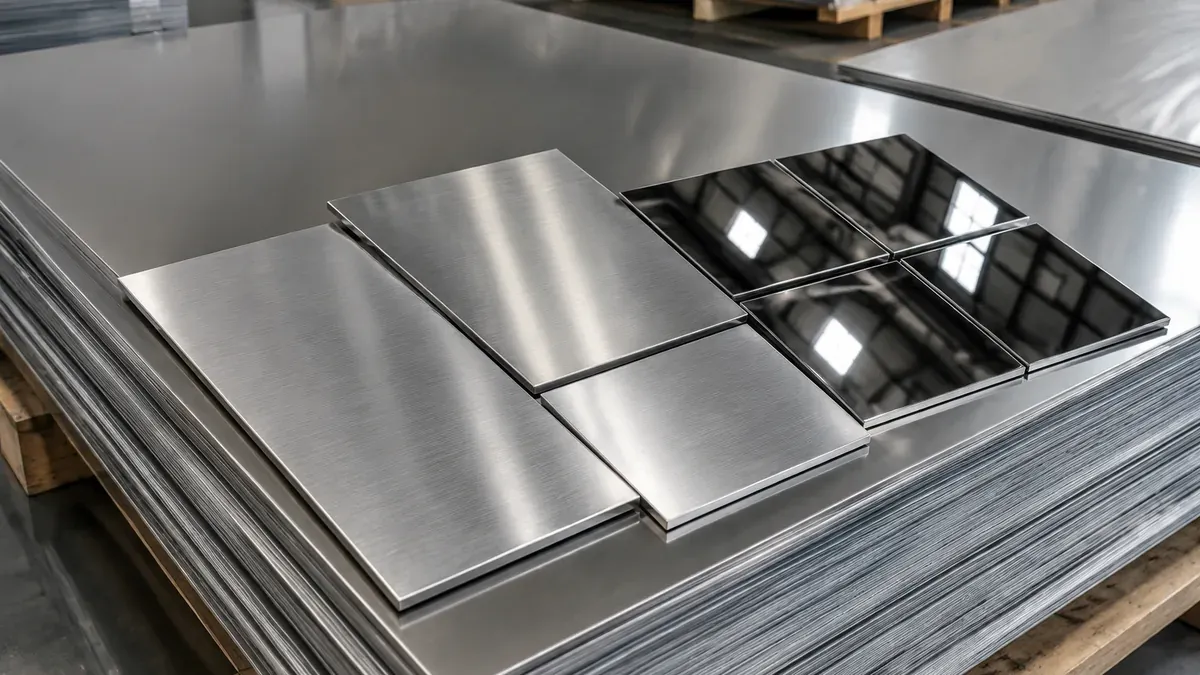
Illustrations identify the compared grade references; they are not photographs of the quoted material or proof of a mill heat.
Decision matrix
Key Differences
Full grade sheets:201 Stainless Steel/304 Stainless Steel
| Factor | 201 | 304 | Procurement decision |
|---|---|---|---|
| Alloy balance | 201 has higher specified manganese and nitrogen ranges with a lower nickel range in the displayed chemistry. | 304 has a lower manganese limit and higher nickel range in the displayed ASTM A240 chemistry. | Verify the exact designation by traceable chemistry; appearance and magnet response cannot approve substitution. |
| Corrosion screening | 201 requires controlled exposure review where humidity, salts, cleaning chemicals, crevices or retained deposits are present. | 304 is commonly evaluated for a wider range of atmospheric and cleaned equipment duties, but chlorides can still limit it. | Use exposure data, precedent or testing; do not publish a fixed outdoor performance period for either grade. |
| Forming behavior | 201 can work-harden rapidly, increasing tooling load, springback and the need to validate severe drawing on the actual coil. | 304 also work-hardens, but established austenitic forming routes do not remove the need for gauge-specific trials and tooling review. | Send the part drawing, draw depth, bend direction and finish requirement before choosing by nominal ductility. |
| Mechanical condition | Displayed annealed ASTM A240 minimum tensile and yield values for 201 exceed those shown for 304. | 304 properties depend on annealed or cold-worked condition, product standard, thickness and test orientation. | Do not convert a higher minimum into a blanket component advantage; validate forming, joints and design allowables. |
Service and production route
Corrosion and Fabrication Boundaries
201 corrosion screening
- For this 201 vs 304 review, 201 forms a chromium-rich passive film like other austenitics, but its lower nickel and higher manganese/nitrogen balance usually give less margin than 304 in humidity, salt deposits, acidic cleaners or outdoor wetting.
- For this 201 vs 304 review, Against ferritic 430, annealed 201 typically forms and welds more like an austenitic grade and stays essentially non-magnetic until cold worked, yet neither grade replaces 304 where chlorides, continuous wetness or frequent chemical cleaning dominate.
- For this 201 vs 304 review, Check chlorides, temperature, crevices, deposits, process chemistry and cleaning conditions. A grade designation alone is not a service-life guarantee.
304 corrosion screening
- For this 201 vs 304 review, 304 relies on a chromium-rich passive film for general atmospheric, indoor and many process duties, but it is not automatically suitable for warm chloride, coastal salt deposits or persistent crevice-prone service — 316/316L or a higher alloy may be needed.
- For this 201 vs 304 review, Against lower-nickel 201, annealed 304 usually offers more corrosion margin in humidity, outdoor wetting and chemically cleaned food-contact duty; against ferritic 430 it remains the more formable, weldable austenitic default when magnetism and deep drawing matter.
- For this 201 vs 304 review, Review chlorides, temperature, pH, deposits, crevices, drainage, cleaning chemistry, weld heat tint and surface finish for the actual component. A grade designation alone is not a service-life guarantee.
| Operation | 201 | 304 |
|---|---|---|
| Welding | Generally weldable with a qualified procedure and matching or over-alloyed filler where required; remove heat tint when corrosion service demands it. Do not assume weld zones retain cold-worked strip strength. | Generally weldable with a qualified austenitic procedure, matching or over-alloyed filler where required, controlled heat input and heat-tint removal when corrosion service demands it. For as-welded heavy sections, prefer 304L or dual-certified material meeting the low-carbon limit rather than assuming standard 304 HAZ behavior. |
| Forming | Annealed sheet and strip draw and bend well, but 201 work-hardens rapidly — tooling load, springback, bend radius and any intermediate anneal must be proven on the actual gauge and reduction route. | Annealed 304 sheet and strip draw and bend well, but the alloy work-hardens during forming — tooling load, springback, bend direction, draw ratio and any intermediate anneal must be proven on the actual gauge and reduction route. |
| Machining | Use rigid tooling, positive feeds and controlled heat because the material work-hardens; free-machining grades require separate corrosion and welding review. | Use rigid tooling, positive feeds and controlled cutting heat to avoid a work-hardened surface; qualify the route on the delivered condition. Free-machining sulfur grades (for example 303) require separate corrosion and welding review. |
| Heat treatment | Solution annealing and rapid cooling restore the intended annealed condition after heavy cold work where applicable. Austenitic 201 is not hardened by conventional quench-and-temper treatment. | Solution annealing with rapid cooling restores the intended annealed austenitic condition after suitable cold work or fabrication where applicable. Conventional quench-and-temper treatment does not through-harden austenitic 304. |
Reference data
Composition and Mechanical Requirements
Values below come from each grade's displayed reference dataset. Product form, thickness, condition and contracted standard can change the applicable acceptance table.
Chemical composition (wt%)
| Element | 201 | 304 |
|---|---|---|
| C | ≤0.15 | ≤0.08 |
| Mn | 5.5–7.5 | ≤2.00 |
| Si | ≤1.00 | ≤0.75 |
| Cr | 16.0–18.0 | 17.5–19.5 |
| Ni | 3.5–5.5 | 8.0–10.5 |
| N | ≤0.25 | ≤0.10 |
| P | ≤0.060 | ≤0.045 |
| S | ≤0.030 | ≤0.030 |
Mechanical properties
| Property | 201 | 304 |
|---|---|---|
| Tensile strength | ≥655 MPa (95 ksi) | ≥515 MPa (75 ksi) |
| Yield strength (0.2%) | ≥260 MPa (38 ksi) | ≥205 MPa (30 ksi) |
| Elongation (50 mm) | ≥40% | ≥40% |
| Hardness | ≤241 HBW | ≤201 HBW |
Quotation workflow
Application Decisions
- For indoor decorative tube or trim, evaluate 201 only with defined humidity, cleaning, finish, edge exposure and cosmetic acceptance criteria.
- For cookware or kitchen components, separately approve food-contact requirements, salt exposure, forming severity, joining and cleaning conditions.
- For outdoor, coastal or chemically cleaned equipment, compare 304 and higher-alloy candidates against measured exposure rather than using an indoor precedent.
- For deep-drawn components, trial the actual coil condition and confirm draw ratio, earing, springback, surface protection and final polish.
Quote 201 when
- Indoor decorative tube, trim and railings with documented dry service
- Cookware bodies and utensils with normal washing and an accepted 201 history
- Appliance panels in dry indoor environments already proven in 201
- Applications whose field history and appearance criteria already name 201
Quote 304 when
- Outdoor, coastal or humid installations
- Food processing with salts, acids or daily cleaning chemicals
- Deep drawing and demanding forming operations
- Contracts where long-term cosmetic appearance is part of acceptance
Hold point
Do Not Substitute Without Review
- Do not supply 201 against a purchase order for 304 without an authorized deviation and documented review of chemistry, design, fabrication and service.
- Do not identify either grade from visual appearance or magnet response; require heat traceability and use qualified PMI when specified.
- Do not infer outdoor life, staining resistance or warranty performance from a grade label without exposure-specific evidence.
- Do not apply flat-product values to decorative tube, bar or finished cookware without the appropriate product and finished-article requirements.
Specification boundary
Standards, Temperature and Approval
Product and project approval
The displayed chemistry and annealed properties use ASTM A240/A240M flat-product context. Decorative tubing, finished articles and other forms require their own material, dimensional and regulatory requirements. The purchase-order edition, product specification, end-use rules and buyer-approved material review control acceptance.
Temperature boundary
This page sets no universal service-temperature limit for 201 or 304. Temperature changes corrosion, cleaning and mechanical behavior, while cold work and welding change the delivered component condition. The project specification, exposure evidence and design review must establish the accepted range.
Commercial comparison
Cost and Availability Factors
Quote 201 and 304 on one RFQ with the same product form, dimensions, tests and documents. This page does not represent current stock, price or lead time.
Cost factors
- Current heat chemistry, mill route and availability for the required grade, product form and condition.
- Forming yield, surface quality, finish, protection, dimensions, tolerances and edge requirements.
- Traceability, certificate type, PMI, finished-article testing and inspection or sample approval.
- Quantity, packing, freight, Incoterm, delivery timing and risk of a non-approved material change.
Inputs for a like-for-like quotation
- Required UNS designation, product form, governing standard and explicit substitution prohibition or approval route.
- Dimensions, tolerances, quantity, delivery condition, finish, critical face and protective film.
- Indoor or outdoor exposure, humidity, chlorides, cleaning chemicals, drainage and cosmetic criteria.
- Part drawing, draw ratio, bend direction, welding or joining route, polishing and acceptance sample.
- MTC type, heat traceability, PMI or other tests, packing, destination and Incoterm.
Continue the specification
Related Grades, Standards and Applications
Grade references
Standards
Applications
201 Stainless Steel Coil
Cold-rolled 201 coil in 2B and BA, J1/J2 as ordered. Common inquiry range 0.2–3.0 mm, 1000/1219 mm or slit from 20 mm, for tube mills and appliances.
View details →
304 Stainless Steel Sheet
304/304L ASTM A240 sheet in 2B, BA, No.4 and mirror. Common inquiry range 0.3–6.0 mm, 1000/1219/1500 mm widths, cut to size with quoted documents.
View details →
304 Stainless Steel Welded Pipe
304 welded stainless steel pipe and tube to ASTM A312, A249 and A554 — industrial, sanitary and polished decorative, round, square and rectangular sections.
View details →
304 Stainless Steel Round Bar
304/304L round bar in bright, peeled or hot-finished routes. Common inquiry range 3–300 mm diameter, 3 m / 6 m or cut-to-length, for pins, shafts and fittings.
View details →
Buyer questions
Frequently Asked Questions
How can I tell if material sold as 304 is actually 201?
Not by looking; both can have a similar finished appearance. Require the mill test certificate and heat traceability, then use a qualified PMI method when the inspection plan requires independent verification. The method, calibration and acceptance criteria must suit the alloying elements being distinguished.
Does 201 rust outdoors?
Outdoor performance depends on chloride deposition, humidity, temperature, finish, crevices, drainage and cleaning. 201 and 304 should be compared with local precedent, testing or a corrosion review; neither grade name establishes a fixed time to staining or pitting.
Can a magnet distinguish 201 from 304?
No. Both may become magnetic after cold work. Use traceability and composition testing such as XRF or OES when positive grade identification is required.
Published by Tsingshan (Shandong) Iron & Steel Co., Ltd..Sources, update policy and technical limitations.
Quote request
Get a Stainless Steel Quote
Send the product, grade and quantity you already have. We will complete the specification and quote the supply route.