
420 Stainless Steel (UNS S42000)
Martensitic · ASTM A240/A240M, A276 · Density 7.75 g/cm³
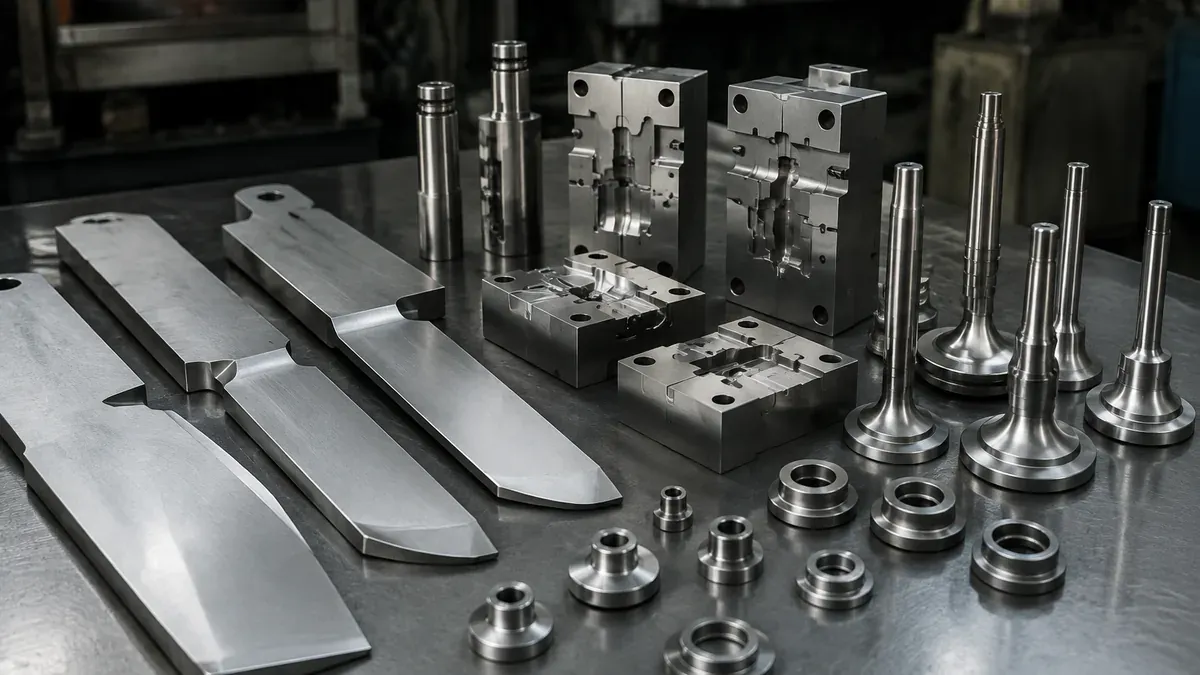
Type 420 (UNS S42000) is a 13% chromium martensitic stainless steel with at least 0.15% carbon. Supplied annealed for machining and forming, it is then hardened and tempered to 48–52 HRC, which makes it the standard grade for knife blades, surgical instruments, plastic mold tooling and valve trim.
Quotation brief
Quote 420 When
Quote 420 when a martensitic stainless component needs a defined hardening response and the designer can specify the carbon variant, heat-treatment condition and finished-part acceptance. It is considered for blades, instruments, molds, shafts and valve trim, but the label covers chemistry and product-standard context rather than one universal hardness. Toughness, retained austenite, distortion, grinding and corrosion exposure must be balanced for the actual section.
Best fit
- Blades and cutting components with an approved carbon variant, heat-treatment route, target hardness and edge or wear acceptance.
- Instrument, mold and valve parts machined in a soft condition and finish-ground after qualified hardening and tempering.
- Orders naming UNS S42000 or the exact approved JIS designation under the correct product standard with heat and condition traceability.
Limits to check
- 420, 420J1 and 420J2 are not interchangeable labels; chemistry, product standard and attainable properties must match the drawing.
- A hardness range without section, austenitizing, quench, temper and toughness requirements does not define the finished component.
- Wet, chloride, sterilization or hygienic exposure needs project-specific surface and corrosion validation and may require another material.
Quoted product forms
Quoted product forms for 420 Stainless Steel (UNS S42000)
We quote 420 Stainless Steel as bar, sheet / plate, coil / strip against the named product standard.
- Traceability: heat or lot identity plus the inspection document named in the RFQ (EN 10204 3.1 when that route supports it).
- Processing: decoiling, cutting, polishing, shearing and beveling as ordered.
- Next step: send product form, size and quantity; we quote the supply route.
Chemical Composition (wt%)
| C | Mn | Si | Cr | P | S |
|---|---|---|---|---|---|
| ≥0.15 | ≤1.00 | ≤1.00 | 12.0–14.0 | ≤0.040 | ≤0.030 |
Single values are maximums unless a range is shown. Balance: Fe. Per ASTM A240/A240M, A276.
Mechanical Properties
| Condition (as supplied) | Annealed |
|---|---|
| Hardness (annealed) | ≤223 HBW |
| Hardness (hardened + tempered) | 48–52 HRC (typ.) |
| Tensile (hardened, typ.) | ≈1600–1800 MPa |
Room-temperature minimum values are summarized for annealed flat product under ASTM A240/A240M, A276 unless a condition is named in the property label; product form and thickness can change the requirement.
Physical Properties & Structure
| Density | 7.75 g/cm³ |
|---|---|
| Magnetic response | Magnetic in annealed and hardened conditions. |
| Microstructure | Martensitic |
Corrosion Resistance & Limits
- 420 corrosion behavior changes with carbon variant, hardening response and surface preparation; dissolved chromium, carbide distribution and final polish all matter to the finished part.
- Clinical, food-adjacent or wet service requires explicit cleaning, sterilization, chloride, crevice and passivation criteria rather than a general claim based on blade hardness.
Fabrication & Heat Treatment
| Welding | Welding is difficult because the joint can form hard martensite; any approved repair or fabrication weld needs controlled preheat, filler, restraint and post-weld tempering. |
|---|---|
| Forming | Perform cutting and substantial forming in the annealed condition, allow for limited ductility, and account for distortion during subsequent austenitizing and quenching. |
| Machining | Rough-machine annealed stock with allowance for heat-treatment movement and finish grinding; tooling and feeds must match the delivered carbon variant and hardness. |
| Heat treatment | Carbon variant, austenitizing temperature, hold, quench, cryogenic step if specified and temper determine hardness, retained austenite, toughness and corrosion response. |
Equivalent Grades
The closest international equivalents of 420 Stainless Steel are 1.4021 / 1.4028 (X20Cr13 / X30Cr13) in the EN system, SUS420J1 / SUS420J2 in the JIS system, 20Cr13 / 30Cr13 in the GB system.
These are common corresponding designations, not unconditional substitutes. Verify chemistry, mechanical properties, product standard, delivery condition, dimensions and project approval before changing designation.
| System | Designation |
|---|---|
| UNS | S42000 |
| EN | 1.4021 / 1.4028 (X20Cr13 / X30Cr13) |
| JIS | SUS420J1 / SUS420J2 |
| GB | 20Cr13 / 30Cr13 |
Ordering Checks for 420
- State the exact UNS or JIS designation, governing product standard, bar or flat form, section, delivery condition and surface finish.
- Specify target hardness range, toughness or impact requirement, heat-treatment sequence, section size and final dimensional allowance.
- Define grinding, polishing, passivation, sterilization, cleaning and service-exposure requirements for the completed part.
- Request inspection documentation for heat chemistry, product condition, hardness or mechanical tests, dimensions and thermal-process traceability.
Reference Product Forms & Dimensional Ranges
Common reference product forms for 420 stainless steel: Bar, Sheet / Plate, Coil / Strip.
| Conditions | Annealed; hardening by 980–1035 °C oil quench + temper |
|---|---|
| Bar diameter | 6–300 mm |
| Sheet / plate thickness | 2–60 mm |
Common surface and delivery options
- No.1, 2B, BA or mechanically polished finish when supported by the product route
- Hot rolled, peeled, bright drawn, ground or polished bar condition according to tolerance
These published ranges are engineering references, not a live-stock or production-capability promise. Send the required product form, dimensions, condition and finish; we quote the matching supply route.
Browse related product hubs:Sheet & plate,Coil & strip,Pipe & tube,Bar & rod.
Typical Applications
- Knife blades and cutting tools
- Surgical and dental instruments
- Plastic injection mold bases
- Pump shafts and valve trim
- Scissors and hand tools
420 Compared With Other Grades
Frequently Asked Questions
What is the difference between 420J1 and 420J2?
Carbon content: J1 runs roughly 0.16–0.25% C, J2 0.26–0.40% C (JIS designations). More carbon means higher attainable hardness — J2 reaches about 52 HRC versus 50 for J1 — at some cost in toughness and corrosion resistance. Budget knives typically use J2.
Is 420 stainless steel rust proof?
No stainless grade is rust proof. For 420, heat-treatment condition, surface finish, retained scale, cleaning chemicals, chlorides and crevices all affect staining or pitting. The finished part needs its own corrosion and hygiene acceptance criteria.
420 vs 440C — which knife steel should I choose?
440C has a higher carbon and chromium range and may be specified for a higher-hardened wear surface, while 420 covers different carbon variants and heat-treatment responses. Compare required hardness, toughness, section, corrosion exposure, grinding route and the current quotation before choosing either grade.
Published by Tsingshan (Shandong) Iron & Steel Co., Ltd..Sources, update policy and technical limitations.
Quote request
Get a 420 Stainless Steel Quotation
Send the product, grade and quantity you already have. We will complete the specification and quote the supply route.