
Grade quotation brief
409L vs 430 Stainless Steel
Quote 409L for a validated exhaust or hot-component route that needs its stabilized ferritic chemistry, forming and welding behavior. Quote 430 for a controlled indoor panel or trim route where the ordered finish and appearance are central. Neither grade name guarantees outdoor life, a thermal limit or a fabricated-part result; the drawing, exposure map and validation plan control approval.
Quote 409L when an approved exhaust design depends on its stabilized ferritic fabrication route and has passed the required thermal, condensate and salt validation. Quote 430 when the drawing and exposure basis prioritize the specified decorative or appliance finish. A need for different corrosion or weld behavior should trigger a formal review of 439, 441, 304 or another candidate rather than an informal swap.
Unsure whether 409L or 430 matches the operating temperature and chemistry? Send the service conditions with the RFQ. We quote the approved designation, product form and test plan.
Request a Quote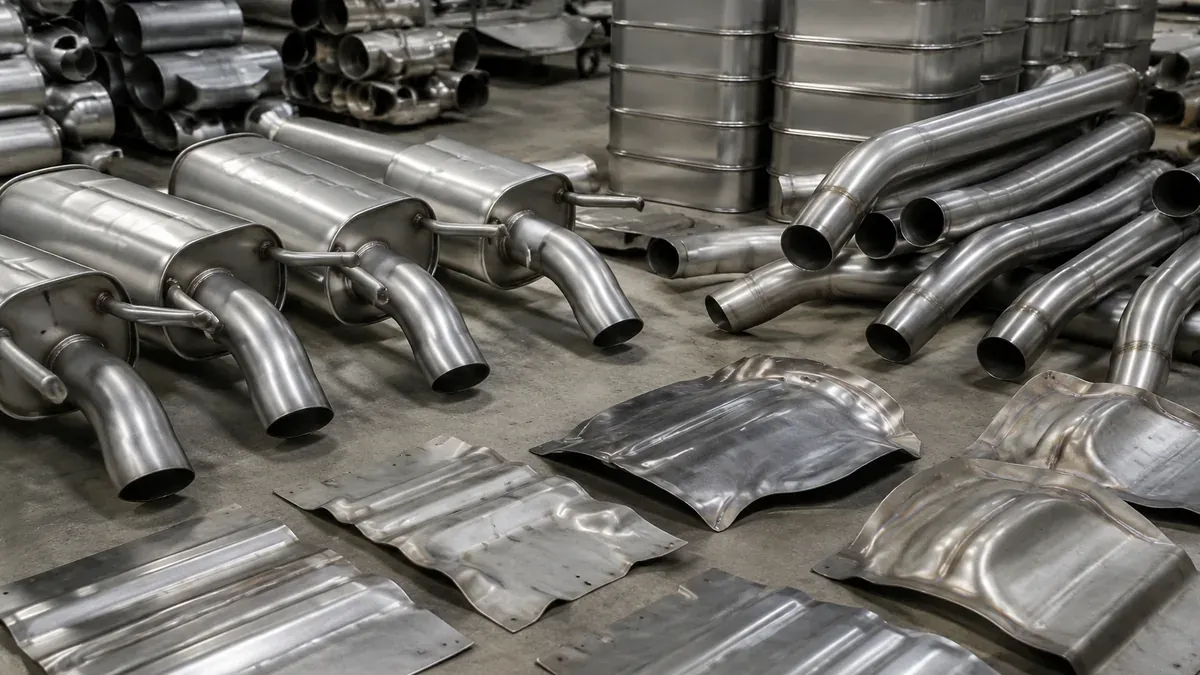
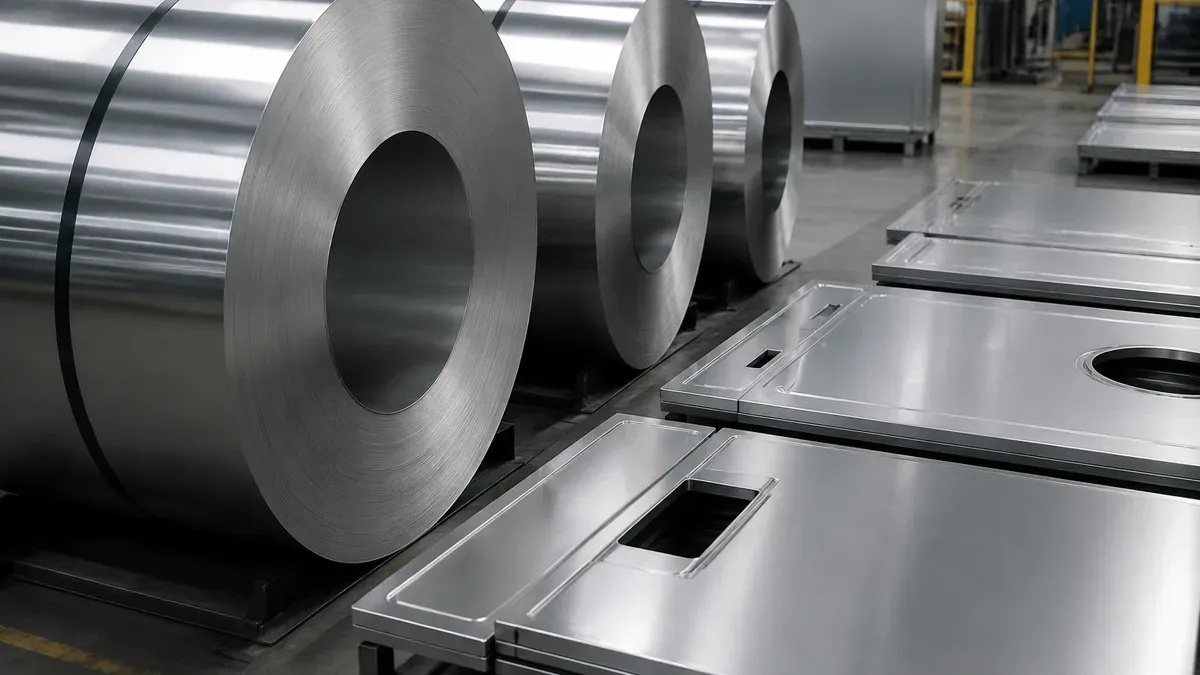
Illustrations identify the compared grade references; they are not photographs of the quoted material or proof of a mill heat.
Decision matrix
Key Differences
Full grade sheets:409L Stainless Steel/430 Stainless Steel
| Factor | 409L | 430 | Procurement decision |
|---|---|---|---|
| Chemistry and stabilization | 409L has a lower displayed chromium range and a specified stabilization route associated with exhaust fabrication. | 430 has a higher displayed chromium range but follows a different unstabilized ferritic product context. | Verify the exact designation and heat chemistry because chromium level alone does not define welded-part performance. |
| Primary procurement role | 409L is commonly ordered for functional exhaust tube, shells and formed hot-side components. | 430 is commonly ordered as sheet for appliance panels, dry interior equipment and decorative trim. | Start with the component drawing, joining route and exposure instead of treating both as generic ferritic sheet. |
| Surface acceptance | 409L applications may use a functional appearance criterion tied to location and validation. | 430 applications often require a controlled finish, protective film and visible-surface acceptance sample. | Define roughness, finish direction, allowable defects, film and post-fabrication cleaning on the RFQ. |
| Fabrication qualification | 409L tube and sheet require control of forming, weld heat input, contamination, heat tint and condensate geometry. | 430 forming and joining must account for gauge, bend direction, weld exposure and finish preservation. | Qualify the actual fabricated part because a flat-product certificate cannot validate welds or service life. |
Service and production route
Corrosion and Fabrication Boundaries
409L corrosion screening
- For this 409L vs 430 review, 409L's low chromium range provides limited cosmetic staining resistance compared with 430 or 439. Exhaust condensate acidity, de-icing salt, deposits, wet-dry cycling and crevices can control attack, especially near cold-end welds and retained moisture.
- For this 409L vs 430 review, The ferritic structure has a different chloride stress-corrosion response from common austenitic grades, but this does not prevent pitting or general section loss. Acceptance must define allowable staining, penetration and remaining thickness for the component.
430 corrosion screening
- For this 409L vs 430 review, 430 forms a chromium-rich passive film suited to dry indoor atmospheres and many decorative appliance faces, but coastal exposure, persistent wetting and chloride cleaners can stain or pit sooner than on common austenitic grades such as 304.
- For this 409L vs 430 review, Ferritic grades generally resist chloride stress-corrosion cracking better than common austenitics, while pitting and crevice attack still depend on chromium level, surface finish, deposits and drainage — do not treat 430 as marine or chloride-primary service material.
- For this 409L vs 430 review, Against 201, corrosion ranking still depends on the actual humidity, salt and cleaning chemistry; against 304, annealed 430 is usually chosen for magnetic decorative indoor duty rather than as a corrosion upgrade. Validate fabrication and environment rather than relying on the grade name alone.
| Operation | 409L | 430 |
|---|---|---|
| Welding | Thin exhaust sheet and tube require controlled heat input, fit-up and shielding to limit grain growth, burn-through and oxide contamination. Titanium stabilization supports weld performance but does not replace procedure qualification or corrosion cleaning. | Control heat input, interpass temperature and joint design to limit grain growth and loss of toughness in the HAZ. Thin decorative sheet may be spot- or TIG-welded after trials; do not treat this page as a fabricated WPS — qualify the procedure for the ordered gauge and duty. |
| Forming | 409L is commonly roll formed, stamped and bent in thin gauges, with tooling and blank orientation selected for ferritic anisotropy and springback. Severe draws, edge stretch and formed weld seams require trial validation. | Annealed sheet and coil form adequately for bends and moderate stampings, but ductility and stretch formability are lower than common austenitic grades such as 304 or 201. Prove bend radius, draw severity and springback on the actual gauge. |
| Machining | Use sharp tools, rigid support and controlled cutting heat, particularly on thin-wall tube and stamped shells. Prevent carbon-steel pickup on surfaces that will be welded or exposed to condensate. | Machining is generally straightforward with rigid tooling; avoid smearing, overheating and iron contamination of finished decorative surfaces that will remain visible in BA or 2B. |
| Heat treatment | 409L is not hardened by conventional heat treatment. Any annealing after cold work must follow the ordered product route because temperature, dwell and cooling affect grain size, flatness and subsequent weld behavior. | Ferritic 430 is not hardened by conventional quench-and-temper treatment. Annealing can restore ductility after cold work, but temperature and cooling must follow the product specification — do not invent contractual heat-treat cycles here. |
Reference data
Composition and Mechanical Requirements
Values below come from each grade's displayed reference dataset. Product form, thickness, condition and contracted standard can change the applicable acceptance table.
Chemical composition (wt%)
| Element | 409L | 430 |
|---|---|---|
| C | ≤0.030 | ≤0.12 |
| Mn | ≤1.00 | ≤1.00 |
| Si | ≤1.00 | ≤1.00 |
| Cr | 10.5–11.7 | 16.0–18.0 |
| Ni | ≤0.50 | - |
| Ti | 6×(C+N)–0.50 | - |
| P | ≤0.045 | ≤0.040 |
| S | ≤0.030 | ≤0.030 |
Mechanical properties
| Property | 409L | 430 |
|---|---|---|
| Tensile strength | ≥380 MPa (55 ksi) | ≥450 MPa (65 ksi) |
| Yield strength (0.2%) | ≥170 MPa (25 ksi) | ≥205 MPa (30 ksi) |
| Elongation (50 mm) | ≥20% | ≥22% |
| Hardness | ≤179 HBW | ≤183 HBW |
Quotation workflow
Application Decisions
- For exhaust systems, map hot-end and cold-end positions, gas composition, condensate pH, chloride exposure, cycle frequency, vibration, drainage and weld geometry.
- For appliance and kitchen panels, state whether the surface is visible or product-contact, then define finish, cleaning chemistry, humidity, condensation and sample criteria.
- For flues and heat shields, separate dry oxidation from wet shutdown corrosion and confirm fastening, crevices, contamination and thermal expansion.
- For outdoor trim, document coastal or deicing salts, shelter, runoff, cleaning frequency and appearance expectations before either grade is shortlisted.
Quote 409L when
- Exhaust tube, muffler shells and heat shields validated around a stabilized 409L route
- Formed and welded components whose drawing explicitly names S40910 or its approved equivalent
- Parts where discoloration is secondary to qualified thermal-fatigue and condensate performance
- Programs with defined tube, weld, coating, salt exposure and vehicle-validation requirements
Quote 430 when
- Appliance fronts, dry interior panels and trim whose approved finish is a purchasing requirement
- Formed components with controlled welding or mechanical joining and an accepted 430 route
- Indoor equipment where cleaning chemistry, condensation and appearance acceptance are documented
- Orders needing a specified 430 sheet finish, surface protection and sample approval
Hold point
Do Not Substitute Without Review
- Do not replace 409L with 430, or 430 with 409L, without revised drawing approval and review of forming, welding, corrosion and finish requirements.
- Do not infer fabricated exhaust life from a chromium percentage, grade family or isolated salt-spray result.
- Do not approve 430 weld performance from flat-sheet appearance or use a 409L functional surface criterion for visible 430 panels.
- Do not transfer flat-product chemistry and mechanical summaries to welded tube or finished components without the applicable specification.
Specification boundary
Standards, Temperature and Approval
Product and project approval
ASTM A240/A240M and EN 10088 can govern specified flat products, while welded exhaust tube and completed vehicle or appliance parts require separate dimensional, fabrication and validation specifications. The current edition, exact designation, drawing, finish standard, joining procedure and authorized customer reviewer control acceptance.
Temperature boundary
This page sets no fixed operating-temperature limit for 409L or 430. Actual metal temperature, gas and condensate chemistry, thermal cycling, dwell time, load, section thickness, weld geometry, oxidation, road salts and the component validation protocol determine the accepted range.
Commercial comparison
Cost and Availability Factors
Quote 409L and 430 on one RFQ with the same product form, dimensions, tests and documents. This page does not represent current stock, price or lead time.
Cost factors
- Current alloy inputs and mill availability for the exact grade, form, gauge, width and finish.
- Forming yield, weld route, tooling, surface protection, cleaning and fabricated-part rejection criteria.
- Prototype, thermal-cycle, corrosion, leak, vibration, appearance and customer-validation requirements.
- Quantity, coil or sheet optimization, packing, freight, Incoterm, delivery window and change-approval scope.
Inputs for a like-for-like quotation
- UNS or EN designation, product form, governing material and dimensional standards, drawing revision and substitution policy.
- Gauge, width, length or tube dimensions, quantity, condition, finish, roughness, film and edge requirements.
- Component position, actual temperature cycle, gas or condensate chemistry, salts, drainage, humidity and cleaning exposure.
- Forming severity, bend direction, weld or joining process, filler, heat-tint treatment and contamination controls.
- MTC, heat traceability, inspections, validation tests, sample approval, packing, destination, Incoterm and schedule.
Continue the specification
Related Grades, Standards and Applications
Grade references
Standards
Buyer questions
Frequently Asked Questions
Why does 409L exhaust tube show rust spots?
Surface discoloration can result from condensate, road salts, deposits, heat tint, contamination and limited drainage. Appearance alone does not establish section loss or remaining life; inspect the location, surface condition, thickness and exposure before deciding acceptance.
How should buyers compare 409L and 430 quotations?
Compare the same form, dimensions, finish, stabilization, tolerance, weld route, inspection, packing and delivery window. Base-alloy inputs matter, but forming yield, validation, surface rejection and fabricated-part requirements can change the delivered result.
Can either grade be used outdoors decoratively?
Neither designation is a blanket exterior approval. Coastal salts, deicing exposure, crevices, runoff, surface roughness and cleaning access may require another ferritic grade, 304, 316L or a protective system supported by project testing.
Published by Tsingshan (Shandong) Iron & Steel Co., Ltd..Sources, update policy and technical limitations.
Quote request
Get a Stainless Steel Quote
Send the product, grade and quantity you already have. We will complete the specification and quote the supply route.