
Grade quotation brief
410 vs 420 Stainless Steel
Quote 410 or the exact 420 designation from the final hardness, strength, toughness, wear, corrosion and manufacturing requirements on the component drawing. 420's higher carbon route can support different hardness targets, while 410 can support a different toughness and fabrication balance. Neither grade name guarantees a hardness band: section, austenitizing, quench, temper and testing control the delivered result.
Quote from the final part requirements, not a universal hardness threshold. Quote 410 when the approved design and heat-treatment procedure need its balance of strength, toughness and corrosion behavior. Quote the exact 420 designation when wear or edge requirements justify its carbon route and the part can meet impact, distortion and cracking limits. The drawing must state final condition and acceptance values.
Unsure whether 410 or 420 matches the operating temperature and chemistry? Send the service conditions with the RFQ. We quote the approved designation, product form and test plan.
Request a Quote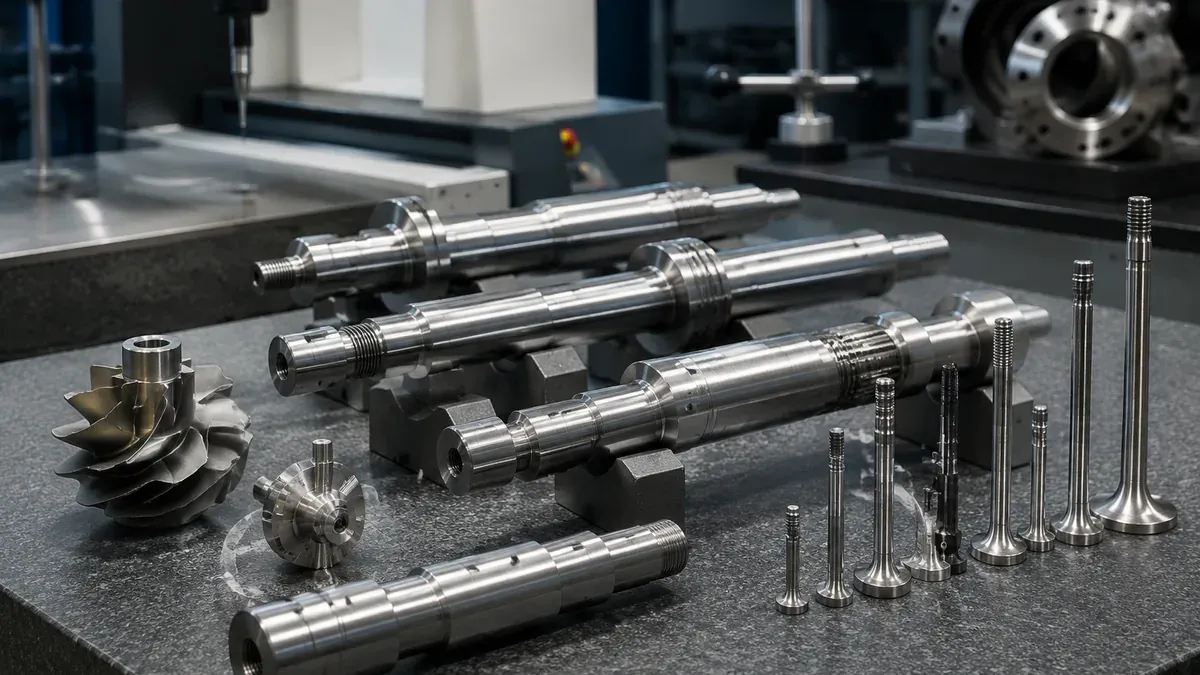
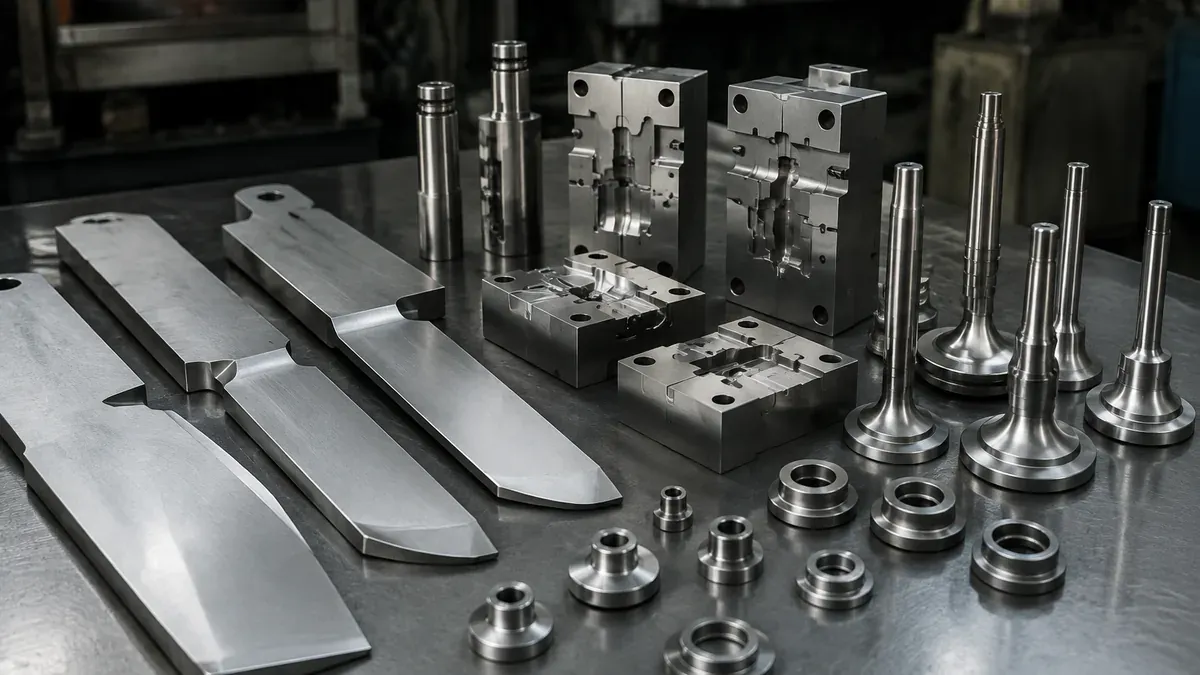
Illustrations identify the compared grade references; they are not photographs of the quoted material or proof of a mill heat.
Decision matrix
Key Differences
Full grade sheets:410 Stainless Steel/420 Stainless Steel
| Factor | 410 | 420 | Procurement decision |
|---|---|---|---|
| Carbon range | 410 has a lower displayed carbon ceiling within its martensitic chemistry context. | 420 designations use a higher-carbon martensitic route whose exact lower limit can depend on the standard. | Order the exact UNS or standard designation and heat chemistry rather than generic 420 steel. |
| Heat-treatment response | 410 properties depend on austenitizing, quench, temper, section and final test location. | 420 also requires section-specific hardening and tempering to reach the drawing's approved condition. | Qualify the complete furnace, quench, temper, straightening and testing route for the actual part. |
| Toughness and wear | 410 is often assessed where toughness and controlled strength are central to a loaded component. | 420 is often assessed where edge retention, hardness or wear carries more weight in the design. | Approve from measured hardness, impact or fracture needs and wear testing, not family-level rankings. |
| Corrosion and finish | 410 corrosion behavior changes with heat treatment, carbide distribution, roughness and passivation. | 420 behavior is likewise condition-dependent and its higher carbon does not guarantee wet-service margin. | Specify final finish, cleaning, exposure and corrosion acceptance after heat treatment and grinding. |
Service and production route
Corrosion and Fabrication Boundaries
410 corrosion screening
- For this 410 vs 420 review, 410 develops useful passive behavior only when chemistry, hardening condition and surface are controlled; it normally offers less wet-corrosion margin than common 304-type austenitic stainless steel.
- For this 410 vs 420 review, Fresh water, condensate, chlorides, tempering temperature, heat tint, grinding contamination and crevices must be reviewed for the finished valve, shaft or blade geometry.
420 corrosion screening
- For this 410 vs 420 review, 420 corrosion behavior changes with carbon variant, hardening response and surface preparation; dissolved chromium, carbide distribution and final polish all matter to the finished part.
- For this 410 vs 420 review, Clinical, food-adjacent or wet service requires explicit cleaning, sterilization, chloride, crevice and passivation criteria rather than a general claim based on blade hardness.
| Operation | 410 | 420 |
|---|---|---|
| Welding | Welding needs a section-specific preheat, low-hydrogen practice, filler choice and post-weld heat treatment because untempered martensite and restraint can create hard cracking. | Welding is difficult because the joint can form hard martensite; any approved repair or fabrication weld needs controlled preheat, filler, restraint and post-weld tempering. |
| Forming | Complete substantial forming in the annealed condition, then account for reduced ductility, springback and distortion through the final hardening and tempering route. | Perform cutting and substantial forming in the annealed condition, allow for limited ductility, and account for distortion during subsequent austenitizing and quenching. |
| Machining | Rough-machine in the annealed condition where practical, retain allowance for heat-treatment movement and final grinding, and qualify tooling for the delivered hardness. | Rough-machine annealed stock with allowance for heat-treatment movement and finish grinding; tooling and feeds must match the delivered carbon variant and hardness. |
| Heat treatment | Austenitizing, quench severity, section size and tempering temperature set the final hardness-toughness balance; the heat treater must qualify the exact part route. | Carbon variant, austenitizing temperature, hold, quench, cryogenic step if specified and temper determine hardness, retained austenite, toughness and corrosion response. |
Reference data
Composition and Mechanical Requirements
Values below come from each grade's displayed reference dataset. Product form, thickness, condition and contracted standard can change the applicable acceptance table.
Chemical composition (wt%)
| Element | 410 | 420 |
|---|---|---|
| C | 0.08–0.15 | ≥0.15 |
| Mn | ≤1.00 | ≤1.00 |
| Si | ≤1.00 | ≤1.00 |
| Cr | 11.5–13.5 | 12.0–14.0 |
| Ni | ≤0.75 | - |
| P | ≤0.040 | ≤0.040 |
| S | ≤0.030 | ≤0.030 |
Mechanical properties
| Property | 410 | 420 |
|---|---|---|
| Tensile strength (annealed) | ≥450 MPa (65 ksi) | - |
| Yield strength (annealed) | ≥205 MPa (30 ksi) | - |
| Elongation (50 mm) | ≥20% | - |
| Hardness (hardened + tempered) | up to ≈40–45 HRC | 48–52 HRC (typ.) |
| Condition (as supplied) | - | Annealed |
| Hardness (annealed) | - | ≤223 HBW |
| Tensile (hardened, typ.) | - | ≈1600–1800 MPa |
Quotation workflow
Application Decisions
- For valve and pump parts, provide pressure, fluid chemistry, sliding or sealing contact, load, impact, galling, leakage and final dimensions.
- For blades or instruments, state edge geometry, wear test, hardness locations, toughness, surface finish, cleaning and any product-contact rules.
- For turbine or power components, identify design code, actual metal temperature, load spectrum, fatigue, erosion, NDE and repair restrictions.
- For mold and precision parts, document section changes, machining allowance, distortion tolerance, polishing, residual stress and dimensional inspection.
Quote 410 when
- Valve trim, pump shafts and fasteners qualified around an S41000 heat-treatment route
- Turbine and mechanical parts whose drawing prioritizes toughness and controlled hardness
- Components supported by section-specific hardening, tempering and inspection procedures
- Orders where 410 form, stock allowance and final-condition certification are available
Quote 420 when
- Cutting, instrument or mold parts whose drawing explicitly specifies a 420 designation
- Wear surfaces needing a qualified higher-carbon martensitic heat-treatment response
- Parts whose impact loading, section and final finish have been validated for 420
- Orders with an approved hardening, tempering, straightening and hardness-inspection plan
Hold point
Do Not Substitute Without Review
- Do not replace 410 with 420, or 420 with 410, without revised heat-treatment qualification and design approval.
- Do not derive a guaranteed HRC range from the grade name without section, furnace, quench, temper and test-method details.
- Do not approve welded repair from a generic martensitic procedure; base condition and final property restoration require qualification.
- Do not use annealed product data as final hardened-part acceptance values or transfer results across section sizes.
Specification boundary
Standards, Temperature and Approval
Product and project approval
ASTM A240/A240M can govern specified flat product, ASTM A276 or A479 can govern bar, and component drawings can invoke separate heat-treatment and mechanical-test requirements. The current standard edition, exact 420 designation, form, section, final condition, design code and authorized reviewer control acceptance.
Temperature boundary
This page publishes no universal operating or heat-treatment temperature for 410 or 420. Furnace uniformity, part section, atmosphere, austenitizing, quench severity, tempering, service temperature, load and exposure duration affect hardness, toughness, distortion, retained phases and corrosion. The qualified procedure controls every value.
Commercial comparison
Cost and Availability Factors
Quote 410 and 420 on one RFQ with the same product form, dimensions, tests and documents. This page does not represent current stock, price or lead time.
Cost factors
- Current material availability for the exact designation, form, section, condition and stock allowance.
- Rough machining, furnace loading, protective atmosphere, quench, temper, straightening and finish machining.
- Hardness mapping, tensile or impact tests, metallography, NDE, dimensional report and rejection risk.
- Quantity, heat-treatment lot size, packing, freight, Incoterm, schedule and procedure qualification.
Inputs for a like-for-like quotation
- UNS designation and exact 420 standard designation, product form, material standard, drawing revision and substitution policy.
- Part dimensions, section transitions, quantity, initial condition, machining allowance, tolerance and final finish.
- Required final hardness, test scale and locations, strength, impact or toughness, wear and corrosion criteria.
- Austenitizing, atmosphere, quench, temper, straightening, stress relief, weld repair and traceability requirements.
- MTC, heat-treatment charts, test reports, NDE, dimensional inspection, packing, destination, Incoterm and schedule.
Continue the specification
Related Grades, Standards and Applications
Grade references
Applications
Buyer questions
Frequently Asked Questions
Which is more corrosion resistant, 410 or 420?
No single ranking covers every heat treatment and surface. Carbon tied in carbides, hardness condition, tempering, roughness, passivation, crevices and service chemistry all affect behavior. Neither designation should be treated as a 304-equivalent wet-corrosion grade.
Can 410 and 420 be welded?
Both martensitic grades can be crack-sensitive. Any weld or repair needs a qualified base condition, preheat, consumable, heat input, hydrogen control and post-weld heat-treatment plan tied to the final hardness and toughness requirements.
Do 410 and 420 need heat treatment?
When the design relies on martensitic strength or wear, hardening and tempering are part of the manufacturing route. State the exact condition, hardness location, test method, section, distortion allowance and required mechanical tests.
Published by Tsingshan (Shandong) Iron & Steel Co., Ltd..Sources, update policy and technical limitations.
Quote request
Get a Stainless Steel Quote
Send the product, grade and quantity you already have. We will complete the specification and quote the supply route.