
303 Stainless Steel Hex Bar
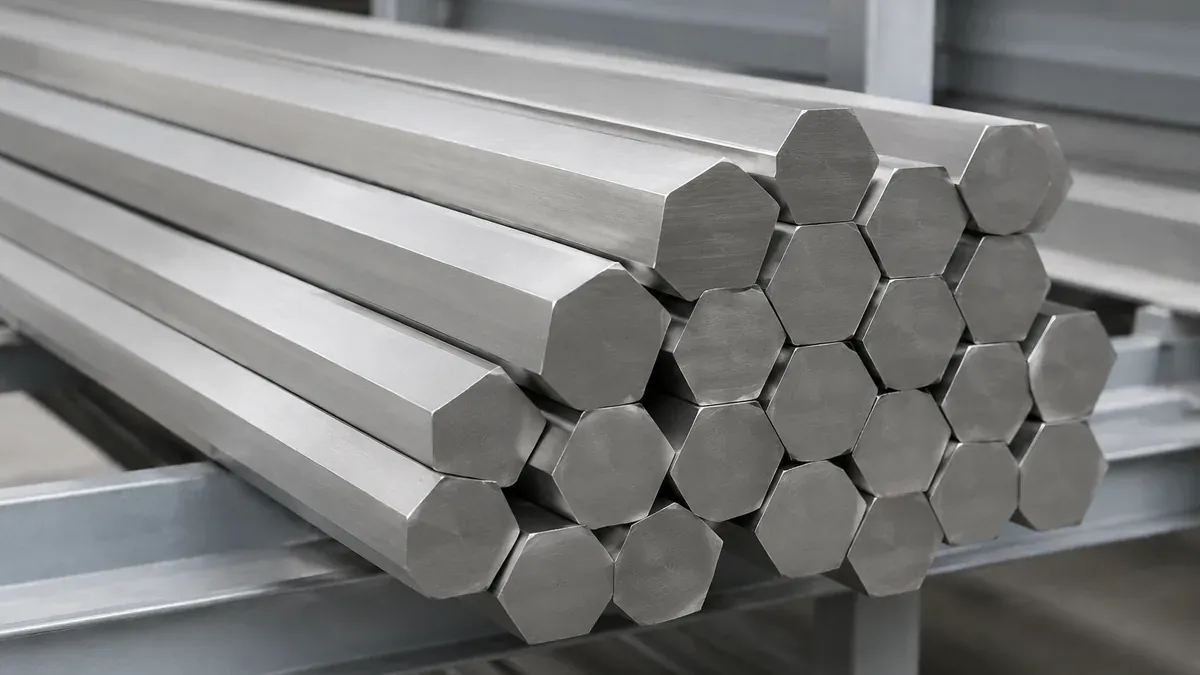
303 stainless steel hex bar is quoted as sulfur-modified free-machining austenitic bar by across-flats size, ASTM A276 cold-finished condition, corner geometry and length. Common inquiry range: mill length or cut pieces for automatic turning.
Supply routes
- Qualified partner-mill sourcing
- Stock coordination
- In-house production or processing
Grade datasheets:303
Where this product solves the job
- High-volume turned or milled components where the design approves Type 303 and chip control is a material-selection priority.
- Nuts, fittings, spacers and similar parts that can begin from hexagonal stock and retain an approved corrosion margin.
- Cold-finished bar orders with defined across-flats tolerance, corner condition, straightness and bar-feeder requirements.
When we recommend another route
- Welded assemblies unless a qualified procedure and the design authority explicitly accept the grade and final properties.
- Chloride-bearing, marine or aggressive cleaning service selected only because the part resembles an existing 304 component.
- Food, pharmaceutical or other regulated contact uses without confirmation from the applicable product and hygiene specification.
Standards we quote against
Send the product standard, edition and any dimensional or finish standard with the RFQ. We quote the ordered combination, not a generic grade name.
Ordered product standards: ASTM A276/A276M · ASTM A484/A484M
What to send so we can quote the right route
- Name Type 303 or UNS S30300, the governing bar standard and edition and the required cold-finished condition.
- State across-flats size and tolerance, corner or edge geometry, twist and straightness criteria and inspection gauge length.
- Define mill or fixed length, cut allowance, end condition, surface class and automatic bar-loader length or bundle constraints.
- Describe the finished part, thread or machined feature, planned passivation and any restriction on inclusions or surface discontinuities.
- List ordered tests, inspection document, heat and piece traceability, marking transfer and moisture-protected packing.
Specifications
| Grade | 303 / UNS S30300 |
|---|---|
| Product standard | ASTM A276/A276M |
| Shape | Hexagonal bar |
| Common inquiry range | 5–80 mm across flats |
| Condition | Cold drawn / bright |
| Length | Common inquiry range: Mill length or cut pieces. |
| Inspection | Tests required by the purchased standard plus PMI, NDE or other checks named in the RFQ |
| Commercial basis | Quantity, MOQ, production route and delivery schedule are quoted for the ordered specification. |
Dimensions and Tolerances
| Length | Common inquiry range: mill length or cut pieces. |
|---|---|
| Other | Common inquiry range: hex across-flats for automatic turning, with corner and straightness named in the RFQ. |
| Order basis | Governing product and dimensional standard, delivery condition and any drawing-specific limits. |
| Special tolerances | Send special tolerances in the RFQ; we quote the accepted production route. |
Published ranges are technical references, not a live-stock or production-capability promise. We confirm the ordered size range, MOQ and delivery schedule in the quotation.
Edge or end condition
- Edge, end or facing condition as ordered from the product form, standard and fabrication need.
Testing and inspection
- Tests required by the purchased product standard.
- PMI, NDE, corrosion, roughness or other supplementary inspection quoted when the RFQ names method, lot scope and acceptance.
Order documents
- Heat identity with EN 10204 3.1, or the inspection document named in the RFQ, against mill, stock or partner-mill route.
- Supplementary reports linked to the ordered test plan.
Export packaging
- Bars bundled with end protection and moisture wrap for sea freight.
- Bundle identity kept with the heat mark; packing method stated in the quotation.
Quote 303 for the machining decision
Type 303 is quoted when chip control and production machining matter. Send welding, exposure, cleaning, forming and any regulated contact requirement with the RFQ so we can confirm the free-machining route. Compare the material boundary on the 303 grade page.
Quote the hexagon as a functional blank
Send across-flats tolerance, corner condition, twist, straightness, surface and bar length. Metric and inch sizes that look close are quoted as separate line items with their own tolerance and identification.
Quote identity through turning
Send the required transfer marking and document link for cut lengths. We quote passivation, cleaning and final inspection with the selected bar surface.
Common ordering mistakes
- Ordering by nominal hex size without specifying whether the controlled dimension is across flats and how corners are evaluated.
- Treating 303 as a drop-in 304 replacement while ignoring corrosion exposure, cold forming, welding and regulatory requirements.
- Assuming every cold-drawn hex bar has the same straightness, twist, corner fill and feeder performance.
- Calling for passivation as if it removes the need to control machining contamination, surface defects and service chemistry.
Handling and transport risks
- Hex corners can be dented or flattened by hard banding, fork contact or poorly fitted separators, affecting chucking and finished geometry.
- Long cold-finished bars can bow or twist when supports are widely spaced or bundles are lifted from unsuitable points.
- Mixed metric and inch bundles can be misidentified when similar across-flats sizes are stored without durable piece or bundle tags.
- Wet wrapping and carbon-steel contact can stain machined surfaces or introduce contamination before passivation and assembly.
Technical content updated: 2026-07-31
Published by Tsingshan (Shandong) Iron & Steel Co., Ltd..Sources, update policy and technical limitations.
Typical Applications
Related technical resources
Grades
Published standards
Applicable standards
ASTM A276/A276M · ASTM A484/A484M
Finishes and processing
What to Include in Your RFQ
Send the known values first. We use them to quote the ordered option, inspection plan and delivery route.
- Grade and governing standard
- 303; ASTM A276/A276M, ASTM A484/A484M. State the exact ordered combination.
- Dimensions and tolerances
- Provide length, other and identify which order basis, special tolerances requirements govern acceptance.
- Finish, processing and edge or end condition
- ; Stainless Steel Cut-to-Length and Leveling; Edge, end or facing condition as ordered from the product form, standard and fabrication need..
- Inspection, documents and packing
- Testing: Tests required by the purchased product standard.; PMI, NDE, corrosion, roughness or other supplementary inspection quoted when the RFQ names method, lot scope and acceptance. Documents: Heat identity with EN 10204 3.1, or the inspection document named in the RFQ, against mill, stock or partner-mill route.; Supplementary reports linked to the ordered test plan. Packing: Bars bundled with end protection and moisture wrap for sea freight.; Bundle identity kept with the heat mark; packing method stated in the quotation.
- Quantity, destination and requested delivery window
- Send quantity per size, unit, destination city or port, trade term and requested delivery window so we can quote the supply and freight route.
Product RFQ Example
RFQ example: ASTM A276/A276M Type 303 cold-finished hex bar, 19.05 mm across flats with the stated tolerance, controlled corner condition and straightness over the specified gauge length, fixed feeder lengths with end allowance, surface suitable for automatic turning, ordered inspection document and heat traceability, durable bundle identification and moisture-protected export packing; we quote the matching route and delivery window.
Frequently Asked Questions
Why does Type 303 usually machine differently from Type 304?
The free-machining additions promote chip breaking and can improve machining productivity. They also change corrosion and fabrication behavior, so the finished-part environment and process must approve 303 rather than choosing it only for cutting speed.
Can 303 hex bar be welded into a finished assembly?
It is generally not selected for routine welding. If a design proposes welding, the responsible engineer must approve the grade, joint procedure, heat input, final properties and inspection; a bar quotation does not provide that approval.
How should a buyer define hex-bar corners?
State the across-flats dimension and tolerance, then define corner fill, radius or edge condition where it affects chucking or finished stock. Include the measurement method if the drawing has a critical corner requirement.
Does passivation make 303 equivalent to 304 in corrosion service?
No. Passivation can be part of a controlled finishing process, but it does not erase grade-level differences or authorize service substitution. Review exposure, cleaning and finished geometry against the approved material specification.
Which straightness details matter for an automatic bar feeder?
Give the straightness limit over a defined gauge length, total bar length, end condition, across-flats tolerance and loader constraints. The accepted bar route should be confirmed against the actual feeding equipment.
Quote request
Get a Stainless Steel Quote
Send the product, grade and quantity you already have. We will complete the specification and quote the supply route.