
Grade quotation brief
2507 vs 2205 Stainless Steel
Quote 2507 only when the corrosion basis and design calculation require more localized-corrosion or strength margin than the approved 2205 route, and the supply chain can qualify super-duplex heat treatment, welding, toughness and inspection. Quote 2205 where measured conditions and service evidence establish adequate margin. PREN supports screening; it does not approve a grade, temperature, seawater system or piping class.
Quote 2507 only when the project corrosion basis, design calculation and qualified fabrication route require its added alloy and strength margin. Quote 2205 where service evidence and the approved duplex route provide sufficient margin. Do not select by a universal chloride-temperature table or PREN threshold: compare the complete environment, product form, weld qualification, inspection plan and dated quotations.
Unsure whether 2507 or 2205 matches the operating temperature and chemistry? Send the service conditions with the RFQ. We quote the approved designation, product form and test plan.
Request a Quote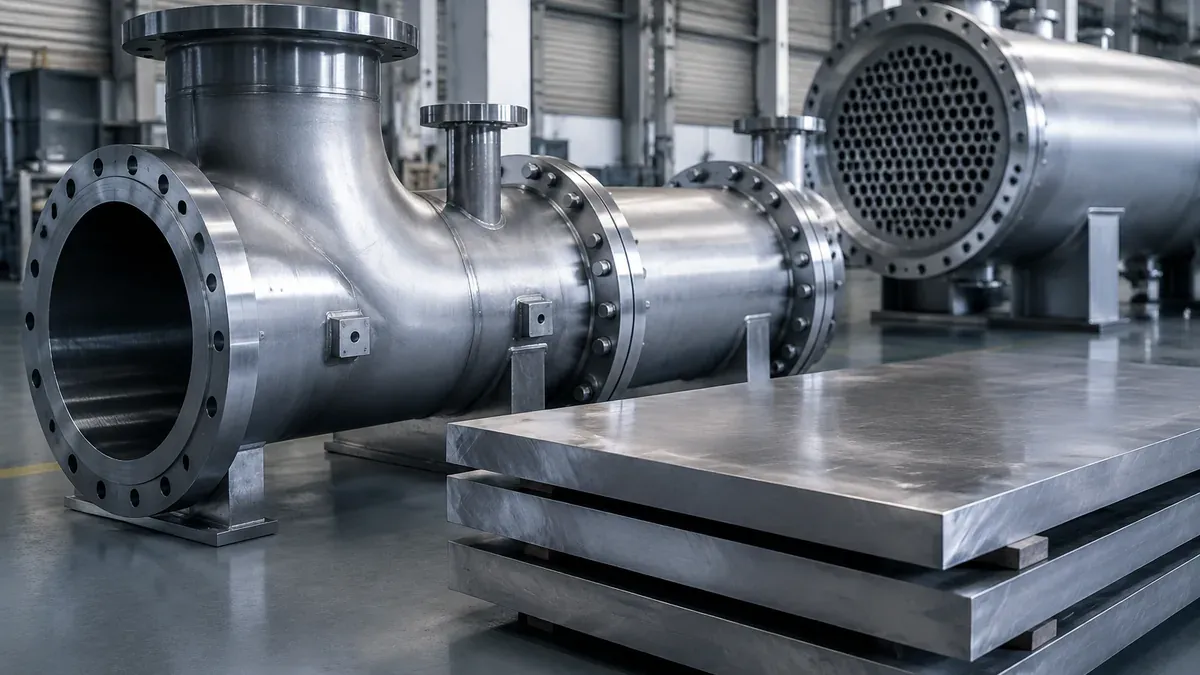
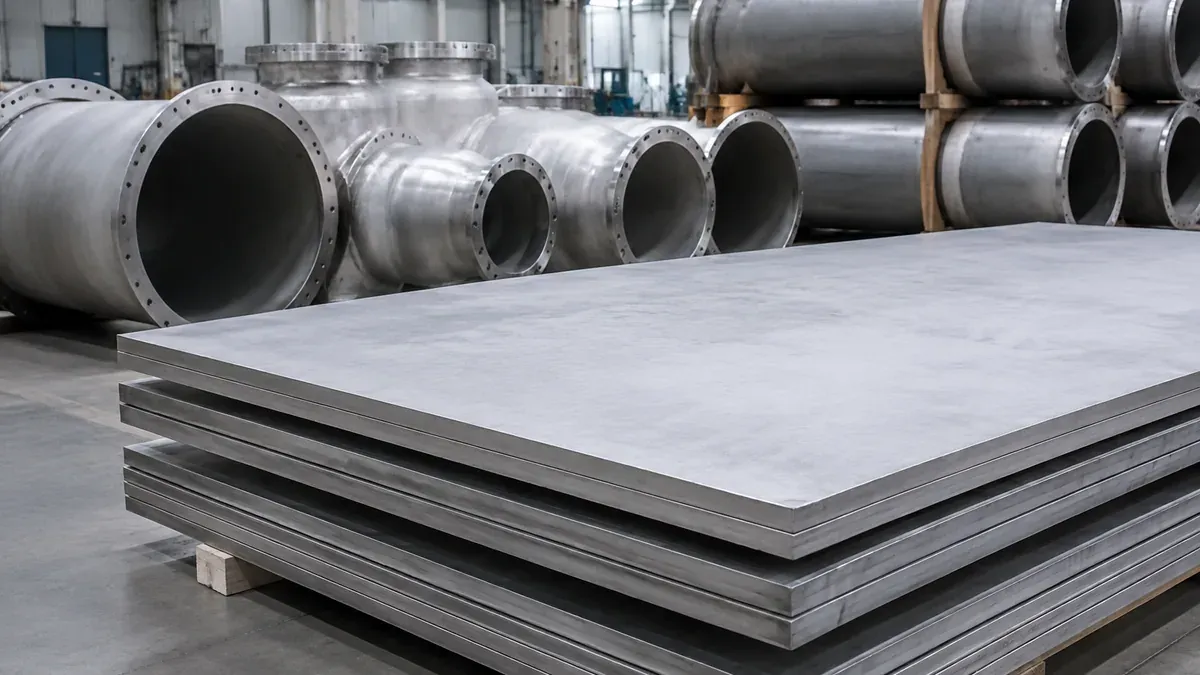
Illustrations identify the compared grade references; they are not photographs of the quoted material or proof of a mill heat.
Decision matrix
Key Differences
Full grade sheets:2507 Stainless Steel/2205 Stainless Steel
| Factor | 2507 | 2205 | Procurement decision |
|---|---|---|---|
| Alloy and PREN | 2507 has higher displayed chromium and nitrogen ranges and a wider molybdenum range, producing a higher calculated PREN screen. | 2205 has a lower displayed alloy balance and calculated PREN while remaining a duplex grade for reviewed chloride duties. | Use PREN to organize candidates only; approve against the actual environment, weld condition and project corrosion basis. |
| Specified strength | The summarized 2507 product contexts show higher minimum tensile and yield values than the displayed 2205 context. | 2205 retains higher displayed strength than common annealed austenitic grades but does not share 2507 values. | Apply the exact product-form standard and design code before changing pressure class, wall or section size. |
| Fabrication window | 2507 needs super-duplex-specific control of solution condition, consumable, heat input, interpass temperature, cooling and phase balance. | 2205 also needs qualified duplex control, with its own material range, weld procedure and acceptance criteria. | Do not transfer a WPS, heat treatment or inspection result between grades without explicit qualification. |
| Supply package | 2507 product-form availability, matching fittings, forgings, consumables and supplementary tests can constrain an order. | 2205 may have broader availability in some forms, but schedule, thickness, condition and project testing still control supply. | Confirm the complete piping or equipment bill before approving a base-material change. |
Service and production route
Corrosion and Fabrication Boundaries
2507 corrosion screening
- For this 2507 vs 2205 review, The mixed austenitic-ferritic structure provides high strength and improved resistance to chloride pitting and stress-corrosion cracking relative to 304/316-type grades.
- For this 2507 vs 2205 review, PREN is only a screening index. Temperature, crevices, weld phase balance, heat tint, deposits and actual solution chemistry still govern suitability.
2205 corrosion screening
- For this 2507 vs 2205 review, Relative to 304/316-type austenitics, correctly processed 2205 often improves resistance to chloride pitting and chloride stress-corrosion cracking, but warm concentrated chlorides, crevices, deposits, heat tint and unbalanced welds can still initiate attack — do not treat duplex as immune.
- For this 2507 vs 2205 review, PREN is only a screening index derived from Cr, Mo and N chemistry. Temperature, crevices, weld phase balance, heat tint, deposits and actual solution chemistry still govern suitability versus 316L or super duplex 2507.
- For this 2507 vs 2205 review, Review design temperature, shutdown chemistry, cathodic protection interaction (where applicable), drainage and cleaning practice for the actual plate, pipe, bar or angle component before approving 2205 from a grade name alone.
| Operation | 2507 | 2205 |
|---|---|---|
| Welding | Use a qualified duplex procedure with controlled heat input, interpass temperature and filler to maintain phase balance, toughness and corrosion resistance. | Use a qualified duplex procedure with controlled heat input, interpass temperature and filler selection to maintain phase balance, toughness and corrosion resistance. Remove heat tint when the service demands it. Do not copy generic austenitic WPS numbers onto duplex joints. |
| Forming | Higher yield strength increases forming load and springback. Severe cold work may require solution annealing under a qualified route. | Higher yield strength than 304/316 increases forming load and springback on plate, bar and angle. Severe cold work may require solution annealing under a qualified route before corrosion-critical service. |
| Machining | Use rigid equipment, positive feeds and lower cutting speed than common austenitic grades because high strength and work hardening raise cutting load. | Use rigid equipment, positive feeds and lower cutting speed than common austenitic grades because high strength and work hardening raise cutting load; qualify tools on the delivered condition. |
| Heat treatment | Solution anneal and rapid cooling are used to restore the specified duplex structure. Local stress relief can form harmful intermetallic phases and is not a generic remedy. | Solution anneal and rapid cooling restore the specified duplex structure after appropriate fabrication routes. Local stress relief can form harmful intermetallic phases and is not a generic remedy for duplex 2205. |
Reference data
Composition and Mechanical Requirements
Values below come from each grade's displayed reference dataset. Product form, thickness, condition and contracted standard can change the applicable acceptance table.
Chemical composition (wt%)
| Element | 2507 | 2205 |
|---|---|---|
| C | ≤0.030 | ≤0.030 |
| Mn | ≤1.20 | ≤2.00 |
| Si | ≤0.80 | ≤1.00 |
| Cr | 24.0–26.0 | 22.0–23.0 |
| Ni | 6.0–8.0 | 4.5–6.5 |
| Mo | 3.0–5.0 | 3.0–3.5 |
| N | 0.24–0.32 | 0.14–0.20 |
| P | ≤0.035 | ≤0.030 |
| S | ≤0.020 | ≤0.020 |
Mechanical properties
| Property | 2507 | 2205 |
|---|---|---|
| Tensile strength | ≥795 MPa (116 ksi) | ≥655 MPa (95 ksi) |
| Yield strength (0.2%) | ≥550 MPa (80 ksi) | ≥450 MPa (65 ksi) |
| Elongation (50 mm) | ≥15% | ≥25% |
| Hardness | ≤310 HBW | - |
| PREN | ≥40 | - |
| PREN (screening) | - | typically ≥34 for S32205 chemistry windows |
Quotation workflow
Application Decisions
- For seawater and firewater systems, separate continuous flow, stagnant branches, chlorination, crevices, deposits, aeration and shutdown chemistry before selecting a duplex grade.
- For desalination, identify intake, pretreatment, high-pressure, concentrate and cleaning zones because one material decision may not fit the entire plant.
- For offshore or sour service, combine corrosion review with hardness, toughness, weld procedure, environmental-cracking and governing project requirements.
- For vessels and structural parts, verify design allowables, minimum fabrication thickness, stiffness, fatigue, weld efficiency and availability before using higher strength.
Quote 2507 when
- Seawater, desalination or offshore duty where project corrosion data requires more localized-corrosion margin than 2205
- High-pressure components where the design code can use the higher specified strength of the ordered 2507 form
- Crevice-prone or concentrated chloride systems supported by qualified super-duplex fabrication and inspection
- Projects that explicitly approve S32750 consumables, heat treatment, phase balance, toughness and corrosion testing
Quote 2205 when
- Brackish water, process brine or structural duplex duty with an established S32205 corrosion basis
- Fabrication-heavy projects where 2205 dimensions, consumables and qualified procedures are the approved route
- Designs whose corrosion and strength requirements do not justify super-duplex requalification
- Orders where matching 2507 pipe, fittings, forgings or test scope are unavailable in the required schedule
Hold point
Do Not Substitute Without Review
- Do not replace 2205 with 2507, or 2507 with 2205, without formal material approval and review of design, corrosion, welding and inspection requirements.
- Do not infer a service-temperature limit or seawater approval from PREN, UNS family or a grade marketing category.
- Do not use flat-product strength or chemistry for pipe, tube, bar, fittings or forgings without the current applicable product standard.
- Do not assume matching pipe, fittings, flanges, bolting, filler and test capacity are available because one base-product size is quoted.
Specification boundary
Standards, Temperature and Approval
Product and project approval
ASTM A240/A240M can govern duplex flat product, ASTM A789/A790 can govern specified duplex tube and pipe, and bars, fittings and forgings require other standards. The current purchase-order editions, product condition, design code, project corrosion basis, welding specification and authorized material reviewer control acceptance.
Temperature boundary
This comparison publishes no universal chloride-temperature boundary for 2507 or 2205. Temperature interacts with chlorination, concentration, pH, crevices, flow, deposits and shutdown conditions; elevated exposure can also affect duplex phase stability, while low-temperature toughness depends on product form, thickness and qualification. The project sets the permitted range.
Commercial comparison
Cost and Availability Factors
Quote 2507 and 2205 on one RFQ with the same product form, dimensions, tests and documents. This page does not represent current stock, price or lead time.
Cost factors
- Current chromium, nickel, molybdenum and nitrogen alloy inputs plus heat and product-form availability.
- Design wall or section, production yield, forming load, machining, weld consumables and qualified fabrication route.
- Solution condition, phase or ferrite checks, impact, corrosion, hardness, PMI, NDE and witness requirements.
- Matching components, quantity, mill minimum, packing, freight, Incoterm, delivery window and requalification scope.
Inputs for a like-for-like quotation
- UNS S32750 or S32205, product form, material and dimensional standards, design code and approved piping or equipment class.
- Dimensions, pressure basis, corrosion allowance, quantity, condition, finish, end preparation and minimum toughness requirement.
- Chloride, chlorination, pH, temperature, flow, stagnation, deposits, crevices, sour constituents and cleaning conditions.
- Weld consumable, WPS/PQR, heat input, interpass, heat treatment, phase balance and surface-restoration requirements.
- MTC, heat traceability, PMI, ferrite or phase, hardness, impact, corrosion test, NDE, inspection, destination and Incoterm.
Continue the specification
Related Grades, Standards and Applications
Grade references
2205 Duplex Stainless Steel Plate
2205 duplex stainless steel plate to ASTM A240 for chloride, chemical and structural service, supplied solution annealed with cutting, testing and traceability options.
View details →
2205 Duplex Stainless Steel Pipe
2205 duplex ASTM A790 seamless or welded pipe for chloride process, water and offshore duty. Common inquiry range NPS 1/2–24, Sch 10S/40S/80S, with quoted tests and heat traceability.
View details →
2205 Duplex Stainless Steel Round Bar
2205 duplex (S32205) solution-annealed round bar. Common inquiry range 10–250 mm, 3 m / 6 m or cut-to-length, with quoted ferrite and corrosion checks.
View details →
Buyer questions
Frequently Asked Questions
Does PREN prove that 2507 will work where 2205 will not?
No. PREN is a chemistry-based screening index. It does not model crevices, weld condition, temperature, chlorination, deposits, velocity, sour constituents or fabrication defects, so project corrosion review remains necessary.
Are 2507 and 2205 welded the same way?
Both require duplex-specific controls, but one procedure is not automatically qualified for both. Confirm consumable, heat input, interpass temperature, cooling, phase balance, toughness and any corrosion test against the ordered material and project specification.
Can 2507 replace 2205 in the same piping class?
Not without review. Recalculate allowable stress and wall, then check pipe, fittings, forgings, bolting, welding, impact and corrosion tests, heat treatment, hardness, sour-service rules and formal project approval.
Published by Tsingshan (Shandong) Iron & Steel Co., Ltd..Sources, update policy and technical limitations.
Quote request
Get a Stainless Steel Quote
Send the product, grade and quantity you already have. We will complete the specification and quote the supply route.