
Grade quotation brief
254 SMO vs 2507 Stainless Steel
Quote 254 SMO when the approved severe-chloride design needs a 6Mo austenitic route for forming, toughness or equipment geometry. Quote 2507 when the design can use super-duplex strength and the supplier-fabricator chain can qualify solution condition, welding, phase balance, toughness and corrosion tests. Both may screen above PREN 40, but that calculation does not make their service behavior, design rules or supply packages interchangeable.
Quote 254 SMO when the corrosion basis needs a 6Mo austenitic route and forming, toughness or product geometry favor that system. Quote 2507 when the approved design uses super-duplex strength and the project can control its phase-sensitive fabrication. Compare the entire component list, design code, weld qualification, tests, product availability and dated delivered cost; neither PREN nor alloy price decides alone.
Unsure whether 254 SMO or 2507 matches the operating temperature and chemistry? Send the service conditions with the RFQ. We quote the approved designation, product form and test plan.
Request a Quote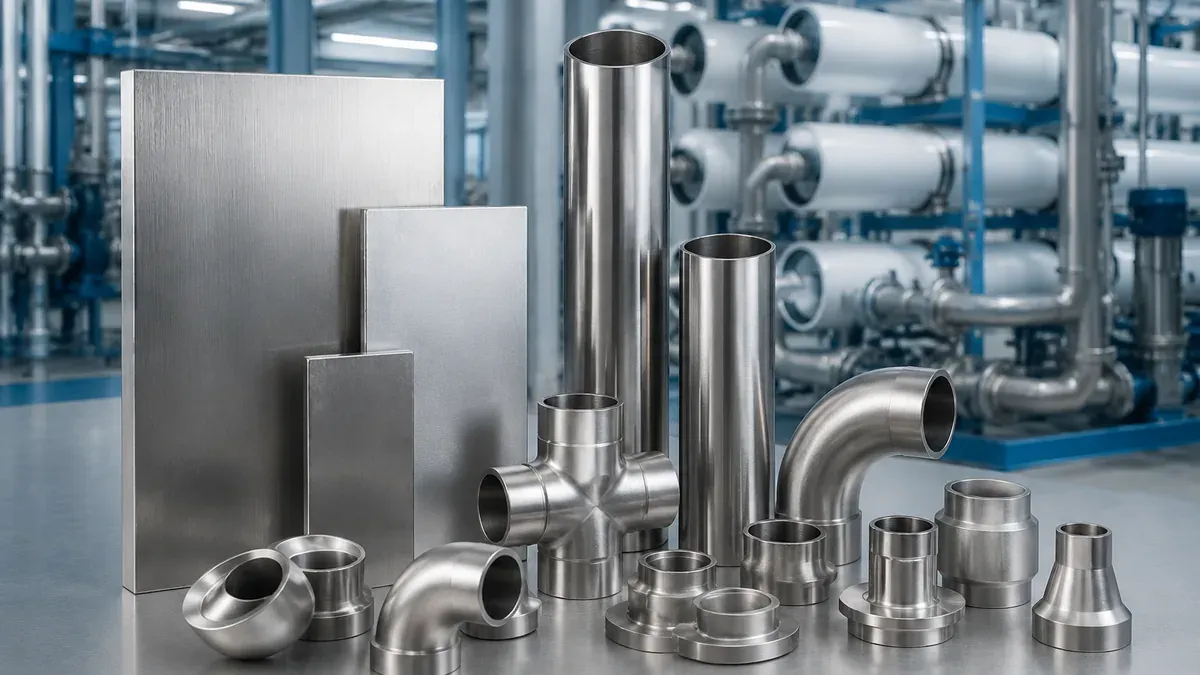
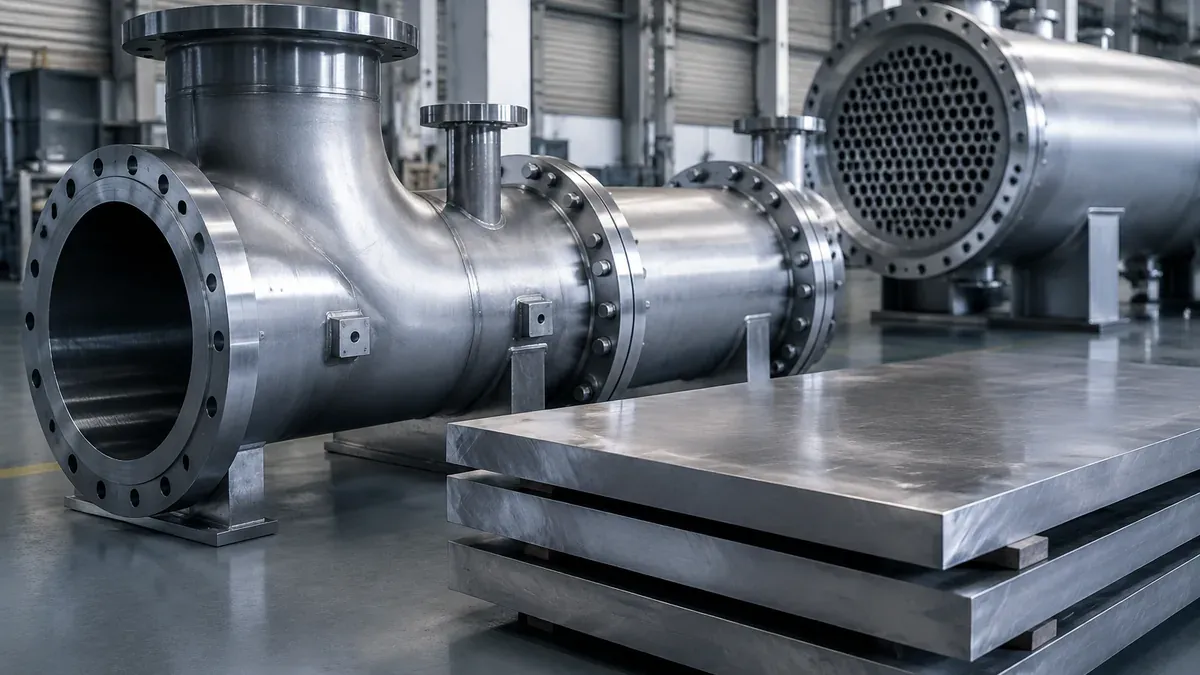
Illustrations identify the compared grade references; they are not photographs of the quoted material or proof of a mill heat.
Decision matrix
Key Differences
Full grade sheets:254 SMO Stainless Steel/2507 Stainless Steel
| Factor | 254 SMO | 2507 | Procurement decision |
|---|---|---|---|
| Microstructure | 254 SMO is a high-molybdenum, nitrogen- and copper-bearing super-austenitic grade with austenitic fabrication behavior. | 2507 is a chromium-molybdenum-nitrogen super-duplex grade whose phase balance depends on thermal and weld history. | Choose a material system that the design and fabrication specification explicitly support. |
| Specified strength | The displayed annealed 254 SMO flat-product summary has lower minimum tensile and yield values with higher elongation than 2507. | The summarized 2507 product context has higher minimum tensile and yield values with lower displayed elongation. | Use the governing form and code calculation; strength does not automatically authorize thinner walls or smaller sections. |
| Corrosion screening | 254 SMO combines high molybdenum, nitrogen and copper in an austenitic system evaluated for selected chloride and acid duties. | 2507 combines a super-duplex alloy balance evaluated for severe seawater, brine and offshore duties. | Compare actual pitting, crevice, general-corrosion and environmental-cracking mechanisms; PREN alone cannot rank every environment. |
| Fabrication and supply | 254 SMO needs high-alloy austenitic forming, machining, consumable and surface-restoration controls and may be favored for complex plate work. | 2507 needs super-duplex solution condition, weld heat-input, interpass, cooling, phase and toughness controls and may favor pressure parts. | Audit the complete shop route and bill of materials before selecting by base-metal price. |
Service and production route
Corrosion and Fabrication Boundaries
254 SMO corrosion screening
- For this 254 SMO vs 2507 review, General corrosion resistance comes from the chromium-rich passive film; nickel, molybdenum, nitrogen and copper change performance by grade.
- For this 254 SMO vs 2507 review, Check chlorides, temperature, crevices, deposits, process chemistry and cleaning conditions. A grade designation alone is not a service-life guarantee.
2507 corrosion screening
- For this 254 SMO vs 2507 review, The mixed austenitic-ferritic structure provides high strength and improved resistance to chloride pitting and stress-corrosion cracking relative to 304/316-type grades.
- For this 254 SMO vs 2507 review, PREN is only a screening index. Temperature, crevices, weld phase balance, heat tint, deposits and actual solution chemistry still govern suitability.
| Operation | 254 SMO | 2507 |
|---|---|---|
| Welding | Generally weldable with a qualified procedure and matching or over-alloyed filler where required; remove heat tint when corrosion service demands it. | Use a qualified duplex procedure with controlled heat input, interpass temperature and filler to maintain phase balance, toughness and corrosion resistance. |
| Forming | Good ductility is typical, but rapid work hardening increases forming load and springback; bend radius and intermediate annealing depend on grade and reduction. | Higher yield strength increases forming load and springback. Severe cold work may require solution annealing under a qualified route. |
| Machining | Use rigid tooling, positive feeds and controlled heat because the material work-hardens; free-machining grades require separate corrosion and welding review. | Use rigid equipment, positive feeds and lower cutting speed than common austenitic grades because high strength and work hardening raise cutting load. |
| Heat treatment | Solution annealing and rapid cooling restore the intended condition where applicable. Austenitic grades are not hardened by conventional quench-and-temper treatment. | Solution anneal and rapid cooling are used to restore the specified duplex structure. Local stress relief can form harmful intermetallic phases and is not a generic remedy. |
Reference data
Composition and Mechanical Requirements
Values below come from each grade's displayed reference dataset. Product form, thickness, condition and contracted standard can change the applicable acceptance table.
Chemical composition (wt%)
| Element | 254 SMO | 2507 |
|---|---|---|
| C | ≤0.020 | ≤0.030 |
| Mn | ≤1.00 | ≤1.20 |
| Si | ≤0.80 | ≤0.80 |
| Cr | 19.5–20.5 | 24.0–26.0 |
| Ni | 17.5–18.5 | 6.0–8.0 |
| Mo | 6.0–6.5 | 3.0–5.0 |
| N | 0.18–0.25 | 0.24–0.32 |
| Cu | 0.50–1.00 | - |
| P | ≤0.030 | ≤0.035 |
| S | ≤0.010 | ≤0.020 |
Mechanical properties
| Property | 254 SMO | 2507 |
|---|---|---|
| Tensile strength | ≥650 MPa (94 ksi) | ≥795 MPa (116 ksi) |
| Yield strength (0.2%) | ≥300 MPa (44 ksi) | ≥550 MPa (80 ksi) |
| Elongation (50 mm) | ≥35% | ≥15% |
| Hardness | ≤223 HBW | ≤310 HBW |
| PREN | - | ≥40 |
Quotation workflow
Application Decisions
- For seawater systems, define salinity, chlorination, temperature, flow, stagnant branches, crevice geometry, deposits, aeration and cleaning before comparing candidates.
- For desalination, separate intake, high-pressure, concentrate, chemical-cleaning and heat-exchanger zones rather than selecting one alloy for the plant label.
- For scrubbers and chemical equipment, include acid species, concentration, contaminants, oxidants, solids, abrasion, condensation and shutdown exposure.
- For pressure equipment, combine corrosion selection with design allowables, weld joint, toughness, NDE, supplementary tests and matching component availability.
Quote 254 SMO when
- Complex formed sheet, plate or vessel work whose approved route requires a high-alloy austenitic material
- Selected scrubber, bleach-plant, desalination or chemical equipment qualified for UNS S31254
- Low-temperature or toughness-sensitive designs supported by the ordered form and project qualification
- Fabrications that can control 6Mo consumables, work hardening, heat tint, passivation and surface acceptance
Quote 2507 when
- High-pressure seawater, desalination or offshore systems with a documented super-duplex corrosion basis
- Pipe, bar, forgings or pressure parts where the design code can use the higher specified 2507 strength
- Projects with qualified super-duplex welding, heat treatment, phase, toughness and corrosion testing
- Equipment bills where matching S32750 forms and components are available in the required dimensions
Hold point
Do Not Substitute Without Review
- Do not substitute S31254 and S32750 without formal review of corrosion mechanism, design code, allowable stress, toughness, fabrication and inspection.
- Do not infer equal seawater resistance or service life because both grades can have a calculated PREN above 40.
- Do not use flat-product properties to approve pipe, tube, bar, fittings or forgings without the applicable current product standard.
- Do not assume the same weld consumable, WPS, heat treatment, PMI target, surface restoration or corrosion test applies to both alloy systems.
Specification boundary
Standards, Temperature and Approval
Product and project approval
ASTM A240/A240M can govern flat products for S31254 and S32750, while specified duplex tube and pipe may use ASTM A789/A790 and other forms require separate standards. The current purchase-order edition, product condition, design code, welding specification, project corrosion basis and authorized material reviewer control acceptance.
Temperature boundary
No universal temperature limit on this page approves 254 SMO or 2507 for seawater, brine or acid service. Temperature interacts with chlorination, salinity, concentration, pH, crevices, deposits, flow and shutdown chemistry; duplex phase stability and low-temperature toughness also depend on product and qualification. The project corrosion and design basis set the range.
Commercial comparison
Cost and Availability Factors
Quote 254 SMO and 2507 on one RFQ with the same product form, dimensions, tests and documents. This page does not represent current stock, price or lead time.
Cost factors
- Current nickel, chromium, molybdenum, nitrogen and copper inputs plus heat and product-form availability.
- Design wall or section, forming and machining yield, consumables, qualified welding and surface restoration.
- Solution condition, phase or ferrite, toughness, corrosion, hardness, PMI, NDE and inspection requirements.
- Matching components, quantity, mill minimum, packing, freight, Incoterm, delivery window and project requalification.
Inputs for a like-for-like quotation
- UNS S31254 or S32750, product form, governing material and dimensional standards, design code and substitution policy.
- Dimensions, pressure or structural basis, corrosion allowance, quantity, condition, finish and end preparation.
- Salinity, chlorides, chlorination, pH, acid chemistry, temperature, flow, stagnation, deposits, crevices and cleaning cycle.
- Weld consumable, WPS/PQR, heat input, interpass, heat treatment, phase balance and surface-restoration requirements.
- MTC, heat traceability, PMI, ferrite or phase, hardness, impact, corrosion test, NDE, inspection, destination and Incoterm.
Continue the specification
Related Grades, Standards and Applications
Grade references
Buyer questions
Frequently Asked Questions
Which has higher strength?
The displayed product summaries list higher minimum tensile and yield values for 2507. Any wall or section change still needs the actual product standard, design allowables, corrosion allowance, stiffness, fatigue, weld efficiency and project approval.
Which is easier to fabricate?
They require different controls. 254 SMO follows a high-alloy austenitic route with strong work hardening and compatible consumables; 2507 requires duplex heat-input, interpass, cooling and phase-balance control. Review the actual drawing and shop qualification.
Can either grade handle seawater?
Both can be candidates, but neither name guarantees acceptance. Temperature, chlorination, salinity, oxidants, flow, stagnation, crevices, deposits, weld condition and cleaning must be evaluated against project corrosion data.
Published by Tsingshan (Shandong) Iron & Steel Co., Ltd..Sources, update policy and technical limitations.
Quote request
Get a Stainless Steel Quote
Send the product, grade and quantity you already have. We will complete the specification and quote the supply route.