
Grade quotation brief
444 vs 316L Stainless Steel
Quote 444 only when the defined water chemistry, component gauge, forming, welding and validation plan support a stabilized ferritic route. Quote 316L when the approved design relies on austenitic ductility, toughness, finish or a broader component supply chain. PREN can screen localized-corrosion candidates, and microstructure can inform stress-corrosion review, but neither provides service approval.
Quote 444 where a qualified hot-water component can use its stabilized ferritic route and lower susceptibility to the common austenitic chloride stress-corrosion mechanism. Quote 316L where the approved design needs austenitic forming, toughness, finish or product-form availability. PREN, molybdenum content, magnetism or a quoted gauge alone cannot approve either material.
Unsure whether 444 or 316L matches the operating temperature and chemistry? Send the service conditions with the RFQ. We quote the approved designation, product form and test plan.
Request a Quote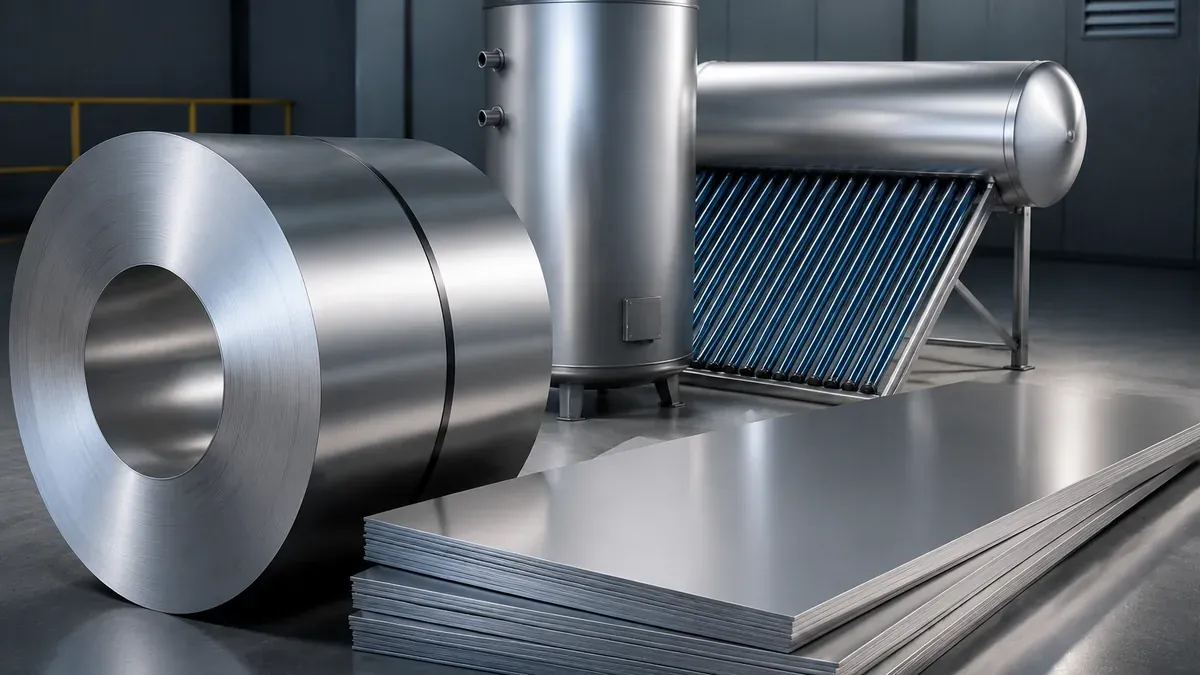
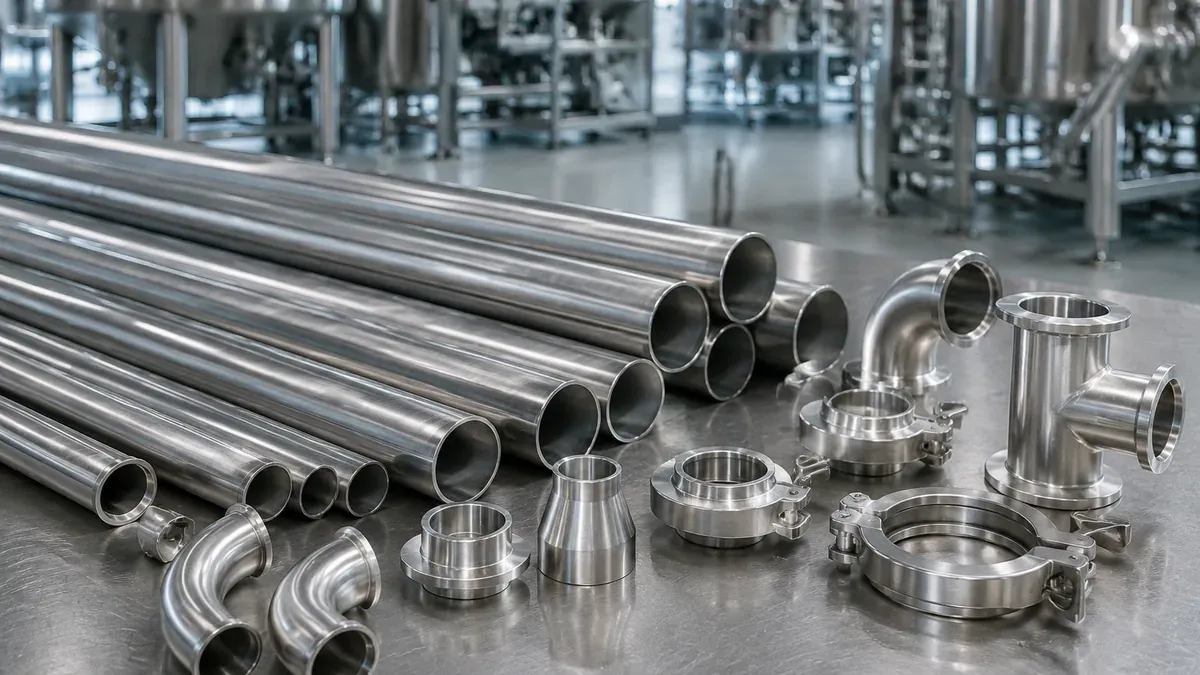
Illustrations identify the compared grade references; they are not photographs of the quoted material or proof of a mill heat.
Decision matrix
Key Differences
Full grade sheets:444 Stainless Steel/316L Stainless Steel
| Factor | 444 | 316L | Procurement decision |
|---|---|---|---|
| Microstructure | 444 is a stabilized ferritic grade with ferritic forming, toughness, welding and magnetic-response behavior. | 316L is a low-carbon austenitic grade with a different forming, toughness and welding route. | Qualify the component process and duty for the selected microstructure rather than comparing chemistry alone. |
| Localized-corrosion screen | 444 contains specified chromium and molybdenum ranges that support consideration in defined water environments. | 316L also contains molybdenum but has a different chromium, nickel and microstructural system. | Use PREN only for screening, then review water chemistry, crevices, deposits, welds and surface condition. |
| Environmental cracking | Ferritic 444 does not share the common austenitic chloride stress-corrosion response, but other damage modes remain possible. | 316L requires review of chloride concentration, temperature, tensile stress, cold work, crevices and shutdown exposure. | Assess the complete stress, fabrication and environment combination instead of publishing a zero-risk claim. |
| Form and fabrication | 444 procurement is commonly centered on qualified sheet or tube gauges with controlled forming and weld practice. | 316L is available through a wider austenitic ecosystem of flat, tubular, bar, fitting and forged products. | Confirm the complete bill of materials, forming severity, weld qualification and impact needs before selection. |
Service and production route
Corrosion and Fabrication Boundaries
444 corrosion screening
- For this 444 vs 316L review, Ferritic grades resist chloride stress-corrosion cracking better than common austenitic grades, while pitting resistance still depends on chromium, molybdenum and exposure.
- For this 444 vs 316L review, Weld condition, section thickness, crevices, deposits and surface contamination can control service performance; validate the actual fabrication and environment.
316L corrosion screening
- For this 444 vs 316L review, Molybdenum-bearing 316L improves localized-corrosion resistance versus the 304/304L chromium-nickel family in many chloride, chemical-cleaning and coastal exposures; lower carbon reduces sensitization risk in suitable as-welded construction but does not raise pitting resistance beyond the 316 alloy family.
- For this 444 vs 316L review, Permanent seawater immersion, hot concentrated brine, tight crevices, deposits and poorly drained wet-dry cycling can still pit 316L — screen duplex 2205 or higher alloys after engineering review rather than relying on a marine-grade label.
- For this 444 vs 316L review, Review chlorides, temperature, pH, deposits, crevices, drainage, cleaning chemistry, weld heat tint and surface finish for the actual as-welded component. A grade designation alone is not a service-life guarantee.
| Operation | 444 | 316L |
|---|---|---|
| Welding | Control heat input, interpass temperature and joint design to limit grain growth and loss of toughness; stabilized grades improve but do not remove these controls. | Generally weldable with a qualified austenitic procedure, matching or over-alloyed filler where required, controlled heat input, purge on tubular joints and heat-tint removal when corrosion service demands it. The ≤0.030% carbon limit reduces sensitization (IGC) risk in the HAZ for as-welded tanks, pipe and structural weldments, but it does not qualify the WPS, filler or surface restoration — and Mo alloying is still not a substitute for duplex or higher alloys in severe chloride envelopes. |
| Forming | Formability is useful in sheet gauges but lower than common austenitic grades, especially in heavy sections and severe draws. | Annealed 316L sheet and strip draw and bend well, but the alloy work-hardens during forming — tooling load, springback, bend direction, draw ratio and any intermediate anneal must be proven on the actual gauge and reduction route. |
| Machining | Machining is generally straightforward with rigid tooling; avoid smearing, overheating and iron contamination of finished surfaces. | Use rigid tooling, positive feeds and controlled cutting heat to avoid a work-hardened surface; qualify the route on the delivered condition. Free-machining sulfur grades require separate corrosion and welding review. |
| Heat treatment | Ferritic grades are not hardened by heat treatment. Annealing can restore ductility, but the temperature and cooling route must follow the product specification. | Solution annealing with rapid cooling restores the intended annealed austenitic condition after suitable cold work or fabrication where applicable. Conventional quench-and-temper treatment does not through-harden austenitic 316L; do not rely on post-weld anneal unless the project actually schedules it. |
Reference data
Composition and Mechanical Requirements
Values below come from each grade's displayed reference dataset. Product form, thickness, condition and contracted standard can change the applicable acceptance table.
Chemical composition (wt%)
| Element | 444 | 316L |
|---|---|---|
| C | ≤0.025 | ≤0.030 |
| Mn | ≤1.00 | ≤2.00 |
| Si | ≤1.00 | ≤0.75 |
| Cr | 17.5–19.5 | 16.0–18.0 |
| Mo | 1.75–2.50 | 2.00–3.00 |
| Ni | ≤1.00 | 10.0–14.0 |
| Ti+Nb | 0.20+4×(C+N)–0.80 | - |
| N | ≤0.035 | ≤0.10 |
| P | ≤0.040 | ≤0.045 |
| S | ≤0.030 | ≤0.030 |
Mechanical properties
| Property | 444 | 316L |
|---|---|---|
| Tensile strength | ≥415 MPa (60 ksi) | ≥485 MPa (70 ksi) |
| Yield strength (0.2%) | ≥275 MPa (40 ksi) | ≥170 MPa (25 ksi) |
| Elongation (50 mm) | ≥20% | ≥40% |
| Hardness | ≤217 HBW | ≤217 HBW |
Quotation workflow
Application Decisions
- For domestic or industrial hot-water tanks, provide make-up water, chloride, disinfectant, pH, hardness, temperature cycle, stagnation and cleaning conditions.
- For solar-thermal systems, include glycol or inhibitor chemistry, oxygen ingress, peak and cycling conditions, joining method and shutdown exposure.
- For heat exchangers, identify both fluids, flow, deposits, crevice geometry, pressure, tube or plate gauge, welds, cleaning and leak-test basis.
- For food or hygienic equipment, add finish, cleanability, product-contact rules and fabrication approval before moving from an established 316L route.
Quote 444 when
- Hot-water tank or heater components qualified around an S44400 ferritic route
- Solar-thermal and exchanger sheet or tube with defined water chemistry and weld validation
- OEM programs that can control gauge, forming, seam welding, surface restoration and leak testing
- Projects whose corrosion review specifically addresses ferritic environmental-cracking behavior
Quote 316L when
- Deep-drawn, complex-formed or polished equipment qualified around an austenitic route
- Pressure, hygienic or process components whose specification and fabrication base name 316L
- Low-temperature or impact-sensitive duty supported by product-form and thickness qualification
- Orders requiring 316L pipe, fittings, forgings or dimensions not approved in 444
Hold point
Do Not Substitute Without Review
- Do not replace 316L with 444, or 444 with 316L, without authorized review of corrosion, design, forming, welding, toughness and product-form requirements.
- Do not infer pitting equivalence or service approval from PREN, molybdenum content or a short-term coupon result.
- Do not publish a universal ferritic stress-corrosion guarantee; verify the actual environment, stress state, welds and alternative damage mechanisms.
- Do not transfer flat-product properties or gauge practices to pipe, fittings, forgings or completed pressure components.
Specification boundary
Standards, Temperature and Approval
Product and project approval
ASTM A240/A240M and EN 10088 can govern specified flat products, while 316L pipe may use ASTM A312 and ferritic tube or completed tanks require other product and fabrication specifications. The current edition, exact designation, form, design code, water-system approval and authorized reviewer control acceptance.
Temperature boundary
This page publishes no universal water-temperature boundary for 444 or 316L. Temperature interacts with chlorides, disinfectants, pH, hardness, dissolved oxygen, stagnation, deposits, crevices, residual stress and cleaning; low-temperature toughness also depends on form, gauge, weld condition and qualification.
Commercial comparison
Cost and Availability Factors
Quote 444 and 316L on one RFQ with the same product form, dimensions, tests and documents. This page does not represent current stock, price or lead time.
Cost factors
- Current alloy inputs and mill availability for the exact grade, form, gauge, width and condition.
- Forming route, tooling, weld speed, consumables, cleaning, leak testing and production yield.
- Corrosion qualification, impact testing, PMI, inspection documents, prototype and customer validation.
- Complete component availability, quantity, packing, freight, Incoterm, delivery window and reapproval scope.
Inputs for a like-for-like quotation
- UNS S44400 or S31603, product form, governing material and dimensional standards, design code and substitution policy.
- Gauge or wall, dimensions, quantity, condition, finish, tolerances, edge or end preparation and fabrication drawing.
- Water or process chemistry, chlorides, disinfectants, pH, temperature cycle, flow, stagnation, deposits and cleaning.
- Forming severity, joining process, filler, WPS/PQR, heat-tint removal, passivation and leak-test requirements.
- MTC, heat traceability, PMI, corrosion or impact tests, inspection, sample approval, destination, Incoterm and schedule.
Continue the specification
Related Grades, Standards and Applications
Grade references
316L Stainless Steel Sheet
316/316L stainless sheet for chloride and chemical service in 2B, BA and brushed finishes. Common inquiry range 0.3–6.0 mm, 1000/1219/1500 mm, cut to size.
View details →
316L Stainless Steel Seamless Pipe
Seamless 316L ASTM A312 pipe, pickled and annealed. Common inquiry range NPS 1/8–24, Sch 5S–XXS, 6 m or cut-to-length, with quoted tests and heat identity.
View details →
Buyer questions
Frequently Asked Questions
Does PREN prove that 444 can replace 316L?
No. PREN is a chemistry-based screening index and does not model crevices, deposits, welds, residual stress, surface condition, water treatment, temperature cycles or product-form toughness. Project corrosion and fabrication approval remain necessary.
Is 444 magnetic?
444 is ferritic and normally shows a magnetic response, while annealed 316L is austenitic but can respond after cold work. Magnetism can support identification screening; it does not establish grade, corrosion performance or acceptance.
Can 444 be used at low temperature?
Ferritic toughness depends on product form, thickness, grain structure, weld condition and temperature. Low-temperature or impact-critical service needs the governing code, required test temperature and qualified material data rather than a general grade comparison.
Published by Tsingshan (Shandong) Iron & Steel Co., Ltd..Sources, update policy and technical limitations.
Quote request
Get a Stainless Steel Quote
Send the product, grade and quantity you already have. We will complete the specification and quote the supply route.