
Stainless Steel PMI Testing Checklist
Use a practical stainless steel PMI testing checklist for XRF and OES grade verification at receiving, fabrication and RFQ - without treating PMI as a substitute for MTC evidence.
Published Sep 8, 2026 · Technical content updated: Sep 8, 2026 ·Tsingshan (Shandong) Iron & Steel Co., Ltd.
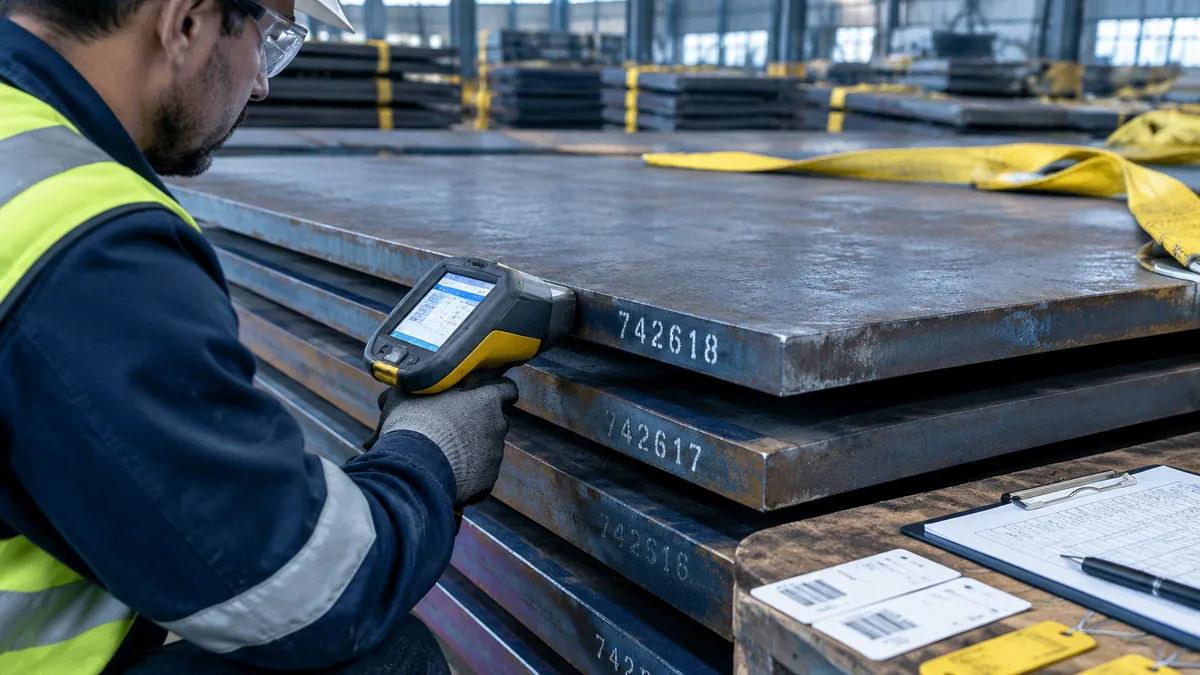
Reference image for this topic; it does not show Tsingshan Steel facilities, inventory or completed orders.
Featured answer
A stainless steel PMI testing checklist verifies that the metal in front of you matches the ordered grade family before it is cut, welded, installed or released for shipment. Use Positive Material Identification (usually handheld XRF, and OES when lighter elements matter) as an on-product screen. Compare readings with the named product-standard chemistry limits, keep results tied to heat or tag identity, and quarantine mismatches. PMI does not replace a heat-linked mill test certificate; put both requirements in the RFQ when grade mix-up risk is material.
| Decision | Put this on the order | Why it matters |
|---|---|---|
| Method | XRF, OES, or XRF plus lab/OES for light elements | Method limits which elements you can rely on |
| Sampling | Heat-by-heat, percentage, or 100% of pieces | Controls cost versus mix-up exposure |
| Acceptance basis | Named grade + standard edition chemistry limits | Avoids arguing against a single MTC line value alone |
| Traceability | Heat/tag ID on every reading | Makes a fail actionable instead of anecdotal |
| Disposition | Hold, expanded sampling, lab confirm, reject | Stops wrong material entering cutting or welding |
This page is a PMI workflow for receiving, fabrication and RFQ wording. For certificate-type selection see EN 10204 3.1 vs 3.2. For reading an inspection document field by field see how to read a mill test certificate.
PMI vs MTC: two controls, one identity chain
Buyers often treat PMI and MTC as interchangeable. They answer different questions.
| Control | What it proves | What it does not prove |
|---|---|---|
| PMI (XRF/OES) | The measured surface chemistry of this piece is consistent with the ordered grade family | Full heat history, mechanical properties, all ordered tests, or every light element if the method cannot measure them |
| MTC / EN 10204 document | Heat- or lot-linked chemistry and the inspections listed in its scope | That the tagged piece in front of you was never mixed after packing or cutting |
| Markings and packing list | Commercial identity for receiving | Alloy chemistry by themselves |
The useful sequence is identity first, then documents, then PMI:
- Match purchase order grade, standard, form and size to tags and packing list.
- Match heat or lot numbers to the MTC package.
- Run PMI on the agreed sample of those same identified pieces.
- Hold any piece whose reading falls outside the agreed grade limits or cannot be tied to identity.
Use the quality-control workflow when you need the broader STS inspection and document route, and the stainless steel grades hub when you are still confirming which grade family belongs on the RFQ.
When PMI is required
PMI is not mandatory on every small general-purpose order. It becomes a proportionate control when the cost of a wrong grade exceeds the cost of testing.
Require or strongly consider PMI when any of the following apply:
- Mixed grades share one container, rack, cutting list or fabrication bay (for example 304 next to 316L).
- The service depends on molybdenum or duplex chemistry (chloride, chemical, marine-adjacent or pressure-retaining duty).
- Material will be cut into many unmarked pieces before welding or assembly.
- The supplier route is new, or previous deliveries showed tag and certificate mismatches.
- The project specification, end-user QA plan or insurer already names PMI coverage.
- Critical spares must match installed alloy family with no room for visual guesswork.
State the trigger in commercial language: “PMI required before shipment release” or “PMI at receiving before cutting” so both parties know who owns the method, sampling and hold authority.
Choose XRF or OES for the job
| Method | Practical strength | Buyer caution |
|---|---|---|
| Handheld XRF | Fast, portable, non-destructive screening of key alloying elements such as Cr, Ni and Mo | Follow radiation and handling rules; prepare bare metal; do not treat it as a full substitute for light-element control |
| Spark OES | Better suited when carbon or other light-element discrimination is part of grade acceptance | Leaves a burn mark; needs suitable surface access and controlled setup |
| Lab chemical analysis | Reference route for disputed or borderline results | Slower; use after quarantine, not as the only receiving gate when speed matters |
Do not publish or accept unsupported claims about universal instrument accuracy. Acceptance should name the grade standard and edition, the elements that decide the grade family for your order, the method, and what happens if a reading is inconclusive.
Receiving and fabrication PMI checklist
Use this checklist at goods receipt, before cutting, and again when unmarked remnants re-enter stock.
Before the first reading
- Confirm the purchase order grade, product standard and edition, form, size and any dual-grade wording.
- Collect MTCs, packing list and tag photos for the same delivery.
- Verify heat or lot numbers on tags against documents before opening mixed bundles.
- Confirm instrument identity, operator competence and the daily performance check with a reference sample.
- Define the sampling plan in writing: which heats, how many pieces, how many spots per piece.
- Prepare a clean bare-metal test area; avoid coated, painted, heavily scaled or contaminated surfaces.
- Keep radiation and handling safety rules in force for handheld XRF — do not hold the sample in hand during measurement.
During measurement
| Check | Pass condition | Fail or hold trigger |
|---|---|---|
| Spot selection | Flat, representative base metal away from edges, weld overlays and labels | Reading taken on coating, stamp ink, weld metal or a tilted edge only |
| Elements reviewed | Cr, Ni, Mo and other agreed markers fall inside the named grade limits | Key marker outside limit or inconsistent with claimed family |
| Repeatability | Agreed number of spots recorded for the piece or heat | Single unexplained outlier used as acceptance without recheck |
| Identity link | Every reading references heat/tag/item ID | Result stored only as “304 OK” with no piece identity |
| Photo evidence | Tag, location and instrument screen or report ID captured when required | Photos without heat identity or date |
After measurement
- Compare averaged or agreed readings with the standard grade limits, not only with one MTC printed value.
- Release only pieces that pass method, identity and sampling rules.
- Quarantine fails immediately with HOLD marking; do not return them to the cutting queue.
- Expand sampling when one fail appears in a mixed heat or mixed-grade package.
- Use OES or laboratory analysis for borderline light-element disputes when the contract allows.
- File the PMI report with the receiving record and keep the same identity chain through fabrication.
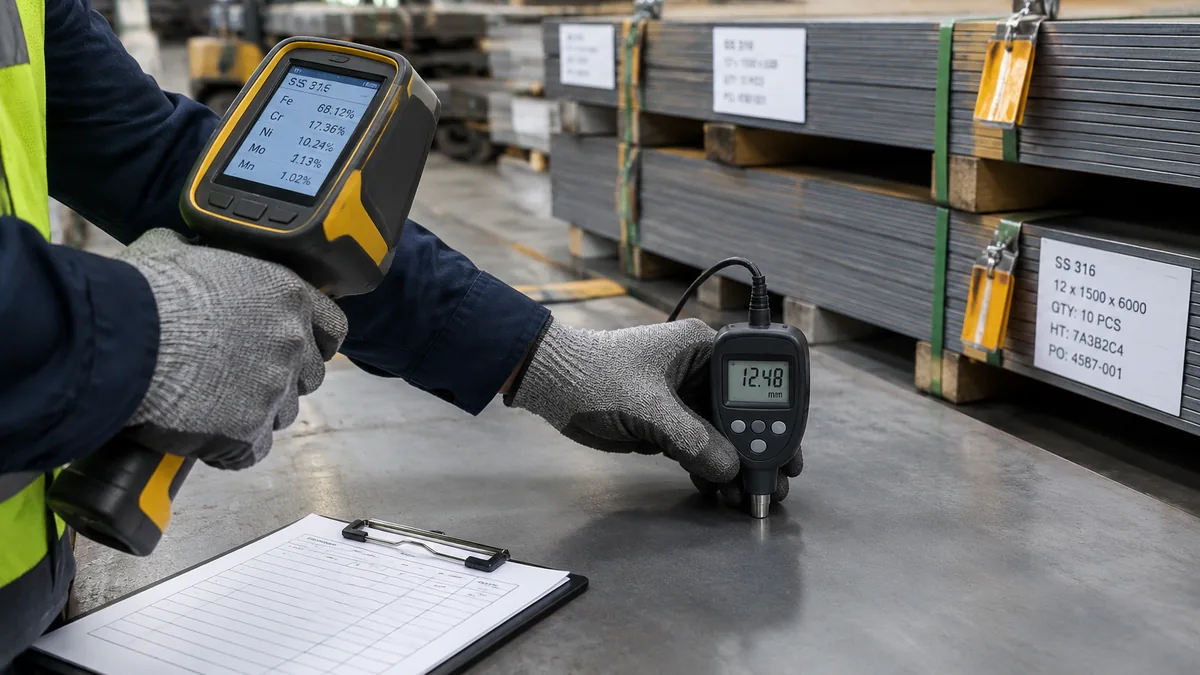
Red flags that justify a shipment or cutting hold
Treat these as stop-work triggers, not as automatic accusations of fraud:
- Tag grade and MTC grade disagree, or heat numbers cannot be reconciled.
- Visual stock is mixed and unmarked cut lengths have already entered production.
- XRF shows molybdenum where none is expected for the ordered family, or missing molybdenum where 316/316L is claimed.
- Only one rushed reading was taken on a critical heat with no daily instrument check recorded.
- The supplier offers “typical chemistry” language instead of heat-linked evidence plus agreed PMI scope.
- Packing marks were overwritten, restickered or separated from the pieces after sampling.
A hold preserves evidence. Release the hold only after identity is restored and the agreed confirmation method is complete.
Practical Inspection Notes From Export Handover
Export and fabrication handovers fail in repeatable ways. Pieces are PMI-checked after labels are removed. A good XRF screen on one pipe end is treated as proof for an entire mixed bundle. Burn marks from OES are mistaken for defects instead of planned verification marks. Buyers argue about a 0.1% difference against an MTC line while both values still sit inside the grade table. Packing lists show one heat while straps and tags show another after container stuffing.
The practical countermeasure is boring and effective: identify first, sample second, record third, cut last. Keep PMI results in the same folder as the packing list and MTC. If material must move, move the HOLD tag with it.
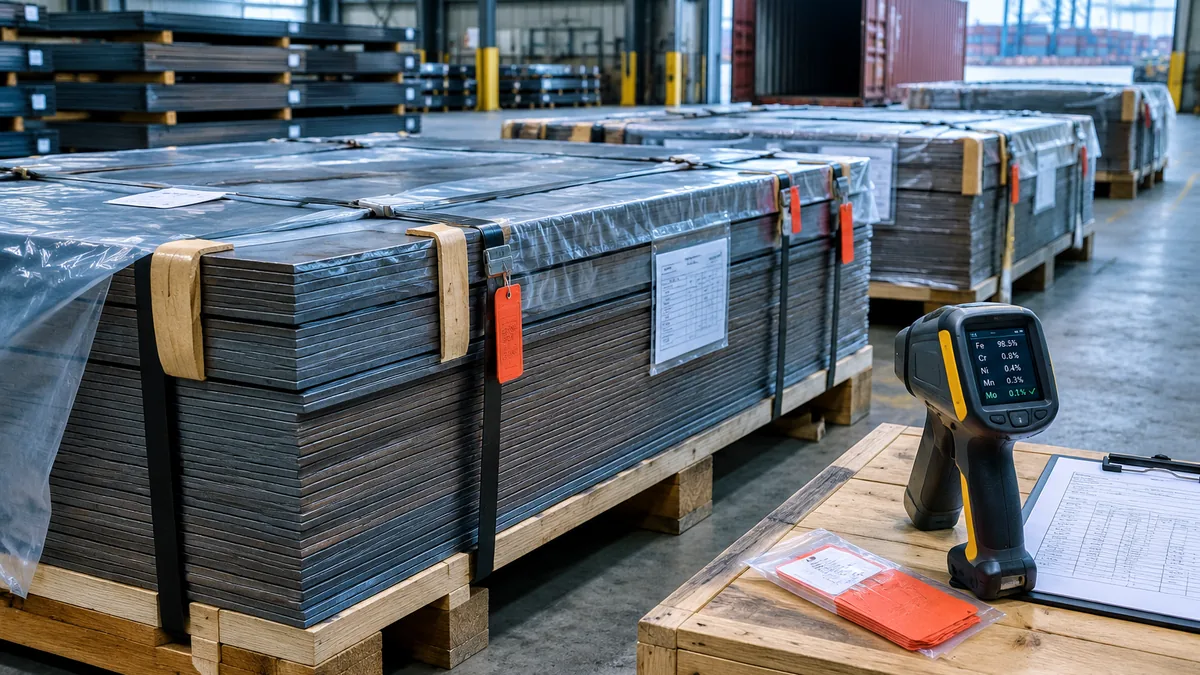
Put PMI into the RFQ
Copy and adapt this block:
Product: [sheet/coil/plate/pipe/tube/bar/fitting], grade [e.g. 304 / 316L / 2205],
standard and edition [e.g. ASTM A240 / A312], dimensions and finish as quoted.

Documents: heat-linked EN 10204 [3.1/3.2 or project document], packing list and
tag photos before shipment release.

PMI: required — method [XRF / OES / XRF+lab confirm], sampling [heat-by-heat /
__% / 100%], elements reviewed [Cr, Ni, Mo, others as applicable], acceptance
against named grade chemistry limits, report to include instrument ID, daily check
status, heat/tag identity, readings, disposition.

Hold rule: any mismatch or missing identity stops cutting and shipment until
written disposition.
Send the completed specification through the stainless steel inquiry form or email sales@tsingshansts.com. For urgent commercial follow-up use phone/WhatsApp +86 176 8661 3207. Tsingshan (Shandong) Iron & Steel Co., Ltd. can align grade, document route and PMI sampling language before production so receiving inspection is not improvising at the dock.
Sources and application limits
This guide supports purchasing decisions. The ordered product standard, project specification and approved inspection plan control the final decision.
- Handheld XRF and spark OES Positive Material Identification practice for alloy grade screening
- ASTM/ASME stainless grade chemistry limits as the acceptance reference for alloying elements such as Cr, Ni and Mo
- EN 10204 inspection documents and heat-linked mill test certificates as separate evidence from on-product PMI
Technical content updated: Sep 8, 2026
Frequently Asked Questions
Does PMI replace a mill test certificate for stainless steel?
No. PMI is an on-product grade screen. An MTC or EN 10204 inspection document remains the heat-linked chemistry and test record. Use both when the order requires grade verification plus traceable mill evidence.
When should buyers require PMI on stainless steel?
Require PMI when mix-up risk or consequence is high — mixed grades in one shipment, 316/316L or duplex substitutions, pressure or chloride service, critical spares, or a new supply route. State method, sampling rate and acceptance basis on the RFQ.
Is handheld XRF enough to verify every stainless steel grade?
Handheld XRF is widely used to screen key alloying elements such as Cr, Ni and Mo. It may not fully resolve light elements such as carbon or nitrogen. Where those elements decide acceptance, specify OES or laboratory analysis in addition to XRF.
What should a PMI report include for receiving acceptance?
Record instrument identity and daily check status, operator, date, item and heat or tag identity, surface preparation, reading locations, elemental results compared with the named grade standard, disposition and any hold or NCR reference.
Send the product form, grade and quantity from this guide. We quote the matching stainless route.
Ready to quote your stainless specification?
Send product, grade and quantity. We quote the confirmed supply route.