
Stainless Steel Pipe Fittings RFQ Checklist: Elbows to Caps
RFQ stainless pipe fittings with grade, ASME/EN standard, schedule/OD, end type, finish, MTC and packing frozen for Gulf and Southeast Asian buyers.
Published Sep 29, 2026 · Technical content updated: Sep 29, 2026 ·Tsingshan (Shandong) Iron & Steel Co., Ltd.
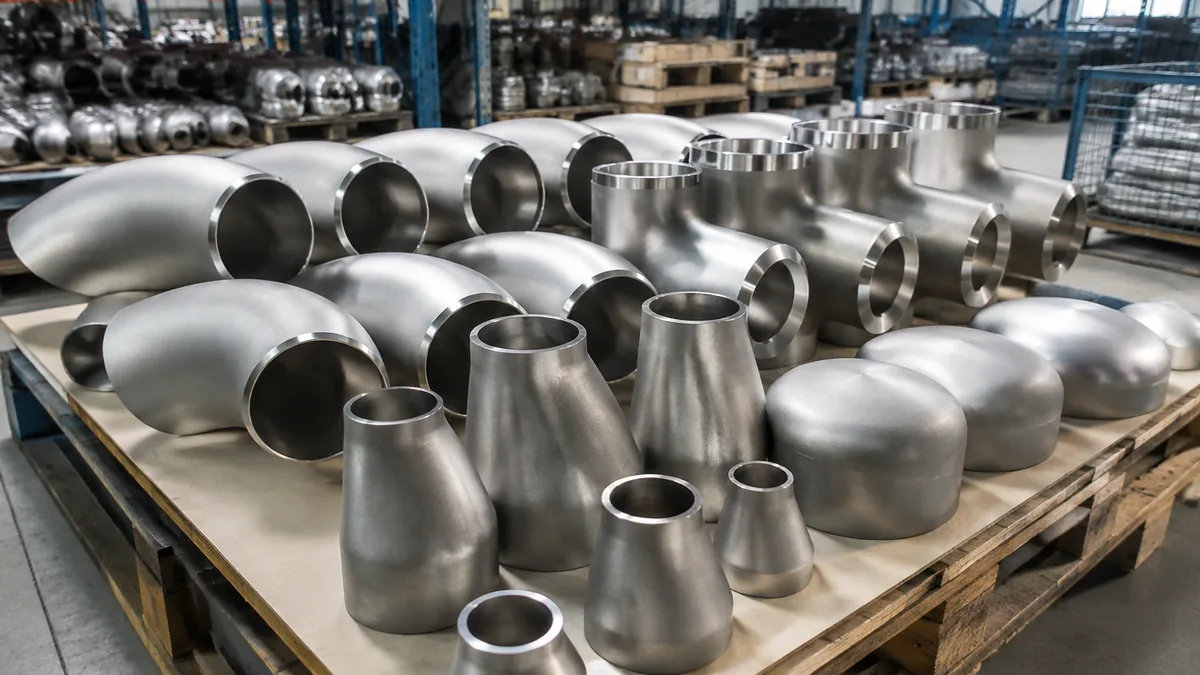
Reference image for this topic; it does not show Tsingshan Steel facilities, inventory or completed orders.
Featured answer
Stainless steel pipe fittings RFQs fail when the line says SS fittings without type, grade, dimensional standard, schedule/OD and end prep. Freeze elbow / tee / reducer / cap (and connection system), 304 / 304L / 316L, material + dimensional standards with editions, NPS + schedule (or OD + wall) at every end, end type, finish, EN 10204 type and destination packing so MENA and Southeast Asia quotes stay comparable. Match the fittings class to the connected pipe — do not invent a second wall language on the reducer small end. Available forms are listed in the stainless steel product range (open the stainless steel pipe fittings category from there). Pipe-side 304L vs 316L duty gates are covered on the 304L vs 316L process piping RFQ.
| Screening step | What you freeze | Typical next action |
|---|---|---|
| Type + connection | Elbow/tee/reducer/cap; BW / SW / threaded / sanitary | No brochure nickname |
| Grade gate | 304 / 304L / 316L (dual-cert rules) | Match piping class |
| Standards | Material + dimensional + editions | ASME vs EN named |
| Size language | NPS/Sch or OD/wall at every end | Comparable geometry |
| Ends + finish | Bevel/plain/thread/face; pickle/polish | Same line as type |
| Documents + packing | EN 10204, heat marks, end caps | Export-ready award |
Name the fitting type and connection system before grade
Fittings RFQs fail when one line says SS304 elbows across butt-weld process spools, socket-weld utilities, threaded instrument takes and sanitary clamp packages. A grade nickname is not a connection certificate.
Capture at least:
- Fitting family — elbow (angle/radius), tee (equal/reducing), reducer (concentric/eccentric), cap, stub end, coupling or other named type
- Connection system — butt-weld, socket-weld, threaded, or sanitary clamp/ferrule
- Matching pipe/tube class — which piping class or isometric the item must fit
- Quantity by item — not one ton of mixed fittings
- Drawing / BOM revision when geometry is non-standard
- Duty note — utility, mild process, coastal, hygienic (sanitary packages need surface language)
If the package is flanges, use the stainless flanges RFQ guide. If the problem is only pipe grade (304L vs 316L) with no fittings list, use the process-piping RFQ guide. Seamless-versus-welded pipe route belongs on the seamless vs welded stainless pipe guide.
Freeze grade: 304 / 304L / 316L for fittings RFQs
Use grade as a commercial screen that matches the connected piping class — not a plant-wide nickname.
1. Match the pipe class first
If the isometric already freezes 304L pipe, do not silently quote 316L fittings (or the reverse) without a revision.
2. Prefer L-grades for as-welded butt-weld packages
When assemblies stay as-welded and carbon control matters, 304L / 316L are the usual commercial screen. Weld-carbon depth belongs on the site 304 vs 304L welding buyer guide.
3. Keep 304 / 304L for owner-accepted mild envelopes
Indoor utilities and mild process tags the owner already accepts can stay on 304/304L fittings when the class document says so.
4. Escalate to 316L when chlorides or coastal duty compress the envelope
Brine-adjacent, coastal yard headers, wash-down and chloride-bearing process tags usually move the fittings line with the pipe class toward 316L under owner review.
5. Ban silent dual-cert surprises
If dual certification is allowed, write the rule on the RFQ. If not, ban silent 304/316L swaps on mixed crates.
Standard, schedule/OD and end type that make bids comparable
Grade alone does not freeze a fitting.
| Field | What to write | Why it matters |
|---|---|---|
| Material standard | ASTM A403 (or named equivalent) + edition + WP grade | Chemistry / HT / product acceptance |
| Dimensional standard | ASME B16.9, MSS SP-43, or named EN/ISO system + edition | Geometry basis — no silent swap |
| Size language | NPS + schedule or OD + wall at every end | Prevents reducer small-end guesses |
| Elbow geometry | Angle (45/90/180) and LR/SR (or named radius) | Fit-up and BOM match |
| Tee / branch | Equal vs reducing; branch NPS/Sch | Stops incomplete branch quotes |
| Reducer | Concentric vs eccentric; large and small end sizes/walls | Face-to-face and orientation |
| Cap / stub end | Type and matching pipe size/wall | Closure / lap-joint basis |
| End type | Bevel (BW), plain, threaded, socket, sanitary face | Fabrication fit-up |
| Manufacturing route | SMLS / welded fitting route if project restricts | Stops silent route swaps |
Pipe-versus-tube vocabulary and OD-only tube language belong on the pipe vs tube buyer guide. Schedule charts are a tooling aid — the RFQ still needs one size language per line.
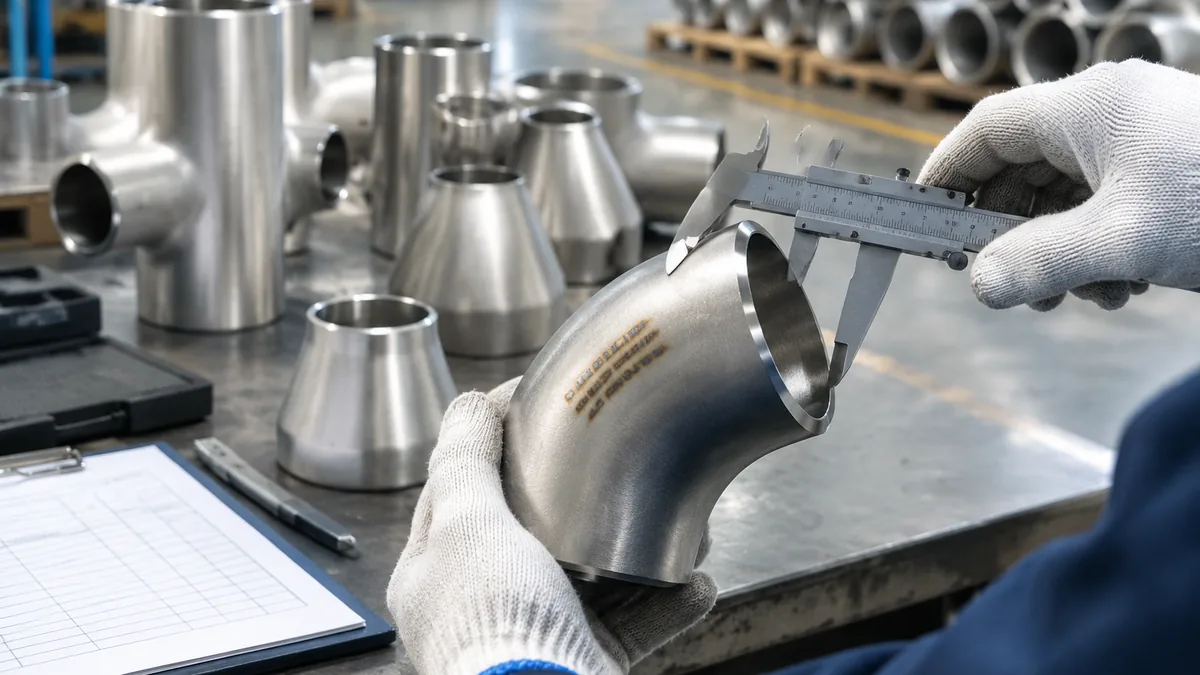
Finish, examination and drawing notes buyers skip
Export fittings packages often fail after award on surface and NDE — not on the grade nickname.
- Finish — pickled/passivated as default commercial screen; name OD/ID polish or electropolish only when the duty needs it (sanitary packages need surface language on the same line).
- Examination — state whether visual only, or project NDE/PMI hold points apply; certificates do not invent un-ordered tests.
- Heat treatment / repair-weld rules — only when the piping class restricts them.
- Non-standard geometry — attach the drawing revision; do not ask the mill to invent center-to-end from a photo.
- Marking — heat/lot identity that must survive packing and match the MTC.
RFQ field checklist for stainless pipe fittings
Copy these fields into the clarification sheet before price comparison:
- Fitting type + connection — elbow/tee/reducer/cap; BW / SW / threaded / sanitary
- Grade — 304 / 304L / 316L (and dual-cert rules)
- Material standard + edition — e.g. ASTM A403 WP316L
- Dimensional standard + edition — e.g. ASME B16.9 (or named EN system)
- Size at every end — NPS + schedule or OD + wall
- Geometry — elbow angle/radius; tee branch; reducer concentric/eccentric
- End type — bevel / plain / thread / socket / sanitary face
- Finish + examination — pickle/passivate or polish class; PMI/NDE if required
- Quantity by item and delivery lot split by grade/type
- Documents — EN 10204 type, heat identity, marking
- Packing / destination — MENA or SEA marks, end/face protectors, wrap, desiccant
- No silent substitution across grade, standard, schedule or connection system
Keep flanges, sanitary tubing depth and pipe-only grade gates on their dedicated posts when the BOM already leaves fittings.
MTC, marking and packing that protect ends and lots
Plant packages often mix elbows, tees and reducers across 304L and 316L crates on the same vessel. Document type alone does not prevent swaps or damaged bevels.
- Name EN 10204 type on the PO (Type 3.1 common; Type 3.2 only when required).
- Require heat/lot identity on tags that match crate and item marks.
- Ban silent grade or schedule substitution on mixed fittings packages.
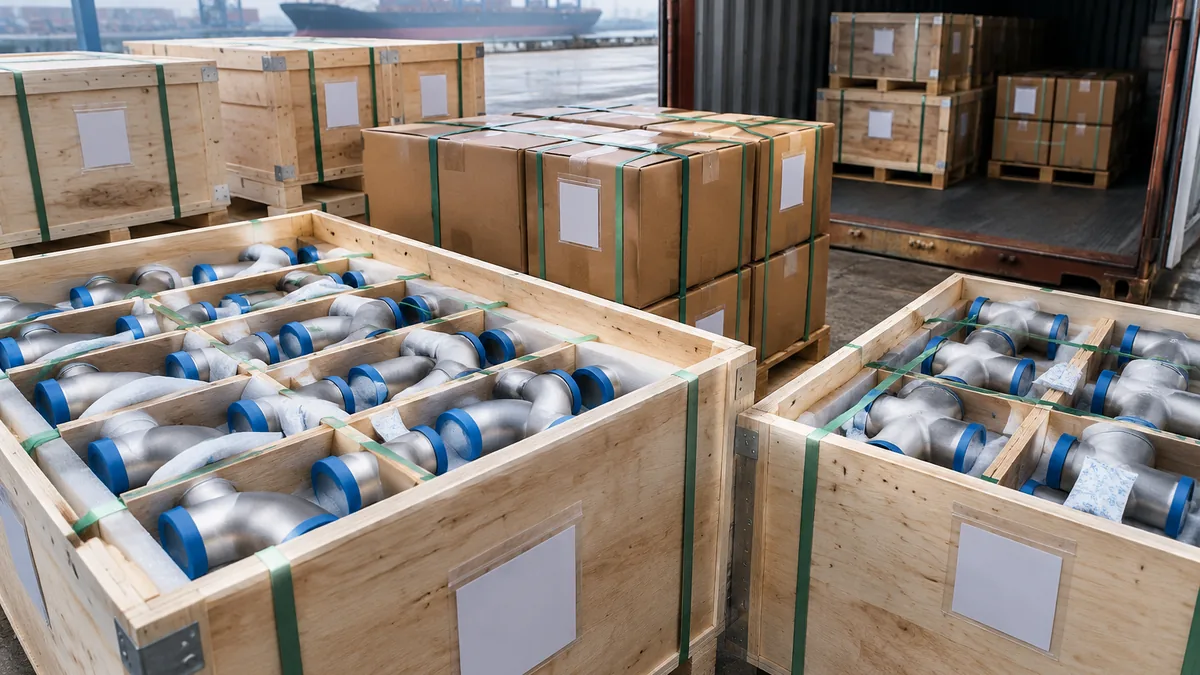
- For Gulf and Southeast Asian humidity, freeze bevel/thread/face protectors, wrap and desiccant expectations at RFQ — not after freight booking.
- Keep destination marks readable after wrap; unclear marks create receiving disputes on type-split lots.
- Sanitary faces and thin-wall ends need individual protection — open crates on humid routes contaminate clean fittings.
For grade chemistry, see the stainless steel grades index.
Practical notes from fittings RFQs
Patterns that burn weeks on Gulf plant and SEA EPC packages:
- One line SS fittings assorted with no type, NPS or schedule split
- Reducer quoted with large-end Sch 40 and a blank small end
- ASME B16.9 and MSS SP-43 mixed after award as if identical
- Butt-weld and threaded items buried on one price line
- 304L fittings awarded against a 316L pipe class because stock was cheaper
- Bevel protectors left until the forwarder asks; damaged ends reject at fit-up
- Mixed-grade containers without heat marks matching the MTC
- Sanitary clamp parts ordered with process BW bevel language
If the team only needs the pipe-side 304L vs 316L duty gate, use that process-piping RFQ guide. If the problem is flanges, use the flanges RFQ guide.
Freeze the RFQ line before material award
Award stainless fittings only after the line can be read without guesses:
Fitting [elbow 90 LR / equal tee / concentric reducer / cap / …], connection [BW/SW/threaded/sanitary], grade [304 / 304L / 316L] per ASTM A403 [edition] (or named equivalent), dimensions per ASME B16.9 [edition] (or named EN system). Size [NPS + Sch — every end / OD × wall …]. Ends [bevel/plain/…]; finish [pickle/passivate / polish class]. EN 10204 Type 3.1; heat identity on marks; packing and end protectors for [destination port]. No silent substitution of grade, standard, schedule or connection system.
Send that freeze with quantities by item to contact. We quote against named fittings fields for Middle East and Southeast Asia packages — not against an undefined SS fittings nickname.
Sources and application limits
This guide supports purchasing decisions. The ordered product standard, project specification and approved inspection plan control the final decision.
- ASTM A403/A403M wrought austenitic stainless steel piping fitting naming practice with edition on the purchase order
- ASME B16.9 factory-made wrought butt-welding fittings dimensional practice commonly paired with NPS and schedule ordering
- Common MENA and Southeast Asia procurement pattern that incomplete end size, schedule and bevel notes produce non-comparable fittings bids
- Industry materials practice that butt-weld, socket-weld, threaded and sanitary connection systems must not share one silent price line
Technical content updated: Sep 29, 2026
Frequently Asked Questions
Which fields freeze a stainless steel pipe fittings RFQ for Gulf and Southeast Asian buyers?
Freeze fitting type (elbow/tee/reducer/cap and connection system), grade (304/304L/316L and dual-cert rules), material and dimensional standards with editions, NPS and schedule or OD/wall at every end, end preparation, finish, quantity by item, EN 10204 type, heat identity, and destination packing/marks. Missing small-end schedule on a reducer or a mixed connection line is the usual reason bids cannot be compared.
Should 304, 304L and 316L fittings share one price line?
No. Keep grade splits by duty and piping class. 304/304L can fit mild utility and owner-accepted mild process tags; escalate to 316L when chlorides, coastal exposure or the owner basis compress that envelope. Use the 304L vs 316L process-piping RFQ guide for the pipe-side grade gate; this page freezes the fittings line that must match that class.
What is the difference between the material standard and the dimensional standard?
The material product standard (for example ASTM A403 WP304L/WP316L) governs chemistry, heat treatment and product acceptance. The dimensional standard (for example ASME B16.9 or the named EN/ISO system) governs geometry, center-to-end and end preparation. Write both with editions. Do not treat MSS SP-43 and ASME B16.9 as silent swaps.
How should reducers and branch fittings be ordered?
Name every connected end size and schedule or wall, concentric vs eccentric orientation, branch geometry for tees, and face-to-face or center-to-end basis. One blank small-end wall turns the RFQ into a guess.
Send the product form, grade and quantity from this guide. We quote the matching stainless route.
Ready to quote your stainless specification?
Send product, grade and quantity. We quote the confirmed supply route.