
Application specification brief
Stainless Steel for Food Processing Equipment
Begin with the food, cleaning chemistry, contact time, temperature, drainage, and hygienic acceptance criteria rather than a generic food-grade label. Separate product-contact parts from guards and frames, then define the grade, product standard (including A270 sanitary tube vs A269 general-service tube), weld condition, measurable surface requirement, traceability, packing and destination for MENA or SEA delivery, and cleaning records for each group. Final acceptance belongs to the equipment designer and the buyer's hygiene program.
Send the service, product form and inspection plan. We quote the matching stainless product forms; the project authority keeps final service approval.
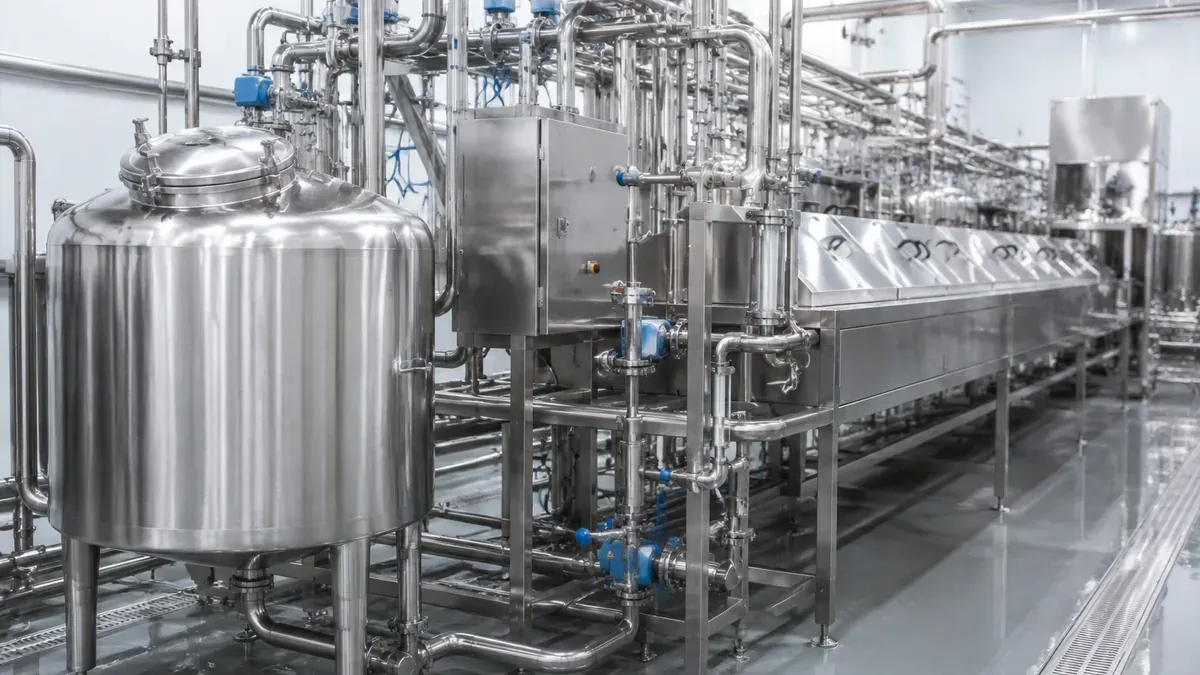
Four-state review
Service Boundary
Review the complete operating cycle, not only nominal process conditions.
Normal operation
Record every food or beverage in contact with the metal, including salt, organic acids, preservatives, solids, residence time, process temperature, aeration, and whether deposits can remain on horizontal or shielded surfaces.
Cleaning and maintenance
Identify each rinse, detergent, disinfectant, and clean-in-place step with concentration, temperature, duration, frequency, water quality, and final-rinse practice. Cleaning duty can govern selection even when the food itself is mild.
Shutdown and standby
Describe whether equipment is drained, rinsed, dried, left wet, or held with residual product. Gaskets, dead legs, spray shadows, and retained deposits can create a more severe local condition than normal production.
Upset and abnormal cases
Provide credible over-concentration, dosing error, temperature excursion, extended hold, and loss-of-rinse cases. These conditions require project review and cannot be converted into a grade approval from this page alone.
Inputs before the RFQ
Operating Environment
| Variable | What to review | Procurement impact |
|---|---|---|
| Product chemistry | List chloride or salt, pH, organic acids, preservatives, solids, and product changes by recipe. | Defines whether general 304 screening is enough or whether 316L and a wider corrosion margin require evaluation. |
| Cleaning regime | State chemical identity, concentration, temperature, exposure time, frequency, and final rinse quality. | Controls grade screening, weld treatment, surface acceptance, and the records requested from the fabricator. |
| Hygienic geometry | Mark product-contact zones, drain direction, gaskets, crevices, dead legs, and areas inaccessible to cleaning. | Drives tube and fitting route, weld access, fabrication details, and inspection hold points. |
| Surface condition | Specify an approved finish or measurable roughness where required, including internal tube and weld acceptance. | Prevents a finish name such as 2B or No.4 from being treated as a complete hygienic specification. |
| Thermal cycle | Give production, cleaning, sterilization, cooling, and transient temperatures together with duration. | Allows environment and fabrication effects to be reviewed without publishing a universal temperature limit. |
Design and fabrication risks
Failure Modes and Controls
| Failure mode | Drivers to review | Specification control |
|---|---|---|
| Pitting beneath deposits | Salt or chloride retained under product residue, insulation, labels, or shielded equipment details. | Review worst-case chemistry, improve drainage and cleaning access, and increase alloy margin where the approved design requires it. |
| Crevice corrosion | Tight gasket interfaces, lap joints, threaded details, dead legs, and stagnant liquid during production or shutdown. | Remove avoidable crevices, specify hygienic joints and gasket interfaces, and include shutdown condition in material review. |
| Free-iron staining or rouging | Carbon-steel tooling contamination, heat tint, incomplete cleaning, or unsuitable water and operating conditions. | Segregate stainless fabrication, define weld discoloration removal and passivation procedure, and inspect before release. |
| Product retention | Rough welds, discontinuities, scratches, poor drainability, or finish variation outside the approved acceptance basis. | Use measurable surface and weld criteria, visual access, drainability review, and documented final cleaning. |
Screening ladder
Material Selection
Grades are screening routes, not unconditional substitutes. Product standards, fabricated condition, and project approval still govern.
| Grade reference | Where to screen it | Approval boundary |
|---|---|---|
| 304 Stainless Steel | Quote for general product-contact equipment handling mild foods with controlled cleaning and drainage. | Do not approve from the food-grade name alone; chloride, acid, heat, deposits, welds, and cleaning chemistry still require review. |
| 316L Stainless Steel | Quote for brines, acidic products, aggressive cleaning, welded vessels, and duties needing additional localized-corrosion margin. | Molybdenum and low carbon do not remove crevice, heat-tint, surface, or hygienic-design requirements. |
| 430 Stainless Steel | Quote for dry non-contact cladding, panels, and trim where corrosion conditions and forming route permit. | Keep it outside the product-contact selection unless the equipment owner has explicitly approved that service and construction. |
| 444 Stainless Steel | Quote for selected hot-water or chloride-bearing components when ferritic behavior and fabrication route suit the design. | Product form, joining procedure, code acceptance, and the actual environment must be confirmed before substitution. |
Supply route
Product Forms and Ordering Basis
| Form | Typical scope | Order basis |
|---|---|---|
| Sheet and plate | Tanks, hoppers, tables, conveyor components, covers, and fabricated product-contact surfaces. | State grade, product standard, thickness, flatness, finish, roughness if applicable, film, dimensions, and inspection documents. |
| Tube and pipe | Product transfer, utility runs, spray devices, frames, and fabricated manifolds. | Define tube or pipe route (A270 sanitary vs A269/A312), OD or NPS, wall, weld condition, internal finish or Ra, end preparation, dimensional acceptance, PMI and test scope. |
| Fittings | Hygienic changes of direction, branches, reducers, and detachable connections. | Name the dimensional and hygienic system, end type, material, surface, marking, traceability, and required inspection. |
| Profiles and bar | Frames, supports, shafts, guards, and non-contact structural elements. | Separate contact classification, grade, section or drawing, tolerance, surface condition, fabrication allowance, and finish repair. |
Delivered condition
Fabrication, Welding, Surface, and Cleaning
Material segregation
Prevent carbon-steel contact and identify the cleaning method for tools, work areas, handling equipment, and finished surfaces.
Welding
Specify process qualification, joint geometry, filler where applicable, internal purge criteria, weld profile, heat-tint acceptance, and repair records.
Surface finish
State incoming finish plus maximum roughness or approved sample when needed; define whether the requirement applies to base metal, welds, or both.
Post-fabrication treatment
Define cleaning, pickling, passivation, electropolishing, final rinse, protection, and acceptance responsibility in the purchase documents.
Protection and packing
Use compatible film and separators, prevent grit entrapment, close hygienic ends, and preserve identification through shipment.
Release evidence
Inspection and Documents
| Stage | Required evidence |
|---|---|
| Material receipt | Verify ordered grade, product standard, heat identification, dimensions, finish, and material certificate scope before fabrication. |
| Fabrication | Apply the buyer-approved weld, purge, visual, dimensional, and contamination-control checks at stated hold points. |
| Surface acceptance | Record roughness readings or sample comparison where specified, plus weld finishing, heat-tint removal, and treatment status. |
| Final release | Compile traceability, dimensional report, requested NDT, cleaning or passivation records, packing list, and document index. |
Continue the specification
Related Standards and Grade Decisions
Product and dimensional standards
Related grade comparisons
Buyer questions
Frequently Asked Questions
Should food equipment use 304 or 316L?
Use 304 for most neutral foods and routine cleaning. Choose 316L when chloride, salt, acidic products, elevated temperature or aggressive cleaning reduces the corrosion margin. Keep alloy choice on the grade pages; keep hygienic tube roughness on the A270 vs A269 buyer guide.
Is a 2B finish always hygienic enough?
Not automatically. Hygiene depends on measured roughness, fabrication, weld finishing and cleanability. State a maximum Ra when the process requires it, and separate sheet finish from sanitary tube ID acceptance.
Why use low-carbon grades for welded tanks?
304L and 316L reduce sensitization risk in welded zones and are widely available as dual-certified material. Dual cert is valid only when the heat and MTC meet both chemistry and strength rules.
When should food lines specify ASTM A270 instead of A269 tubing?
Use A270 when the project requires sanitary/hygienic tubing with special surface finishes, cleaning and documentation beyond general-service A269. Freeze OD, wall, ID finish or Ra, end connection and protection on the RFQ - see the site ASTM A270 vs A269 guide and contact page for quotation.
Published by Tsingshan (Shandong) Iron & Steel Co., Ltd..Sources, update policy and technical limitations.
Quotation package
What to Include in the RFQ
- Equipment item and product-contact classification for each component
- Food chemistry, salt or chloride, pH, solids, temperature, and residence time
- Cleaning and disinfection chemicals with concentration, duration, frequency, and rinse water
- Grade, product form, governing product standard, dimensions, tolerance, and quantity
- Incoming surface, maximum roughness or approved sample, grain direction, and protective film
- Weld, purge, finish, passivation, electropolish, and cleaning acceptance requirements
- Material certificate, traceability, inspection, NDT, and document-index requirements
- Packing method, MENA or SEA destination port, delivery terms, project approvals, and required schedule
Quote request
Get a Stainless Steel Quote
Send the product, grade and quantity you already have. We will complete the specification and quote the supply route.