
Surface procurement brief
No.4 Brushed Stainless Steel Finish
Choose No.4 when a visible component needs a directional satin grain rather than an as-rolled mill surface. The trade name does not identify one universal abrasive, roughness, gloss, color, or scratch limit. A repeatable order ties the finish to an incoming 2B or other approved surface, production abrasive sequence, grain direction, critical face, reference sample, viewing method, forming and weld plan, protective film, batch grouping, and finished-part inspection.
- Use this guide for
- Directional satin finish selection and sample approval
- Relevant to
- Commercial-kitchen, equipment, elevator, cladding, and fabricated-panel buyers
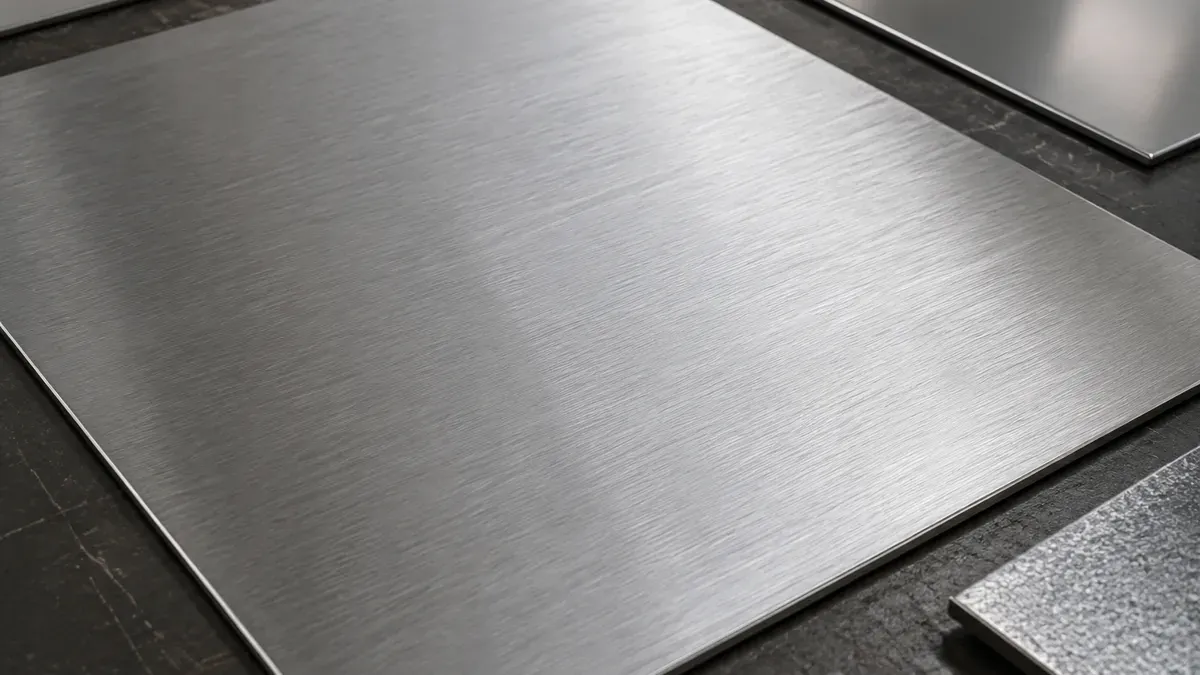
Incoming surface to delivered finish
Finish Class and Process Route
Finish class
Directional mechanical abrasive finish used as a final satin surface on sheet, coil, tube, and fabricated components.
Incoming-surface dependency
The starting mill finish, flatness, scratches, weld profile, and local conditioning remain important because the No.4 abrasive route removes only a limited surface layer. Different incoming coils or products may not converge to the same tone after an identical nominal belt sequence.
| Stage | Control to state | Risk if omitted |
|---|---|---|
| Incoming-surface preparation | Identify the base finish, allowable defects, flatness, weld condition, and whether polishing occurs before or after fabrication. | Deep scratches, pits, dents, and waviness can print through or require excessive local removal. |
| Abrasive belt finishing | State the approved production route or sample, grain direction, critical face, and controls for belt wear and feed overlap. | Nominal grit alone cannot control gloss, grain density, chatter, or shade when equipment and process differ. |
| Cleaning and visual inspection | Remove abrasive residue and inspect under agreed directional lighting before film application. | Residual compound, cross scratches, or banding can be hidden by film and discovered only after installation. |
| Film, identification, and packing | Use finish-compatible film and mark grain direction, panel sequence, and visible face. | Incorrect orientation or film imprint can make individually acceptable panels fail as an assembly. |
Measurable and visual controls
Acceptance Criteria
| Criterion | What to specify | Boundary |
|---|---|---|
| Approved surface sample | Approve a representative sample made with the intended substrate, equipment, and production route. | A small coupon may not reveal full-sheet banding, flatness, or adjacent-panel variation. |
| Grain direction | Show direction on drawings and labels, including bends, returns, tube axis, and adjacent panels. | Rotating one panel changes reflected light even when abrasive texture is otherwise within range. |
| Roughness and gloss | Where measured, define method, direction, cutoff, sampling locations, and acceptance range. | No.4 does not correspond to one universal grit, Ra, or gloss number. |
| Visual defects | Set viewing distance and light for cross scratches, chatter, stop marks, edge burn, stains, dents, and tone variation. | Inspection through protective film may not represent the cleaned installed surface. |
| Batch and panel match | Group visible panels by substrate coil and polishing campaign and record panel sequence. | Commercial supply cannot assume perfect matching across replacement lots without a retained master sample. |
Preserve the ordered surface
Fabrication, Cleaning, Film, and Packing
| Stage | Effect on finish | Required control |
|---|---|---|
| Cutting and bending | Heat, burr, tools, and bend dies can mark the grain or stretch its appearance. | Orient grain before nesting, use compatible film and clean tooling, and inspect a formed first article. |
| Welding and blending | The original finish is removed around the weld and manual blending can create halos or direction changes. | Define weld placement, blend width, abrasive sequence, grain continuity, and full-part sample acceptance. |
| Cleaning and installation | Abrasive residue, adhesive, fingerprints, chloride cleaners, and rubbing across grain affect appearance. | Specify approved cleaning materials, wipe direction, film removal timing, and protected installation handling. |
Finish-specific disputes
Defects, Causes, and Prevention
| Defect | Likely cause | Prevention input |
|---|---|---|
| Belt chatter or alternating bands | Equipment vibration, belt splice, pressure variation, feed overlap, or uneven belt wear can create repeating bands. | Control machine condition and belt life, inspect full width under grazing light, and retain a production master sample. |
| Cross scratches | Contaminated tables, handling across grain, damaged film, or an out-of-sequence abrasive can cut across the directional pattern. | Segregate clean contact surfaces, handle along the grain, inspect between stages, and reject cross-direction repair attempts without approval. |
| Weld-blend halo | Local manual polishing may use a different abrasive, pressure, path length, or heat than the surrounding machine finish. | Qualify the blend procedure on a representative joint and inspect the whole visible area from the agreed viewing position. |
Application-led choice
Where This Finish Fits
| Use case | Selection guidance | Approval boundary |
|---|---|---|
| Commercial kitchen and equipment covers | Use No.4 with a cleanable geometry, controlled weld blending, and agreed roughness or sample where hygiene-related cleaning matters. | Finish name alone does not certify food contact, hygienic design, or cleaning performance. |
| Elevator and wall panels | Control grain direction, panel map, batch match, film, edge treatment, and installation lighting. | Approve full-size assemblies where reflections, seams, and replacement-panel matching are critical. |
| Parts with severe forming after polishing | Consider polishing after forming or qualify film and tooling on a first article. | Stretch, die contact, and weld cleanup can make flat-sheet approval irrelevant to the finished component. |
Copy structure, replace values
Purchase Description Example
Continue the specification
Products, Grades, Standards, and Applications
Product forms
Grade datasheets
Product and finish standards
Application briefs
Buyer questions
Frequently Asked Questions
What grit is a No.4 stainless finish?
There is no single universal grit. Equipment, belt type, sequence, speed, pressure, substrate, and belt wear all influence the result. Specify an approved sample and, where useful, measured roughness and gloss with methods.
Should grain direction be included on drawings?
Yes. Show direction on every visible panel and formed part, including returns and adjacent pieces. Labels and nesting plans should preserve that direction through fabrication and installation.
Can a welded joint be restored to the original No.4 appearance?
It can be blended toward an approved appearance, but local manual work may leave a halo, gloss change, or grain discontinuity. Qualify the joint-finishing sequence and inspect a representative fabricated sample.
Published by Tsingshan (Shandong) Iron & Steel Co., Ltd..Sources, update policy and technical limitations.
Quotation package
What to Include in the RFQ
- Material standard, grade, form, base finish, and dimensions
- Production abrasive route or approved master sample
- Critical face and grain direction drawing
- Roughness, gloss, viewing, and defect criteria where required
- Cutting, forming, welding, and blend sequence
- Film type, panel or batch identification, and replacement-match rule
- Inspection record, traceability, cleaning, interleaving, packing, and destination
Quote request
Get a Stainless Steel Quote
Send the product, grade and quantity you already have. We will complete the specification and quote the supply route.