
Surface procurement brief
Pickled and Passivated Stainless Steel
Specify pickling when welding, hot work, or heat treatment has produced scale or heat tint that the project requires removed. Specify passivation when the procedure must remove free iron and other contamination and support restoration of a clean passive surface. The processes can be sequential but are not interchangeable: passivation is not a heavy-scale removal method, and pickling does not replace final cleanliness or material selection. A usable order identifies the fabricated condition, internal and external scope, governing procedure, chemistry compatibility, inaccessible areas, rinsing and neutralization, verification, records, and protection after treatment.
- Use this guide for
- Post-fabrication oxide removal, contamination control, and chemical-treatment scope definition
- Relevant to
- Tank, piping, pressure-equipment, food-system, pharmaceutical, water-treatment, and chemical-fabrication buyers
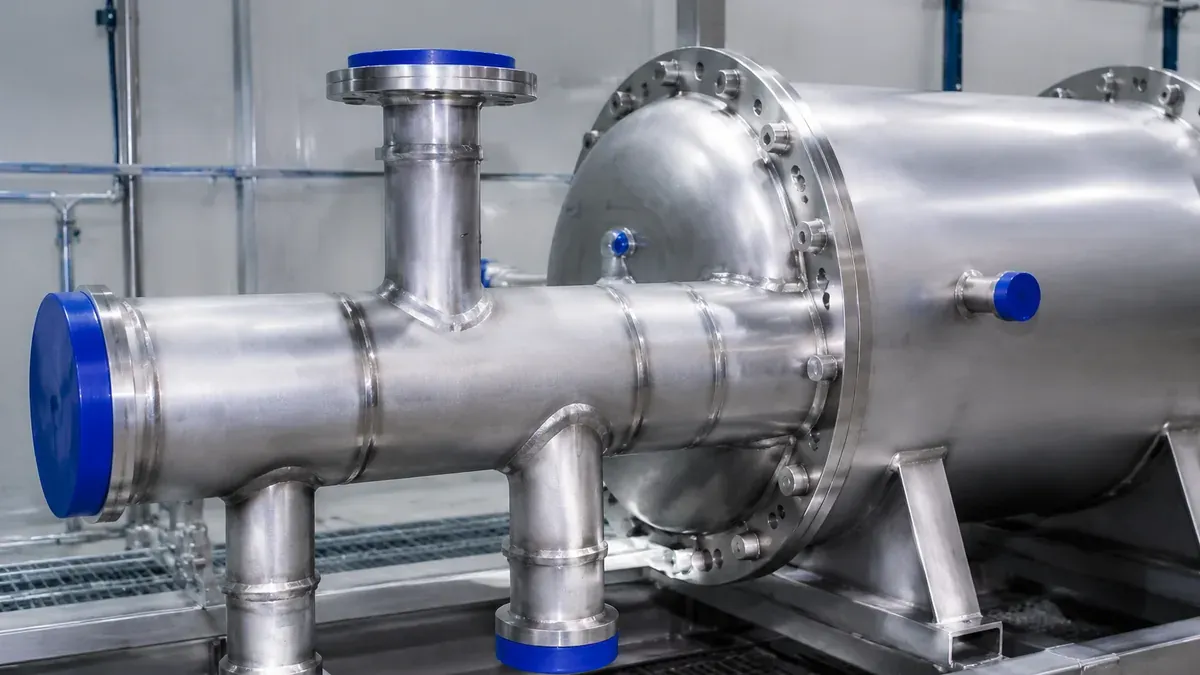
Incoming surface to delivered finish
Finish Class and Process Route
Finish class
Controlled chemical descaling and contamination-removal treatment applied to stainless product or completed fabrication, with pickling and passivation defined as separate process scopes.
Incoming-surface dependency
Alloy grade, mill finish, oxide thickness, weld heat tint, grinding, oils, adhesives, embedded iron, crevices, and fabrication geometry determine the appropriate treatment. Chemistry cannot repair poor weld profile, deep pits, sharp burrs, inaccessible crevices, or wrong alloy selection.
| Stage | Control to state | Risk if omitted |
|---|---|---|
| Fabrication review and degreasing | Map alloys, welds, heat tint, scale, contamination, internal volumes, drains, mixed-metal parts, seals, and surfaces excluded from treatment. | Oil, paint, tape residue, incompatible metals, or trapped liquid can prevent uniform action or be damaged by the selected chemistry. |
| Pickling where oxide removal is required | Use the approved chemistry, concentration, contact method, time, temperature, ventilation, and safety controls without substituting an unqualified route. | Under-treatment leaves scale or heat tint; excessive or trapped acid can etch, stain, attack edges, or remain in crevices. |
| Rinse and passivation | Rinse completely, then apply the contracted passivation route to clean exposed stainless where specified. | Poor rinse water, cross-contamination, incompatible chemistry, or incomplete coverage can leave residues and inconsistent surface condition. |
| Final rinse, drying, verification, and release | Define rinse-water quality, drainage, drying, inspection, testing, records, closures, and protected packing. | Retained moisture or chemistry, dirty handling, and carbon-steel contact can recontaminate a treated surface before service. |
Measurable and visual controls
Acceptance Criteria
| Criterion | What to specify | Boundary |
|---|---|---|
| Treatment scope | Identify pickling, passivation, or both; list internal and external surfaces, welds, dead legs, inaccessible zones, exclusions, and sequence. | A general pickled and passivated note does not prove every surface was reachable or treated identically. |
| Visual oxide removal | Define acceptable residual scale, heat tint, etching, streaks, stains, pits, and tone under stated lighting after drying. | A clean matte appearance is not by itself a chemical-cleanliness or passivation verification. |
| Cleanliness and free-iron verification | Select project-approved tests, sampling locations, acceptance criteria, and reporting where contamination control is required. | No single field test proves every aspect of passive-film quality or future service performance. |
| Rinse and residue control | State water quality, final-rinse acceptance, drainage, neutralization, drying, and treatment of trapped-volume risk. | Visible dryness on accessible surfaces does not confirm hidden cavities are free from retained chemistry. |
| Records and traceability | Require procedure revision, batch, operator or provider, dates, chemistry controls, inspection results, nonconformance disposition, and item traceability as appropriate. | A treatment certificate must reflect the actual item and scope rather than a generic process statement. |
Preserve the ordered surface
Fabrication, Cleaning, Film, and Packing
| Stage | Effect on finish | Required control |
|---|---|---|
| Weld completion before treatment | Later welding or grinding recreates heat tint and exposes a new surface after the recorded treatment. | Complete major hot work and approved weld blending before final chemical treatment, or define local retreatment and reinspection. |
| Mixed materials and components | Carbon steel, reactive non-stainless metals, coatings, seals, and labels may contaminate the stainless or react with chemistry. | Remove, isolate, or qualify incompatible materials and document all exclusions. |
| Complex internal geometry | Dead legs, narrow tubes, overlaps, crevices, and non-draining pockets can receive unequal treatment or retain liquid. | Review access, circulation, spray coverage, venting, draining, rinse validation, and borescope or sampling points. |
| Post-treatment assembly and shipping | Dirty tools, iron-bearing contact, moisture, fingerprints, and unclean caps can recontaminate the surface. | Use clean segregated tools, compatible closures, dry handling, protected storage, and packing matched to the cleanliness class. |
Finish-specific disputes
Defects, Causes, and Prevention
| Defect | Likely cause | Prevention input |
|---|---|---|
| Residual heat tint or scale | Insufficient preparation, chemistry, contact, access, or time may leave oxide at welds and shielded areas. | Map critical zones, qualify the procedure on representative welds, inspect full coverage, and retreat only under an approved route. |
| Over-pickling and acid staining | Excessive exposure, strong chemistry, poor drainage, drying acid, or alloy mismatch can etch or discolor the surface. | Control the approved process, monitor geometry-specific dwell, rinse promptly, and inspect after neutralization and drying. |
| Retained chemistry in crevices | Blind holes, lap joints, dead legs, insulation details, or poor drain orientation can trap treatment liquid. | Design and fixture for drainage, validate rinse circulation, inspect hidden zones, and document exclusions that cannot be verified. |
| Free-iron recontamination | Shared tools, racks, floors, blasting media, wire brushes, or packing can transfer iron before or after treatment. | Segregate contact materials, clean the work area, perform specified verification, and protect the accepted item immediately. |
Application-led choice
Where This Finish Fits
| Use case | Selection guidance | Approval boundary |
|---|---|---|
| Welded tanks, pipe spools, and pressure fabrications | Define weld heat-tint removal, internal and external access, circulation or immersion route, rinse, drainage, inspection, and item-level records. | Treatment does not correct weld contour, lack of fusion, crevice geometry, or pressure-design issues. |
| Food, pharmaceutical, and clean-process systems | Combine the chemical-treatment procedure with surface roughness, weld finish, cleaning validation, material traceability, and project hygiene requirements. | Pickling or passivation alone does not establish sanitary compliance or cleanability of the assembly. |
| Decorative visible surfaces | Approve a visual sample and assess whether localized pickling or full-area treatment will create acceptable tone after fabrication. | Chemical treatment can change gloss and shade; decorative matching requires its own acceptance method. |
Copy structure, replace values
Purchase Description Example
Continue the specification
Products, Grades, Standards, and Applications
Product forms
Grade datasheets
Product and finish standards
Application briefs
Buyer questions
Frequently Asked Questions
Are pickling and passivation the same process?
No. Pickling is used to remove scale, heat tint, and a thin metal layer, while passivation is applied to a clean surface to remove free iron and support passive-surface restoration. The contract should state which stages are required.
Can passivation remove heavy weld heat tint?
Passivation is not a substitute for qualified oxide removal. Heavy heat tint or scale usually requires an approved pickling or mechanical preparation route before final cleaning and passivation.
Does a passivation certificate prove future corrosion resistance?
No. It records the performed procedure and stated verification. Service performance still depends on alloy, design, fabrication, environment, cleaning, contamination, and maintenance.
Published by Tsingshan (Shandong) Iron & Steel Co., Ltd..Sources, update policy and technical limitations.
Quotation package
What to Include in the RFQ
- Material standards, editions, grades, item traceability, dimensions, and fabricated condition
- Pickling, passivation, or combined scope; internal, external, weld, and excluded surfaces
- Approved procedure revision, chemistry compatibility, application method, and safety or environmental constraints
- Heat tint, scale, grinding, weld profile, mixed materials, masks, seals, and inaccessible geometry
- Rinse-water, neutralization, drainage, drying, residue, and cleanliness requirements
- Visual, free-iron, rinse, sampling, inspection, witness, record, and nonconformance requirements
- Post-treatment handling, closures, segregated packing, storage, destination, and quantity
Quote request
Get a Stainless Steel Quote
Send the product, grade and quantity you already have. We will complete the specification and quote the supply route.