
Application specification brief
Stainless Steel for Heat Exchangers & Pressure Equipment
Build the materials basis from both fluids, cleaning chemistry, temperature and pressure transients, flow, vibration, shutdown, corrosion allowance, and code. Assign product standards and conditions to plate, tube, forgings, fittings, flanges, weld metal, and fasteners. Certificates cover only stated tests; authorized project parties retain equipment and service acceptance.
Send the service, product form and inspection plan. We quote the matching stainless product forms; the project authority keeps final service approval.
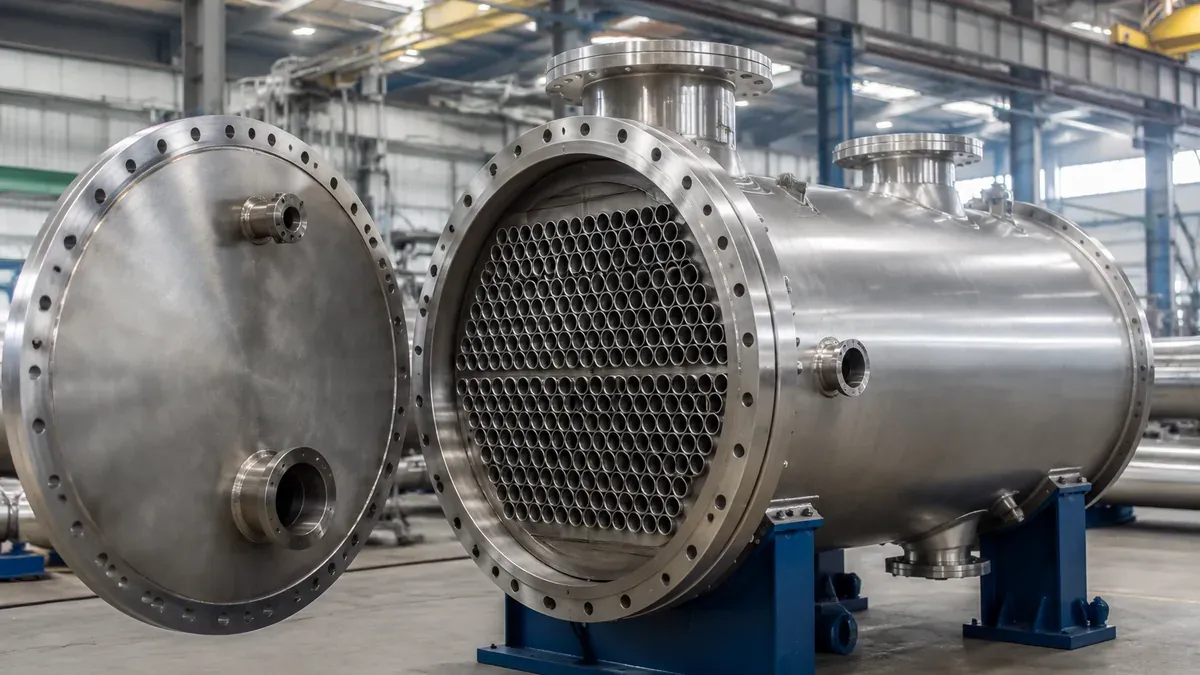
Four-state review
Service Boundary
Review the complete operating cycle, not only nominal process conditions.
Normal operation
Describe both streams, phases, contaminants, temperature, pressure, flow, heat flux, fouling, concentration, vibration, and operating cycle.
Cleaning and maintenance
List mechanical cleaning, wash, steam-out, chemical circulation, descaling, hydrotest, and passivation with chemistry, temperature, duration, drainage, and final state.
Shutdown and standby
State whether each side is drained, flushed, dried, inerted, preserved, stagnant, or aerated; review crevices, deposits, and low points.
Upset and abnormal cases
Provide loss of flow, blocked tube, utility failure, cross-leak, contamination, phase change, temperature or pressure excursion, and extended holds.
Inputs before the RFQ
Operating Environment
| Variable | What to review | Procurement impact |
|---|---|---|
| Shell-side stream | Give composition, phases, contaminants, temperature, pressure, velocity, fouling, heat-transfer state, and transients. | Defines shell, head, nozzle, baffle, tubesheet, weld, corrosion-allowance, and inspection inputs. |
| Tube-side stream | Add flow distribution, deposits, cleaning, support, and leakage consequences to the same chemistry and envelope. | Drives tube alloy, dimensions, route, testing, tubesheet joint, and cleanliness. |
| Construction code | Name code, edition, class, design conditions, joint efficiency, supplements, and jurisdiction. | Controls permitted materials, design values, welding, heat treatment, NDE, testing, and records. |
| Mechanical loading | State thermal cycles, expansion, vibration, supports, fatigue basis, external loads, vacuum, and toughness concerns. | Connects grade and strength to thickness, supports, weld detail, and examination. |
| Fabricated condition | Define forming, cold work, welding, filler, heat treatment, surface restoration, tolerances, and repairs. | Prevents base-material data being assigned to finished equipment without review. |
Design and fabrication risks
Failure Modes and Controls
| Failure mode | Drivers to review | Specification control |
|---|---|---|
| Localized corrosion | Chlorides or aggressive species, deposits, gasket crevices, tubesheet gaps, stagnant zones, heat tint, and concentration by evaporation. | Use both streams and transient data, improve detailing, control fabrication, restore surfaces, and obtain project materials acceptance. |
| Stress-assisted damage | Environment, metal temperature, residual and applied stress, cold work, welding, thermal cycles, and component geometry. | Coordinate materials, stress analysis, forming, welding, heat treatment, NDE, and operating limits through the design authority. |
| Erosion, vibration, or fretting | High local velocity, two-phase flow, impingement, unsupported span, baffle contact, flow-induced vibration, or solids. | Provide hydraulic and mechanical inputs, review tube layout and supports, set dimensional controls, and specify inspection of affected zones. |
| Pressure-boundary nonconformance | Wrong product standard or condition, traceability loss, unqualified procedure, missed NDE, incompatible repair, or incomplete data book. | Use an approved quality plan with material maps, controlled procedures, hold points, test records, concessions, and final dossier review. |
Screening ladder
Material Selection
Grades are screening routes, not unconditional substitutes. Product standards, fabricated condition, and project approval still govern.
| Grade reference | Where to screen it | Approval boundary |
|---|---|---|
| 304L Stainless Steel | Quote for low-chloride vessels and utility exchangers when both streams support it. | Low carbon does not approve chloride, crevice, thermal, code, or upset conditions. |
| 316L Stainless Steel | Quote for broader chemical and moderate-chloride duty using an austenitic route. | Review phases, temperature, deposits, crevices, cold work, welding, and cleaning. |
| 2205 Stainless Steel | Quote for chloride-bearing or strength-driven pressure parts under duplex controls. | Code values, toughness, phase balance, form, and service approval still govern. |
| 254 SMO Stainless Steel | Quote for severe chloride streams supported by the corrosion study. | Confirm form, standard, welding, cold work, crevices, temperature, and acceptance. |
| 321 Stainless Steel | Quote for selected elevated-temperature components when code rules require stabilization. | Time, stress, atmosphere, chemistry, cycles, form, and welding remain item-specific. |
Supply route
Product Forms and Ordering Basis
| Form | Typical scope | Order basis |
|---|---|---|
| Plate and sheet | Shells, heads, channels, baffles, plate tubesheets, jackets, and internals. | State grade, standard, condition, thickness, dimensions, tolerances, forming, surface, tests, and traceability. |
| Heat exchanger tube | Straight or U-tube bundles for condensers, heaters, coolers, and process exchangers. | Define standard, route, OD, wall, length, heat treatment, surface, examination, tolerances, and cleanliness. |
| Pipe and fittings | Nozzles, spools, drains, vents, branches, utility lines, and attachments. | Name material and dimensional standards, NPS, schedule, ends, treatment, examination, testing, and marking. |
| Forgings and flanges | Nozzles, rings, forged tubesheets, covers, flanges, and pressure-boundary parts. | Specify standard, grade, condition, class, facing, bore, dimensions, tests, NDE, and face protection. |
Delivered condition
Fabrication, Welding, Surface, and Cleaning
Forming and heat treatment
Define forming temperature, cold-work limits, solution treatment or other required condition, furnace records, cleaning, and retest obligations.
Welding
Specify procedures, filler, purge, heat input, interpass, joint preparation, production tests, repair cycles, NDE, and duplex or stabilized-grade controls.
Tube-to-tubesheet joints
State expanded, welded, or combined joint details, mock-up or qualification, groove and ligament dimensions, sequence, leak test, and acceptance criteria.
Surface and cleanliness
Define scale and heat-tint removal, pickling or passivation, internal cleanliness, chloride limits for test water, drying, preservation, and inspection.
Dimensional interfaces
Coordinate shell, head, nozzle, tube, baffle, flange, gasket, bore, facing, support, and assembly tolerances before manufacture.
Release evidence
Inspection and Documents
| Stage | Required evidence |
|---|---|
| Design and material approval | Submit data sheets, code basis, material requisitions, standards and editions, deviations, procedures, drawings, and inspection plan. |
| Raw material | Verify certificates, heat identity, chemistry, mechanical and heat-treatment results, dimensions, condition, surface, PMI, and ordered corrosion or impact tests. |
| Fabrication | Record material and weld maps, forming, heat treatment, operators, consumables, repairs, NDT, dimensions, surface treatment, and traceability. |
| Testing | Perform tube examination, leak or pressure tests, dimensional and visual checks, cleanliness, passivation, preservation, and witness points under the approved plan. |
| Final data book | Index approved drawings, calculations where in supplier scope, certificates, procedure records, reports, concessions, release note, and packing documents. |
Continue the specification
Related Standards and Grade Decisions
Product and dimensional standards
Related grade comparisons
Buyer questions
Frequently Asked Questions
Can exchanger tube and shell plate use the same product standard?
Usually not. Plate, tube, forgings and fittings have separate product standards even when the nominal grade matches.
Why must both process streams be provided?
Either side can control corrosion, temperature, contamination and cleaning requirements, including off-design and shutdown conditions.
Does a material certificate prove code compliance?
It documents the tests within its scope. Code compliance also depends on design, fabrication, qualified procedures, inspection and the complete records required by the project.
Published by Tsingshan (Shandong) Iron & Steel Co., Ltd..Sources, update policy and technical limitations.
Quotation package
What to Include in the RFQ
- Equipment tag and type, code and edition, owner specification, jurisdiction, and approval authority
- Both stream compositions, phases, contaminants, solids, ranges, cleaning, shutdown, and upset cases
- Operating and design pressure and temperature, vacuum, allowance, flow, heat duty, fouling, and cycles
- Grade and form for shell, head, tube, tubesheet, baffle, nozzle, fitting, flange, bolting, weld, and internals
- Product and dimensional standards, route, condition, dimensions, tolerances, forming, treatment, welding, and surface
- PMI, mechanical, impact, corrosion, NDT, tube, leak, pressure, dimensional, cleanliness, witness, and third-party inspection
- Traceability, certificates, material and weld maps, document index, deviations, preservation, packing, and delivery
Quote request
Get a Stainless Steel Quote
Send the product, grade and quantity you already have. We will complete the specification and quote the supply route.