
Surface procurement brief
No.1 Hot-Rolled Stainless Steel Finish
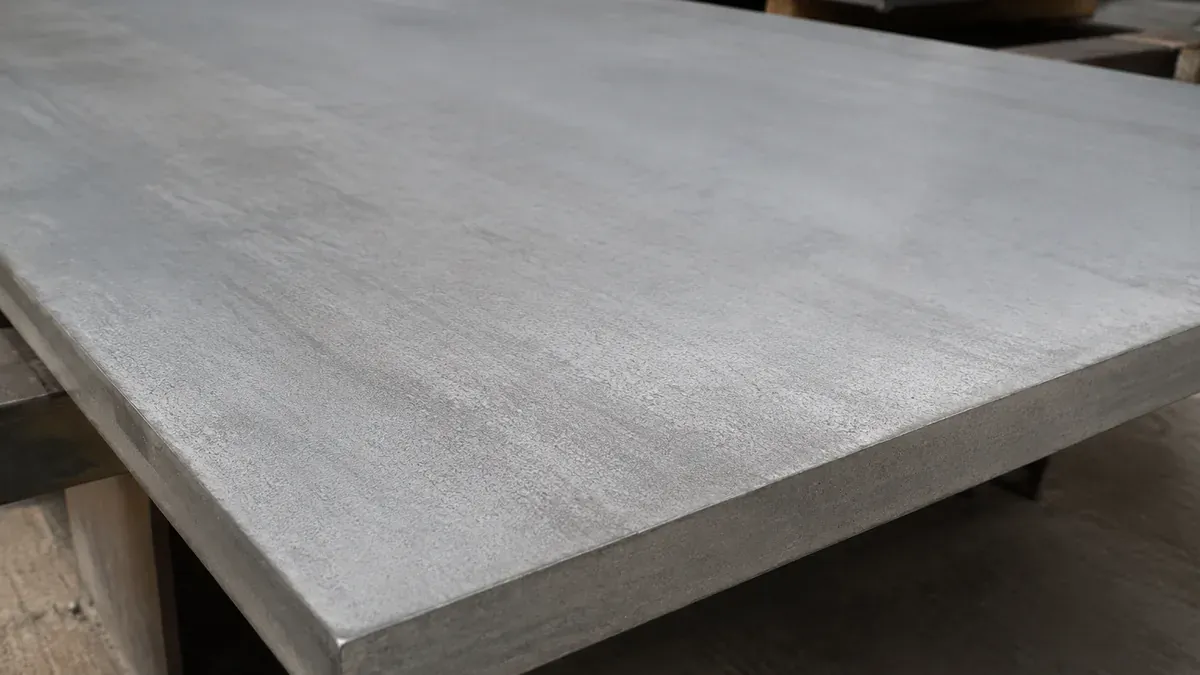
Use No.1 for hot-rolled stainless plate or heavier coil when material condition, descaling, fabrication, and service preparation matter more than decorative uniformity. The surface is heat treated and descaled, commonly by pickling, and may show tone variation, local conditioning, and handling marks within the contract standard. The order must define plate or coil route, grade, thickness, flatness, edge, allowable repair, residual-scale and pit limits, later welding or blasting, traceability, and packing.
- Use this guide for
- Hot-rolled plate or heavy-coil surface and fabrication specification
- Relevant to
- Tank, pressure-equipment, structural, chemical-process, and heavy-plate buyers
Incoming surface to delivered finish
Finish Class and Process Route
Finish class
Hot-rolled, heat-treated, and descaled mill finish for plate and heavier flat product.
Incoming-surface dependency
Hot rolling creates scale and a comparatively textured substrate. Heat treatment, scale condition, descaling intensity, plate leveling, and any local grinding determine the delivered surface. No.1 does not hide plate waviness, laminations, deep mechanical damage, or fabrication defects.
| Stage | Control to state | Risk if omitted |
|---|---|---|
| Hot rolling and heat treatment | State material specification, grade, product route, thickness, ordered condition, and any heat-treatment reporting requirement. | Scale formation, thickness, and thermal history influence the surface that must later be descaled and inspected. |
| Descaling and pickling | Define the required descaled condition, restrictions on retained scale, and any project cleaning procedure. | Under-pickling can leave scale; aggressive or uneven treatment can create stains, roughness, or localized attack. |
| Leveling and local conditioning | State flatness class and whether grinding or surface conditioning is permitted, reportable, or restricted. | Grinding may remove indications but also create visible patches or reduce local thickness if uncontrolled. |
| Marking and heavy-plate handling | Place marks away from critical zones and define lift, separator, edge, and skid protection. | Chains, forks, grit, and plate-on-plate movement can cause gouges, dents, and traceability loss. |
Measurable and visual controls
Acceptance Criteria
| Criterion | What to specify | Boundary |
|---|---|---|
| Descaled condition | Reference the governing product standard and define acceptance for residual scale, oxide, pickling stains, and surface contamination. | No.1 is not a color standard and normal descaling tone can vary. |
| Pits and mechanical damage | State permitted depth or disposition route for pits, gouges, dents, rolled-in material, and handling scratches. | Visual inspection alone may not establish remaining thickness below a conditioned area. |
| Local conditioning | Identify whether grinding is allowed, maximum removal basis, blending requirement, and inspection after repair. | A locally ground patch need not match the surrounding matte appearance. |
| Flatness and dimensions | Give thickness tolerance, flatness class, width, length, edge condition, and cut tolerance. | No.1 describes surface route, not plate shape or dimensional accuracy. |
| Post-fabrication surface | State whether final equipment will remain No.1, be blasted, ground, pickled, passivated, coated, or otherwise cleaned. | The incoming mill finish does not define acceptance after welding and forming. |
Preserve the ordered surface
Fabrication, Cleaning, Film, and Packing
| Stage | Effect on finish | Required control |
|---|---|---|
| Cutting and edge preparation | Thermal cutting leaves oxide and heat-affected edges; shearing can create burr and edge deformation. | Define cut route, edge cleanup, bevel, heat tint removal, and marking transfer on cut pieces. |
| Forming and welding | Heavy forming changes flatness while welding creates heat tint, scale, spatter, and local distortion. | Use the approved fabrication procedure and state final weld cleaning, NDE, dimensional, and surface acceptance. |
| Pickling, blasting, or coating after fabrication | A final treatment can replace the mill appearance and alter roughness or contamination state. | Specify media segregation, chemical procedure, masking, rinse, inspection, and treatment records separately. |
| Transport and site storage | Bare plate can collect carbon-steel debris, road salts, standing water, and handling damage. | Use clean separators and lifting equipment, keep identification visible, and define dry covered storage and contamination cleanup. |
Finish-specific disputes
Defects, Causes, and Prevention
| Defect | Likely cause | Prevention input |
|---|---|---|
| Residual scale or pickling shadow | Scale thickness, bath access, chemistry, or rinse variation can leave dark areas or non-uniform tone. | Set the contract acceptance basis, inspect representative areas after drying, and require re-cleaning only under an agreed procedure. |
| Over-pickled or locally rough surface | Excess exposure, depleted chemistry control, trapped solution, or inappropriate treatment can attack the substrate. | Control the treatment procedure, drainage, timing, rinse, and inspection, with special attention to edges and recesses. |
| Deep gouges and handling dents | Forks, chains, dirty beds, stacked movement, or unprotected edges can damage heavy plates. | Define lift points and separator materials, prohibit dragging, inspect at loading and receipt, and document disposition of depth-critical damage. |
Application-led choice
Where This Finish Fits
| Use case | Selection guidance | Approval boundary |
|---|---|---|
| Pressure equipment and chemical tanks | Use No.1 plate as the incoming material route when the fabrication specification will control welds, cleaning, NDE, and final surface. | Material finish does not approve pressure design, alloy selection, corrosion allowance, or fabricated equipment. |
| Structural and heavy cut components | Prioritize plate tolerance, flatness, surface defect allowance, traceability, and cutting route over cosmetic matching. | Machined or exposed critical faces may require additional stock allowance and downstream finishing. |
| Visible architectural work | Select a controlled abrasive, blasted, patterned, or polished finish if appearance and panel matching are important. | No.1 normally retains variable matte texture and should not be ordered as a decorative final surface without a specific sample. |
Copy structure, replace values
Purchase Description Example
Continue the specification
Products, Grades, Standards, and Applications
Product forms
Grade datasheets
Product and finish standards
Application briefs
Buyer questions
Frequently Asked Questions
Is No.1 stainless plate expected to have a uniform decorative color?
No. No.1 is a functional hot-rolled, heat-treated, and descaled surface. Tone, pickling pattern, local conditioning, and handling marks can vary within the contract standard. A visible project should specify another finish or an approved project sample and inspection method.
Can local grinding be accepted on No.1 plate?
It can be when the governing standard and purchase order permit conditioning and define removal, remaining thickness, blending, inspection, and reporting. The conditioned patch may remain visually different, so cosmetic restrictions must be stated before production.
Does No.1 finish include post-weld pickling and passivation?
No. It describes the delivered mill surface of the flat product. Fabricated welds, heat tint, scale, contamination, pickling, passivation, blasting, and final cleanliness require a separate fabrication and treatment specification.
Published by Tsingshan (Shandong) Iron & Steel Co., Ltd..Sources, update policy and technical limitations.
Quotation package
What to Include in the RFQ
- Material and general-requirements standards with editions
- Grade, plate or coil route, heat-treated condition, and quantity
- Thickness, width, length, tolerance, flatness, and edge
- No.1 descaling and residual-scale acceptance
- Pit, gouge, dent, and local-conditioning disposition rules
- Cutting, forming, welding, and final cleaning route
- Tests, certificate, traceability, marking transfer, lifting, skid, and destination
Quote request
Get a Stainless Steel Quote
Send the product, grade and quantity you already have. We will complete the specification and quote the supply route.