
Application specification brief
Stainless Steel for Marine & Offshore Service
Classify each item as atmospheric, washdown, splash, tidal, immersed, internal seawater, or process duty. Record temperature, salinity, oxygen, flow, deposits, crevices, cleaning, cathodic protection, and dissimilar metals. PREN compares chemistry only; the owner and corrosion engineer approve service, fabrication, and inspection.
Send the service, product form and inspection plan. We quote the matching stainless product forms; the project authority keeps final service approval.
Four-state review
Service Boundary
Review the complete operating cycle, not only nominal process conditions.
Normal operation
Identify exposure zone, water source, salinity, temperature, oxygen, flow, pressure, biology, solids, wet-dry cycle, deposits, and cleaning frequency.
Cleaning and maintenance
Describe washdown, chemical or mechanical cleaning, chlorination, biocide, descaling, flushing, and maintenance chemistry, duration, and final condition.
Shutdown and standby
State whether the system is drained, flushed, preserved, stagnant, flooded, or open to aerated seawater; map deposits, crevices, and low points.
Upset and abnormal cases
Provide loss of flow, blocked intake, warm stagnation, dosing increase, contamination, coating damage, cathodic change, and extended wetting.
Inputs before the RFQ
Operating Environment
| Variable | What to review | Procurement impact |
|---|---|---|
| Exposure zone | Separate sheltered atmosphere, open atmosphere, washdown, splash, tidal, submerged, internal seawater, and process-wetted locations. | Creates item-specific grade, surface, cleaning, isolation, fabrication, and inspection requirements instead of one marine label. |
| Seawater condition | State salinity, temperature, oxygen, velocity, pressure, solids, biological activity, dosing, contamination, and concentration changes. | Provides the basis for localized-corrosion screening and identifies where stagnant or warm conditions govern. |
| Crevice geometry | Map gaskets, flange faces, fasteners, deposits, lap joints, clamps, threaded details, shields, and inaccessible drain points. | Affects alloy margin, joint design, gasket and fastener specification, surface treatment, and inspection access. |
| Electrical interfaces | List coupled metals, area ratios, coatings, isolation details, grounding, impressed-current or sacrificial systems, and installation tolerances. | Coordinates material supply with system-level galvanic and cathodic-protection design rather than treating stainless in isolation. |
| Structural and code duty | Provide loads, pressure, fatigue, impact, fire, classification, design code, welding category, and owner requirements. | Connects corrosion screening to product form, section size, strength basis, toughness, procedures, NDT, and documentation. |
Design and fabrication risks
Failure Modes and Controls
| Failure mode | Drivers to review | Specification control |
|---|---|---|
| Pitting and crevice attack | Warm aerated seawater, deposits, stagnant gaps, gasket interfaces, heat tint, surface contamination, and low-flow zones. | Use the actual zone and water data, reduce crevices, control fabrication, restore surfaces, and obtain project corrosion acceptance. |
| Atmospheric staining or attack | Salt deposition, sheltered surfaces, poor rain washing, rough finish, embedded iron, and infrequent maintenance. | Specify an exposure-appropriate alloy and finish, contamination control, drainage, cleaning access, and maintenance basis. |
| Galvanic interface damage | Unfavorable area ratio, electrical continuity, coating holidays, unsuitable fasteners, or uncoordinated cathodic protection. | Complete a system review and define isolation, compatible hardware, coating termination, electrical checks, and commissioning records. |
| Duplex fabrication loss | Incorrect filler, excessive or insufficient heat input, purge failure, repeated repairs, contamination, or unsuitable thermal exposure. | Use approved procedures, qualified personnel, controlled essential variables, weld traceability, NDT, and ordered phase or corrosion checks. |
Screening ladder
Material Selection
Grades are screening routes, not unconditional substitutes. Product standards, fabricated condition, and project approval still govern.
| Grade reference | Where to screen it | Approval boundary |
|---|---|---|
| 316L Stainless Steel | Quote for draining above-water hardware, sheltered equipment, or selected intermittent exposure where the project environment supports it. | Do not extend an atmospheric or washdown selection to warm stagnant immersion, tight crevices, or internal seawater without a new review. |
| 2205 Stainless Steel | Quote for splash-zone structures, tanks, piping, and selected seawater systems needing added chloride margin and strength. | Product form, thickness design, weld condition, temperature, crevices, impact properties, and project standards still control. |
| 2507 Stainless Steel | Quote for severe chloride-bearing offshore sections under a documented corrosion basis and tightly controlled fabrication route. | Higher PREN does not establish service life or remove local geometry, temperature, welding, cathodic, and inspection requirements. |
| 254 SMO Stainless Steel | Quote for selected seawater handling, flue-gas wash, or fabrication duties that require a high-alloy austenitic route. | Confirm the actual medium, component standard, availability route, weld consumables, cold work, and owner acceptance before selection. |
Supply route
Product Forms and Ordering Basis
| Form | Typical scope | Order basis |
|---|---|---|
| Plate and sheet | Deck equipment, tanks, enclosures, process vessels, cladding, walkways, and fabricated structural details. | State grade, product standard, thickness, dimensions, flatness, finish, forming, weld route, treatment, inspection, and certificates. |
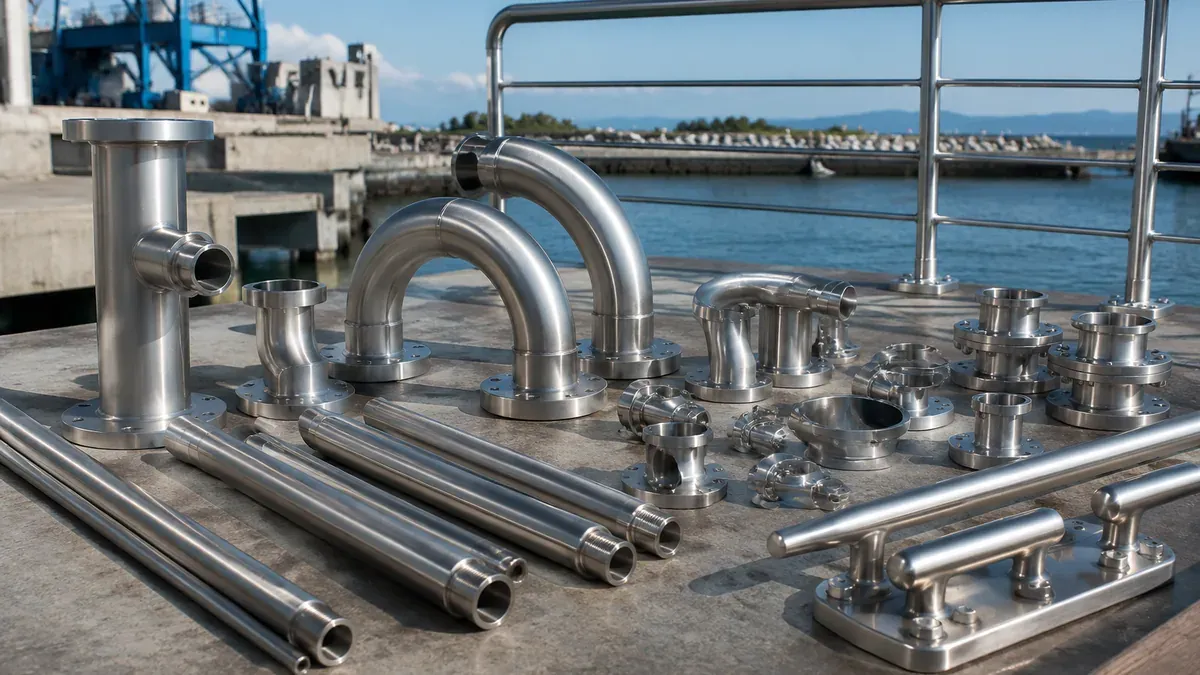
| Pipe and tube | Seawater, firewater, process, utility, drainage, hydraulic, instrumentation, and structural tubing systems. | Define route, material and dimensional standards, NPS or OD, wall, ends, heat treatment, pressure tests, NDT, marking, and cleanliness. |
| Fittings and flanges | Line-class changes, detachable joints, branches, nozzles, valve interfaces, and pressure-boundary connections. | Specify type, schedule, class, facing, bore, standards, heat treatment, examination, marking, traceability, and face protection. |
| Bar and profiles | Shafts, fastener feedstock, handrails, supports, frames, gratings, and machined marine components. | Provide shape or drawing, condition, dimensions, tolerance, machining allowance, loads, finish, joining, NDE, and final-part controls. |
Delivered condition
Fabrication, Welding, Surface, and Cleaning
Welding
Specify procedure and personnel qualification, filler, purge, heat input, interpass, distortion, duplex controls, repair cycles, cleaning, and inspection.
Surface restoration
Remove embedded iron, scale, weld contamination, and unacceptable heat tint; define pickling, passivation, polishing repair, rinse, and records.
Crevice control
Coordinate weld details, gasket compression, drain paths, clamps, fasteners, sealants, lap joints, coating edges, and access for cleaning and inspection.
Galvanic isolation
State isolation materials, bolting, washers, sleeves, coatings, electrical continuity tests, cathodic-protection interface, and installer responsibility.
Transport and installation
Protect machined faces and finished surfaces, segregate carbon steel, keep ends closed, prevent salt contamination, and preserve item and heat markings.
Release evidence
Inspection and Documents
| Stage | Required evidence |
|---|---|
| Engineering review | Submit exposure classification, standards and editions, product route, deviations, procedures, corrosion assumptions, and inspection plan. |
| Material receipt | Verify certificates, heat identity, dimensions, condition, surface, PMI, mechanical or impact results, and any ordered corrosion tests. |
| Fabrication | Record material and weld maps, consumables, essential variables, repairs, NDT, dimensions, treatments, contamination control, and marking transfer. |
| Installation interfaces | Check isolation, bolting, gaskets, coating boundaries, supports, drainage, cathodic-protection coordination, cleanliness, and preservation. |
| Release dossier | Index approvals, certificates, traceability, inspection and test reports, concessions, preservation, packing, and release records by item. |
Continue the specification
Related Standards and Grade Decisions
Product and dimensional standards
Related grade comparisons
Buyer questions
Frequently Asked Questions
Is 316L seawater resistant?
It is useful above water and in intermittent splash, but warm stagnant seawater and crevices can pit it.
What does PREN indicate?
PREN is a chemistry-based screening index for chloride pitting resistance, not a complete service-life prediction.
Why control duplex welding?
Heat input and cooling affect phase balance, corrosion resistance and toughness.
Published by Tsingshan (Shandong) Iron & Steel Co., Ltd..Sources, update policy and technical limitations.
Quotation package
What to Include in the RFQ
- Item tag, exact marine or offshore location, exposure zone, design code, classification, owner specification, and editions
- Water source, salinity, temperature, oxygen, flow, pressure, solids, biology, dosing, contamination, and operating cycle
- Normal, cleaning, shutdown, commissioning, maintenance, and credible upset conditions with duration
- Grade, product form, dimensions, condition, manufacturing route, standards, quantity, loads, pressure class, ends, and corrosion allowance
- Welding, filler, purge, heat input, duplex controls, surface treatment, crevice, isolation, coating, and cathodic requirements
- PMI, NDT, impact, corrosion, pressure or leak tests, dimensions, hold points, witness, and third-party inspection
- Certificate type, traceability, marking, document index, deviation process, preservation, packing, and destination
Quote request
Get a Stainless Steel Quote
Send the product, grade and quantity you already have. We will complete the specification and quote the supply route.