
Surface procurement brief
2B Stainless Steel Finish
Choose 2B when the order needs a smooth cold-rolled mill surface for general fabrication without committing to a decorative polish. The designation identifies a processing family, not one fixed gloss, roughness, shade, scratch limit, or flatness class. A usable purchase description therefore combines the material standard and grade with product form, dimensions, critical face, film, visual acceptance, downstream process, inspection lighting, and packing.
- Use this guide for
- Cold-rolled sheet or coil finish specification for a quotable RFQ
- Relevant to
- Fabricators, appliance buyers, tank builders, and sheet or coil procurement teams
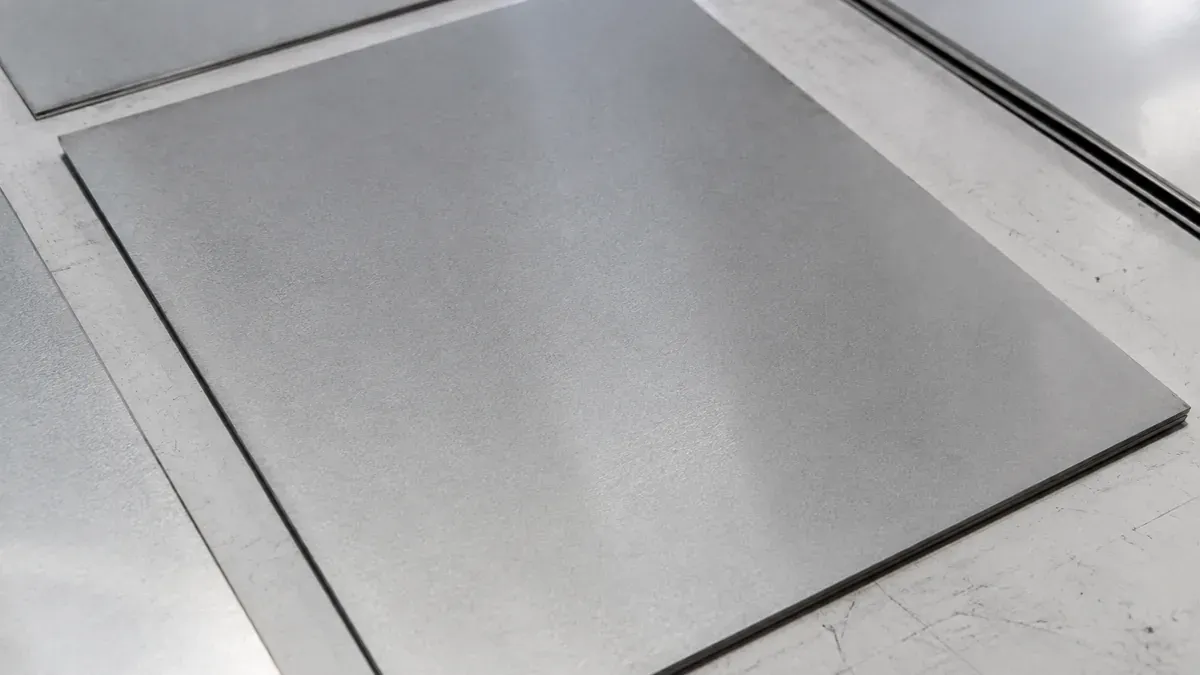
Incoming surface to delivered finish
Finish Class and Process Route
Finish class
Cold-rolled mill finish produced after heat treatment, descaling, and a controlled light skin pass.
Incoming-surface dependency
The incoming cold-rolled strip condition, annealing and descaling route, roll condition, thickness, and mill campaign influence tone and reflectivity. A 2B label cannot make different mills, heats, thicknesses, or coil sections visually identical.
| Stage | Control to state | Risk if omitted |
|---|---|---|
| Cold reduction and annealing | Confirm the ordered product form, grade, thickness, heat-treated condition, and applicable flat-product standard. | Different reduction and annealing routes can change flatness, mechanical response, and the base appearance presented to the finishing rolls. |
| Descaling and surface preparation | Require a clean descaled surface and define whether local conditioning or repair marks are restricted on the critical face. | Pickling variation, residual scale, or local conditioning may remain visible after the final pass. |
| Light skin pass | State whether one or both faces are critical and use a reference sample where adjacent panels must match. | Roll condition and pass practice affect reflectivity, pressure lines, and coil-to-coil tone. |
| Film and release packing | Match film adhesion and peel behavior to laser cutting, forming, storage, and final removal. | Wrong film can trap debris, imprint the surface, leave residue, or lift during fabrication. |
Measurable and visual controls
Acceptance Criteria
| Criterion | What to specify | Boundary |
|---|---|---|
| Finish identity | Name 2B with the governing material and general-requirements standards plus the ordered product condition. | The name distinguishes the mill route but does not define a decorative master sample. |
| Critical face | Identify side A, side B, or both sides on the drawing and state which face remains visible after fabrication. | Back-side commercial quality may differ when only one critical face is ordered. |
| Visual inspection | Agree viewing distance, light direction, sample, and treatment of scratches, roll lines, pits, stains, and shade changes. | Undefined terms such as good surface or premium 2B do not create repeatable acceptance. |
| Roughness and gloss | Add a measurement method and agreed range only where function or appearance requires it. | 2B alone does not establish one universal Ra or gloss value across all products. |
| Dimensions and shape | State thickness tolerance, flatness, edge, width, length, coil set, and camber separately. | Surface finish compliance does not replace dimensional acceptance. |
Preserve the ordered surface
Fabrication, Cleaning, Film, and Packing
| Stage | Effect on finish | Required control |
|---|---|---|
| Laser cutting and blanking | Spatter, dross, tables, and handling can mark the working face. | Select compatible laser film, orient the critical face, keep support surfaces clean, and define film removal timing. |
| Bending and forming | Tooling can emboss, gall, or stretch the visible surface and may create direction-dependent appearance. | Use clean protected tooling, confirm bend orientation, and approve formed samples for visible parts. |
| Welding and cleaning | Heat tint, grinding, pickling, and weld blending replace the original local 2B appearance. | Define whether welded zones remain as-cleaned, are refinished to a sample, or receive a different final treatment. |
| Packing and installation | Sheet-to-sheet movement and trapped particles cause scratches below film. | Specify interleaving, dry packing, edge protection, lift method, label position, and clean storage. |
Finish-specific disputes
Defects, Causes, and Prevention
| Defect | Likely cause | Prevention input |
|---|---|---|
| Roll lines or pressure marks | Finishing-roll condition, debris, or localized pass pressure can create repeating surface indications. | Agree the visual limit, inspect representative coil sections, and isolate repeating marks before slitting or cutting. |
| Shade variation between sheets | Different coils, mill campaigns, thicknesses, or surface histories may reflect light differently. | Reserve visible sets from an agreed batch, mark panel sequence, and approve a comparison sample under installation lighting. |
| Scratches beneath protective film | Debris, sliding sheets, damaged film, or contaminated tables can score the critical face. | Clean contact surfaces, restrict sliding, inspect before and after film application, and define handling through fabrication. |
Application-led choice
Where This Finish Fits
| Use case | Selection guidance | Approval boundary |
|---|---|---|
| General fabricated enclosures and tanks | Use 2B when a smooth cleanable mill surface is acceptable or another finish will be applied after forming and welding. | Final cleanability and service suitability depend on geometry, weld condition, cleaning procedure, and alloy selection. |
| Visible appliance or equipment panels | Use a controlled sample, critical-face instruction, batch plan, and film rather than relying on the 2B name alone. | Choose BA, No.4, hairline, or another specified route if reflectivity or directional texture is the primary design requirement. |
| Parts receiving polishing or coating | Confirm that the incoming 2B surface and defect allowance are compatible with the planned removal depth and final process. | Deep pits, creases, weld distortion, or embedded contamination may remain after a light downstream finish. |
Copy structure, replace values
Purchase Description Example
Continue the specification
Products, Grades, Standards, and Applications
Product forms
Grade datasheets
Product and finish standards
Application briefs
Buyer questions
Frequently Asked Questions
Is every 2B stainless surface visually identical?
No. The designation describes a mill processing route. Grade, thickness, mill, coil section, roll condition, descaling, and lighting can change tone and reflectivity. Visible assemblies need an agreed sample, batch plan, critical-face rule, and viewing method.
Should a 2B order include a roughness value?
Only when function or appearance requires a measured limit. State the instrument, cutoff or method, sampling locations, direction, and acceptance range. Do not infer one universal Ra value from the 2B name.
Can protective film stay on during laser cutting and bending?
It can when the selected film is compatible with heat and forming, but adhesion, residue, peel direction, minimum bend behavior, and removal time should be confirmed on the actual route. Film does not prevent damage from dirty tools or trapped particles.
Published by Tsingshan (Shandong) Iron & Steel Co., Ltd..Sources, update policy and technical limitations.
Quotation package
What to Include in the RFQ
- Material standard and adopted edition
- Grade, product form, thickness, width, length or coil data
- 2B face requirement and critical-side drawing
- Visual sample, roughness or gloss method where required
- Thickness tolerance, flatness, edge, camber, and quantity
- Laser or forming route and compatible film
- Inspection, traceability, marking, interleaving, packing, and destination
Quote request
Get a Stainless Steel Quote
Send the product, grade and quantity you already have. We will complete the specification and quote the supply route.