
Surface procurement brief
Hairline Stainless Steel Finish
Choose hairline when adjacent visible parts need a fine continuous linear grain with restrained reflectivity. Hairline is a commercial description rather than one globally fixed grit or roughness. The contract must identify the incoming surface, long-belt or approved polishing route, grain direction, master sample, critical face, panel map, bend and weld sequence, acceptable stop marks and shade variation, protective film, installation lighting, and replacement-panel strategy.
- Use this guide for
- Architectural panel grain and visual-match specification
- Relevant to
- Architects, elevator contractors, interior fabricators, facade buyers, and panel installers
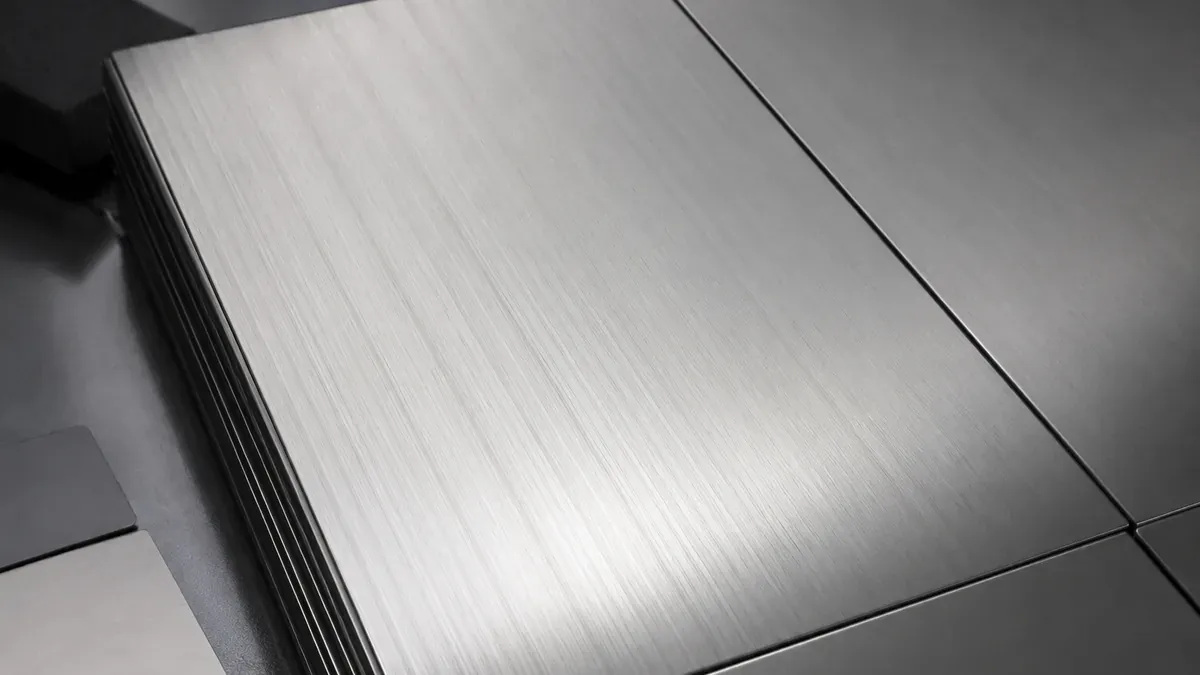
Incoming surface to delivered finish
Finish Class and Process Route
Finish class
Fine directional mechanical finish characterized by long continuous parallel lines.
Incoming-surface dependency
Flatness, coil origin, mill tone, scratches, dents, and prior polishing influence the finished panel. The long-grain route can refine a suitable substrate but cannot reliably erase deep defects or correct shape that distorts reflected light.
| Stage | Control to state | Risk if omitted |
|---|---|---|
| Panel and substrate selection | Group visible panels by grade, thickness, substrate coil, and flatness requirement before polishing. | Mixed substrates can produce different tone and grain response even when processed on the same line. |
| Long-belt polishing | Approve the production abrasive sequence, feed direction, overlap, line density, and retained master sample. | Short strokes, stop-start motion, belt wear, or machine changes can create bands that interrupt the intended continuous grain. |
| Panel mapping and film | Mark grain arrow, panel position, face, drawing revision, and film before release. | Rotation or panel substitution may create a visible mismatch after installation. |
| Final assembly inspection | Inspect representative adjacent panels under the project light direction and viewing distance. | Individually acceptable sheets can form an unacceptable wall because reflections and seams are evaluated as an assembly. |
Measurable and visual controls
Acceptance Criteria
| Criterion | What to specify | Boundary |
|---|---|---|
| Master sample | Retain an approved production sample that records substrate, machine route, abrasive sequence, and viewing condition. | A verbal hairline designation does not define line density, gloss, color, or roughness. |
| Grain continuity | Show arrows and joint relationships on the panel map, including bends, returns, doors, reveals, and trim. | A grain change may be intentional only when the approved design drawing identifies it. |
| Panel match | Define acceptable tone and grain variation across adjacent panels and replacement lots under installed lighting. | Future replacements may require a newly approved match if the original substrate and polishing campaign are unavailable. |
| Visual defects | Set limits for start-stop bands, cross scratches, local polish patches, stains, dents, waviness, and film imprint. | Inspection must distinguish removable film marks from damage in the metal surface. |
| Measured values | Add directional roughness or gloss methods only when they support the approved visual standard. | A single Ra value cannot describe grain length, line continuity, tone, or reflected appearance. |
Preserve the ordered surface
Fabrication, Cleaning, Film, and Packing
| Stage | Effect on finish | Required control |
|---|---|---|
| Nesting, cutting, and bending | Part rotation, cut heat, burr, and die contact can interrupt or damage the grain. | Lock grain direction in CAD and labels, protect the critical face, and inspect a formed first article. |
| Welding and corner finishing | Local blending can create short arcs, halos, or inconsistent line density around joints. | Qualify the joint route with the same final grain direction and approve full-size corners and returns. |
| Installation and cleaning | Misordered panels, adhesive, sealant, abrasive wiping, and uneven lighting reveal mismatch. | Install by panel map, remove film within the stated window, clean along the grain, and perform assembly-level inspection. |
Finish-specific disputes
Defects, Causes, and Prevention
| Defect | Likely cause | Prevention input |
|---|---|---|
| Start-stop polishing bands | Interrupted feed, short manual strokes, belt splice, or pressure changes create visible transverse zones. | Use a qualified continuous route, control feed and belt condition, and inspect full panel length under grazing light. |
| Grain-direction mismatch | Drawing arrows, nesting, labels, or installation sequence may be missing or ignored. | Put grain arrows on CAD, parts, film, crates, and panel maps, then verify orientation before fixing panels. |
| Adjacent-panel shade variation | Different coils, substrate finishes, polishing campaigns, film age, or viewing angle can alter apparent color. | Batch visible sets, dry-lay representative panels, retain a master, and define the replacement-match approval process. |
Application-led choice
Where This Finish Fits
| Use case | Selection guidance | Approval boundary |
|---|---|---|
| Elevator doors and interior wall panels | Use hairline with a panel map, vertical or designed grain direction, batch control, edge protection, and installed-light review. | Door forming, cutouts, returns, and replacement panels must be included in sample approval. |
| Decorative profiles and trim | Specify how grain runs through corners, joints, curved sections, and separate profile lots. | A flat-sheet master may not predict appearance on roll-formed or welded profiles. |
| Hygiene-critical process contact surfaces | Choose a functional roughness and cleaning specification based on geometry and fabrication rather than a visual hairline name. | Directional appearance alone does not establish cleanability or sanitary acceptance. |
Copy structure, replace values
Purchase Description Example
Continue the specification
Products, Grades, Standards, and Applications
Product forms
Grade datasheets
Product and finish standards
Application briefs
Buyer questions
Frequently Asked Questions
Is hairline the same as No.4 stainless finish?
Not necessarily. Both are directional abrasive finishes, but hairline usually describes a finer, longer, more continuous linear grain. Neither term fixes one grit or gloss, so compare production samples and specify grain, measurement, and viewing criteria.
How should hairline direction be controlled across panels?
Show grain arrows on drawings, nesting files, film, parts, crates, and the installation panel map. Review bends and returns, then inspect adjacent panels under the project lighting before final acceptance.
Can a replacement hairline panel match an older installation?
A close match may be possible, but substrate lot, polishing line, belt condition, aging, cleaning, and light can differ. Retain a master sample and require replacement approval against the installed assembly rather than only a generic finish name.
Published by Tsingshan (Shandong) Iron & Steel Co., Ltd..Sources, update policy and technical limitations.
Quotation package
What to Include in the RFQ
- Material standard, grade, substrate finish, thickness, and dimensions
- Hairline production route and retained master sample
- Critical face, grain arrows, panel map, and batch grouping
- Visual lighting, viewing distance, roughness or gloss method
- Cutting, bending, welding, corner, and replacement-panel details
- Film type, marking, cleaning, and installation sequence
- Inspection, interleaving, crate layout, edge protection, and destination
Quote request
Get a Stainless Steel Quote
Send the product, grade and quantity you already have. We will complete the specification and quote the supply route.