
Surface procurement brief
Embossed Stainless Steel Sheet Finish
Choose embossed stainless when a repeatable raised or recessed pattern is required for appearance, stiffness, grip, or damage masking and the project can approve the exact supplier tooling. Pattern names are not universal across producers, and the finished overall thickness is not the same as the starting base-metal thickness. The RFQ should identify the physical sample or tool code, base grade and finish, base thickness, overall envelope or pattern depth where functional, pattern direction, critical face, panel layout, flatness, forming sequence, visible-joint relationship, protective film, and packing.
- Use this guide for
- Patterned sheet tooling, thickness, orientation, forming, and sample approval for a quotable RFQ
- Relevant to
- Elevator, architectural, flooring, transport, equipment-skin, kitchen, and decorative-panel buyers
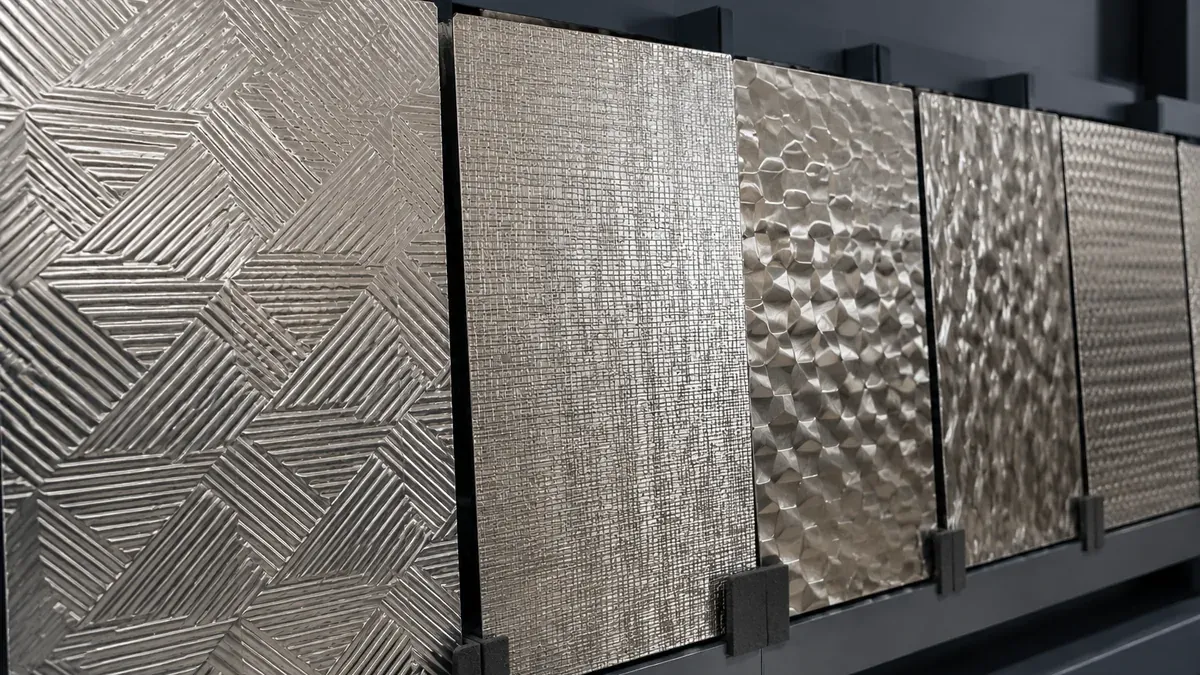
Incoming surface to delivered finish
Finish Class and Process Route
Finish class
Three-dimensional patterned stainless flat product produced by controlled rolling or pressing with dedicated tooling.
Incoming-surface dependency
Base grade, base thickness, mill or decorative finish, hardness, flatness, coil condition, and surface defects influence pattern definition and forming response. Embossing redistributes shape and apparent stiffness but does not repair pits, dents, coil set, or unsuitable mechanical properties.
| Stage | Control to state | Risk if omitted |
|---|---|---|
| Tooling and substrate selection | Approve the exact pattern sample or tool reference and define grade, base thickness, starting finish, hardness or condition, width, and critical face. | Similar trade names can represent different pitch, depth, geometry, gloss, and reverse-side appearance. |
| Pattern rolling or pressing | Control tool alignment, rolling direction, load, feed, repeat, edge margin, and whether one or both rolls form the profile. | Pressure and alignment variation can change depth, stretch the sheet, drift the pattern, or mark the critical face. |
| Leveling, slitting, and cutting | Define acceptable leveling, pattern registration at cut edges, sheet size, squareness, edge, and panel repeat alignment. | Aggressive leveling can flatten relief, while slitting and cutting can leave pattern mismatch, burr, or dimensional drift. |
| Film, identification, and packing | Use film compatible with the relief, mark pattern direction and panel sequence, interleave, support the profile, and prevent crate pressure. | Film bridging, nested sheets, straps, or concentrated loads can polish or flatten high points during transport. |
Measurable and visual controls
Acceptance Criteria
| Criterion | What to specify | Boundary |
|---|---|---|
| Pattern identity | Reference an approved physical production sample, tool code, revision, image, and orientation rather than relying on a generic pattern name. | Tool codes and names are supplier-specific and cannot be assumed interchangeable. |
| Base and overall thickness | State starting base-metal thickness and tolerance separately from overall embossed envelope, peak height, or pattern depth. | A caliper across raised features does not report the remaining base-metal thickness. |
| Pitch, depth, and registration | Define measurement method, locations, allowed variation, repeat alignment, edge margin, and panel-to-panel pattern relationship where functional. | Decorative visual approval may remain necessary even when measured geometry passes. |
| Surface and critical face | Identify raised or recessed visible face, base finish, gloss, scratches, roll marks, flattened peaks, stains, and reverse-side limits. | One approved face does not imply identical pattern or cosmetic quality on the reverse. |
| Shape and panel layout | State flatness or support condition, dimensions, squareness, pattern direction, panel map, joint alignment, and replacement rule. | Embossing can change sheet shape; surface designation does not replace dimensional acceptance. |
Preserve the ordered surface
Fabrication, Cleaning, Film, and Packing
| Stage | Effect on finish | Required control |
|---|---|---|
| Nesting and cutting | Rotated parts, cut positions, burr, and heat can interrupt pattern repeat or reverse the visual direction. | Lock orientation in CAD, place datums against the pattern, and label every visible part and offcut. |
| Bending and roll forming | Dies can flatten high points, mark the critical face, change pitch near bends, and produce different springback. | Use pattern-compatible tooling and approve a formed first article with the actual bend radius and orientation. |
| Welding and joining | Heat, grinding, seam placement, and local pressure can erase the relief or misalign adjacent repeats. | Put seams in the panel map, qualify joint details, and avoid unapproved local texture repair. |
| Installation and cleaning | Uneven backing, fastener pull, sealant, abrasive wiping, and dirt retention alter appearance at peaks and recesses. | Define support, fixing, cleaning tools, panel sequence, and installed-light acceptance. |
Finish-specific disputes
Defects, Causes, and Prevention
| Defect | Likely cause | Prevention input |
|---|---|---|
| Pattern-depth variation | Tool wear, load, base thickness, hardness, feed, or leveling can alter peak and valley geometry. | Qualify the substrate and machine window, sample across width and length, and monitor the approved measurement points. |
| Pitch drift or pattern misregistration | Roll synchronization, feed slip, cutting datum, or panel orientation can move repeats relative to edges and joints. | Use tool and panel datums, inspect repeat and edge margin, and dry-lay visible panel sets. |
| Flattened or polished high points | Leveling, forming dies, sheet nesting, straps, or installation pressure can compress or brighten the relief. | Limit contact pressure, use shaped separators and tooling, and inspect after forming and unpacking. |
| Edge cracking or dimensional distortion | Pattern strain, unsuitable base condition, tight bends, and cut geometry can concentrate deformation. | Select a suitable substrate, run representative forming trials, define edge and bend orientation, and inspect the finished component. |
Application-led choice
Where This Finish Fits
| Use case | Selection guidance | Approval boundary |
|---|---|---|
| Elevator and architectural wall panels | Use a tooling-specific sample, vertical or designed orientation, panel map, repeat alignment, support method, batch grouping, and installed-light review. | A small sample cannot establish full-wall joint alignment or reflection across formed panels. |
| Floors, steps, and grip surfaces | Specify actual load, environment, drainage, cleaning, edge, and project-approved slip test on the delivered configuration. | An embossed appearance or pattern name does not establish slip resistance or structural capacity. |
| Equipment skins and formed covers | Qualify cutting, bending, fastening, cleanability, and protective packing on the actual pattern and base thickness. | Relief can trap soil or flatten at tooling contact, so functional suitability depends on the completed geometry. |
Copy structure, replace values
Purchase Description Example
Continue the specification
Products, Grades, Standards, and Applications
Product forms
Product and finish standards
Application briefs
Buyer questions
Frequently Asked Questions
Is embossed-sheet overall thickness the same as base thickness?
No. Overall thickness includes the raised pattern envelope. Specify the starting base-metal thickness and tolerance separately from peak height, pattern depth, or overall envelope.
Can the same embossed pattern name be sourced from any mill?
Not reliably. Pattern names and tool codes are supplier-specific. Approve a physical production sample and record tool reference, pitch, depth, orientation, base finish, and critical face.
Does embossed stainless automatically provide slip resistance?
No. Slip response depends on pattern, direction, contamination, footwear, drainage, wear, and test method. Require project-specific testing on the delivered configuration where safety depends on it.
Published by Tsingshan (Shandong) Iron & Steel Co., Ltd..Sources, update policy and technical limitations.
Quotation package
What to Include in the RFQ
- Material standard, edition, grade, base condition, starting finish, and dimensions
- Physical sample, tool code and revision, pattern image, raised or recessed critical face, and orientation
- Starting base thickness, overall envelope, depth, pitch, edge margin, and measurement method
- Flatness, squareness, panel repeat, joint alignment, batch grouping, panel map, and replacement rule
- Slitting, cutting, forming, bend direction, welding, joining, fastening, and installation route
- Visual defects, flattened peaks, reverse-side quality, functional tests, inspection, and witness requirements
- Film, separators, pressure protection, sequence labels, packing, destination, and quantity
Quote request
Get a Stainless Steel Quote
Send the product, grade and quantity you already have. We will complete the specification and quote the supply route.