
Surface procurement brief
No.3 Brushed Stainless Steel Finish
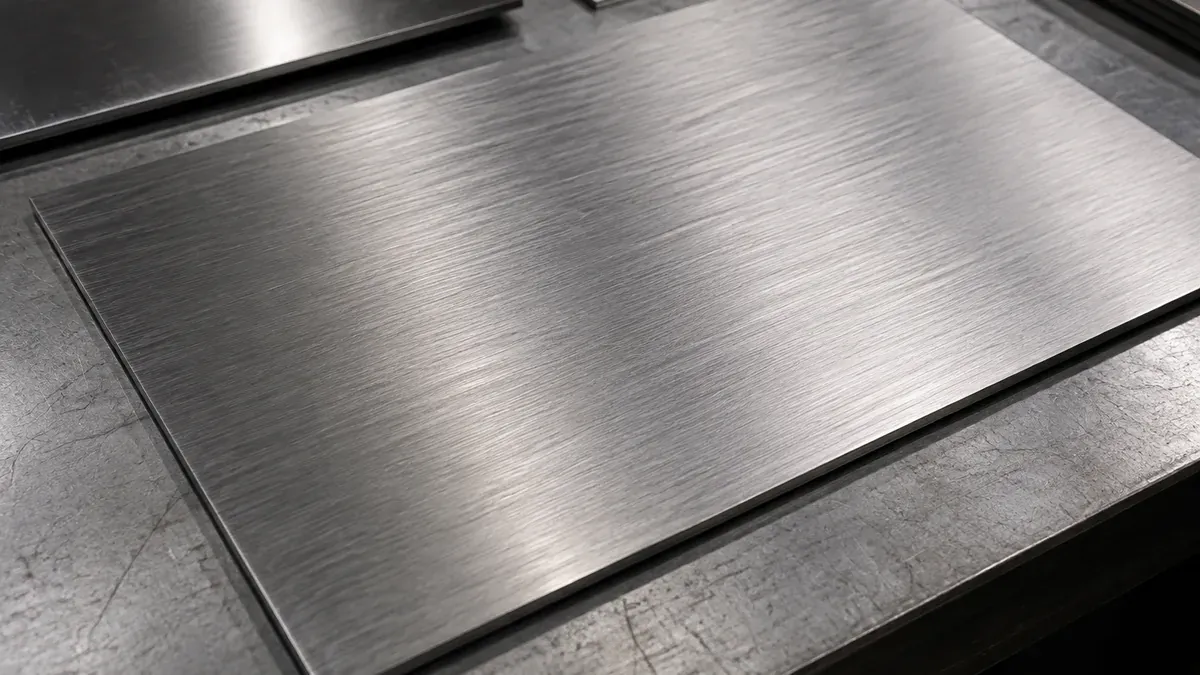
Select No.3 when a visibly coarse directional abrasive texture is acceptable as the final industrial surface or is required as a controlled intermediate stage before finer polishing. The designation does not fix one grit, roughness, gloss, line density, or removal depth. The order should state the base surface, intended final or intermediate role, production abrasive sequence or sample, grain direction, critical face, edge condition, forming and welding route, defect limits, film, inspection, and later finishing responsibility.
- Use this guide for
- Coarse directional finish or intermediate polishing route selection
- Relevant to
- Industrial-equipment, fabricated-component, polishing, and non-critical-panel buyers
Incoming surface to delivered finish
Finish Class and Process Route
Finish class
Coarse directional mechanical abrasive finish, used either as a final industrial texture or a preparation stage.
Incoming-surface dependency
Mill finish, flatness, weld profile, scale, scratches, and prior conditioning determine how much material must be removed. A No.3 pass can expose pits or inclusions and cannot correct severe waviness or deep damage without a separately approved repair route.
| Stage | Control to state | Risk if omitted |
|---|---|---|
| Substrate review | Identify 2B, No.1, welded fabrication, or another starting condition and define allowable incoming defects. | Different substrates require different removal and can produce dissimilar texture under the same nominal abrasive. |
| Coarse abrasive finishing | Approve belt type and sequence or a production sample, grain direction, pressure, feed, and edge treatment. | Uncontrolled pressure or worn belts can create deep grooves, chatter, and edge rounding. |
| Intermediate or final release | State whether No.3 is the delivered final surface or a preparation for No.4, hairline, coating, or another finish. | A supplier may stop at a texture that does not provide the stock-removal consistency required by the next process. |
| Cleaning, film, and packing | Remove abrasive residue, inspect cross scratches, and choose protection appropriate to a coarser grain. | Residue or trapped grit can continue scratching during transport and contaminate later finishing. |
Measurable and visual controls
Acceptance Criteria
| Criterion | What to specify | Boundary |
|---|---|---|
| Finish role | Identify No.3 as final industrial appearance or as an intermediate polishing stage. | Acceptance differs when the surface remains visible versus when it will be refined later. |
| Abrasive texture | Use a production sample and, where required, directional roughness measurements with stated method and locations. | No.3 does not map to one international grit or Ra value. |
| Grain and coverage | State direction, full-area coverage, acceptable overlap, and treatment at edges, holes, corners, and welds. | Machine and manual zones may differ unless the transition is qualified. |
| Defects | Define limits for deep grooves, cross scratches, chatter, missed areas, stains, dents, and excessive edge rounding. | A coarse texture does not make mechanical damage irrelevant. |
| Stock removal | Where dimensional or later-polish critical, state remaining thickness and removal allowance. | Surface finishing can affect thin sheet, sharp edges, and dimensional features. |
Preserve the ordered surface
Fabrication, Cleaning, Film, and Packing
| Stage | Effect on finish | Required control |
|---|---|---|
| Cutting and forming | A coarse visible grain can be damaged by tools, stretched at bends, or misoriented during nesting. | Lock grain direction, protect the face, clean tooling, and inspect the formed component. |
| Welding and repair | Joint preparation and blending can leave swirls, gouges, and local texture changes. | Define the blend area and abrasive progression, and prohibit unapproved rotary repair on directional faces. |
| Later No.4 or hairline finishing | Deep No.3 grooves may remain if the next stage removes insufficient material or changes direction. | Qualify the complete sequence and define whether intermediate groove removal is visually or measurably complete. |
| Cleaning and transport | Loose abrasive and metal debris can transfer to other sheets or processes. | Vacuum and clean the surface, segregate polishing media, interleave, and keep packaging dry. |
Finish-specific disputes
Defects, Causes, and Prevention
| Defect | Likely cause | Prevention input |
|---|---|---|
| Excessively deep grooves | Coarse or damaged belts, high pressure, low feed, or repeated local work can cut below the approved texture. | Control the abrasive sequence and belt life, monitor removal, and reject local correction that risks thickness or visual mismatch. |
| Missed strips or overlap bands | Feed spacing, belt width, machine setup, or manual access may leave alternating texture zones. | Inspect complete coverage under grazing light and qualify transition zones around geometry and welds. |
| Rounded edges and altered features | Concentrated abrasive contact removes material faster at corners, holes, and narrow sections. | Mask or fixture critical geometry, limit dwell, and inspect dimensions after finishing where function requires it. |
Application-led choice
Where This Finish Fits
| Use case | Selection guidance | Approval boundary |
|---|---|---|
| Industrial panels and equipment backs | Use No.3 when a coarse directional texture is acceptable and the order clearly defines critical areas and defect limits. | Visible customer-facing assemblies may need a finer or sample-controlled route. |
| Intermediate polishing stage | Use No.3 to establish consistent directional removal before No.4 or another finer finish under one qualified sequence. | Do not accept intermediate finish independently of the final-surface trial and remaining-thickness requirement. |
| Cleanable process-contact parts | Specify functional roughness, geometry, weld finish, cleaning, and inspection rather than relying on No.3 terminology. | Coarse grain may be unsuitable for some cleaning duties and does not establish hygienic acceptance. |
Copy structure, replace values
Purchase Description Example
Continue the specification
Products, Grades, Standards, and Applications
Product forms
Grade datasheets
Product and finish standards
Application briefs
Buyer questions
Frequently Asked Questions
Is No.3 defined by one abrasive grit?
No. Grit references vary with abrasive type, equipment, substrate, pressure, feed, and sequence. Use an approved production sample and add directional roughness or removal requirements where they matter.
Can No.3 be ordered as an intermediate finish before No.4?
Yes, but the purchase order should identify the complete qualified sequence, required groove removal, remaining thickness, process owner, and final-surface acceptance. The intermediate label alone cannot assure the No.4 result.
Does the coarse grain hide all scratches and fabrication marks?
No. Cross scratches, gouges, missed areas, weld-repair swirls, dents, and edge rounding can remain conspicuous. Define viewing conditions and defect limits for the delivered or finished component.
Published by Tsingshan (Shandong) Iron & Steel Co., Ltd..Sources, update policy and technical limitations.
Quotation package
What to Include in the RFQ
- Material standard, grade, form, dimensions, and substrate
- No.3 final or intermediate role
- Approved abrasive route or production sample
- Critical face, grain direction, coverage, and edge treatment
- Roughness, removal, remaining-thickness, and defect criteria
- Cutting, forming, welding, repair, and later finish sequence
- Cleaning, film, inspection, traceability, interleaving, packing, and destination
Quote request
Get a Stainless Steel Quote
Send the product, grade and quantity you already have. We will complete the specification and quote the supply route.