
Surface procurement brief
Mirror and 8K Stainless Steel Finish
Choose mirror or 8K when a highly reflective decorative surface is central to the design and the project can control substrate flatness, panel size, polishing, fabrication, installation, and handling. The commercial name does not establish optical-mirror accuracy, one reflectance value, zero waviness, or identical appearance between unrelated batches. A repeatable order uses a full-size or representative master sample together with the base grade and finish, critical face, panel map, viewing conditions, acceptable image distortion, edge treatment, film, fabrication sequence, replacement-panel rule, and protected packing.
- Use this guide for
- Reflective decorative sheet and fabricated-panel finish approval for a quotable RFQ
- Relevant to
- Architectural metal, elevator, signage, interior-fit-out, and decorative fabrication buyers
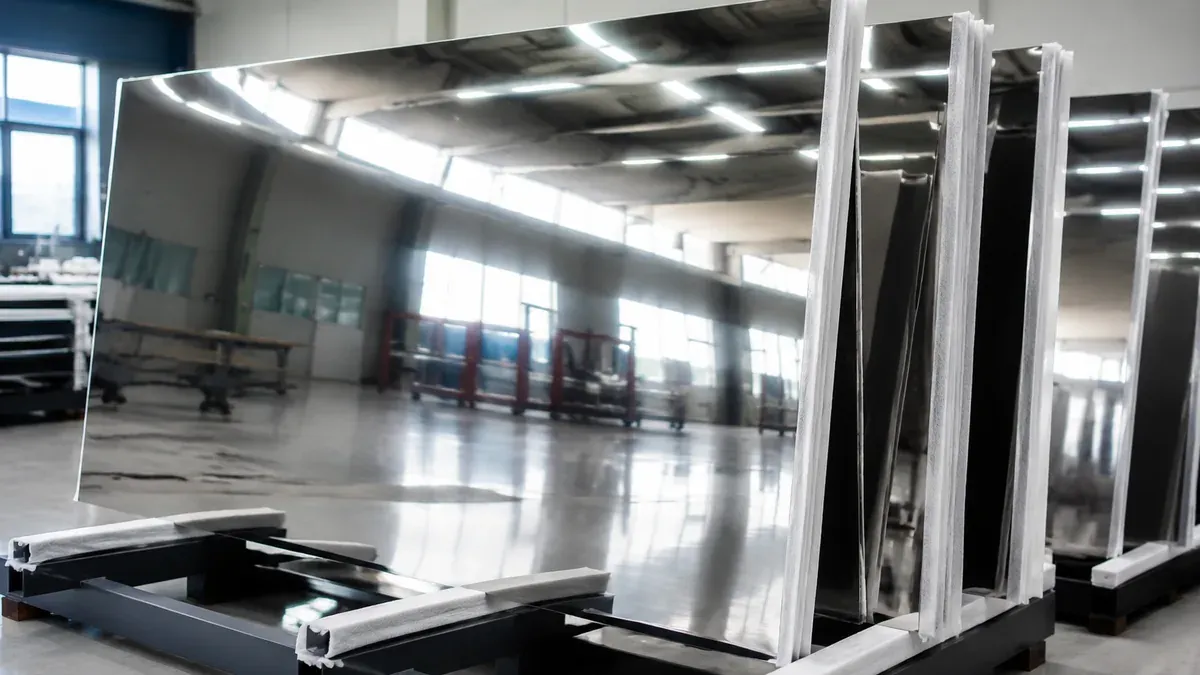
Incoming surface to delivered finish
Finish Class and Process Route
Finish class
Multi-stage mechanical polishing and buffing route intended to produce a highly reflective decorative stainless surface.
Incoming-surface dependency
Sheet flatness, coil set, thickness, residual stress, mill marks, pits, welds, and local repairs remain important after polishing. A reflective surface magnifies waves and dents; polishing can reduce fine indications but cannot economically convert an unsuitable substrate into an optically flat panel.
| Stage | Control to state | Risk if omitted |
|---|---|---|
| Substrate and panel review | Define grade, thickness, flatness, panel size, base finish, critical face, and whether polishing occurs before or after fabrication. | Thin, stressed, welded, or poorly leveled material may distort or reveal substrate marks after the surface becomes reflective. |
| Progressive abrasive polishing | Qualify the abrasive sequence, removal allowance, feed direction, belt condition, edge treatment, and transition between machine and manual zones. | Skipped stages, contaminated abrasives, or uneven pressure can leave deep lines, cloudy bands, pinholes, and rounded edges. |
| Fine polishing and buffing | Use the approved production sample to control reflectivity, haze, residual lines, and image character without prescribing proprietary settings. | Local buffing may change gloss or create swirls, heat tint, and non-uniform reflection. |
| Cleaning, film, and release | Inspect under agreed lighting before applying compatible film, clean separators, edge protection, and rigid export packing. | Film imprint, trapped particles, fingerprints, crate pressure, and sheet movement are conspicuous on the finished face. |
Measurable and visual controls
Acceptance Criteria
| Criterion | What to specify | Boundary |
|---|---|---|
| Approved reflective sample | Retain a signed production-representative sample with substrate, direction, panel size, light source, viewing distance, and revision identified. | A small coupon may not reveal full-panel waviness, seam mismatch, or reflected-image distortion. |
| Reflectivity and haze | Use a visual master and add a stated instrument, geometry, direction, and range only where measurable optical response matters. | The 8K name does not define one universal reflectance, gloss, or haze value. |
| Flatness and image distortion | State dimensional flatness separately and define the acceptable reflected-image character on the installed or supported panel. | Product-standard flatness and decorative reflection are related but are not the same acceptance test. |
| Defects and critical face | Define limits for residual lines, haze bands, pits, pinholes, dents, swirls, edge damage, film marks, and local repair on each face. | A highly polished surface makes minor substrate and handling indications more visible; it does not eliminate them. |
| Panel and replacement matching | Identify visible sets by coil and polishing campaign, panel sequence, orientation, and replacement approval route. | A later replacement may require a new comparison sample when the original material and polishing campaign are unavailable. |
Preserve the ordered surface
Fabrication, Cleaning, Film, and Packing
| Stage | Effect on finish | Required control |
|---|---|---|
| Cutting and forming | Laser spatter, support tables, dies, bending, and springback can mark or distort the reflective face. | Validate film and tooling, orient the critical face, control cut heat, and approve a formed first article. |
| Welding and local blending | Heat tint, shrinkage, grinding, and manual buffing change reflection around seams and corners. | Qualify full-size joints, corners, returns, and blend zones before production; place seams where the panel map permits. |
| Installation | Fastener pull, backing irregularity, sealant, panel stress, and lighting can reveal waves or mismatch that were not obvious on a rack. | Define support, fixing sequence, protective-film removal, panel orientation, and installed-light acceptance. |
| Cleaning and maintenance | Abrasive cloths, contaminated tools, aggressive chemistry, and wiping marks can permanently change gloss. | Provide a tested cleaning procedure and isolate tools used on carbon steel or coarser stainless finishes. |
Finish-specific disputes
Defects, Causes, and Prevention
| Defect | Likely cause | Prevention input |
|---|---|---|
| Reflected-image waviness | Substrate flatness, residual stress, polishing pressure, forming, or uneven support can distort reflections. | Select suitable substrate, agree panel-scale acceptance, control polishing and forming, and inspect the supported assembly. |
| Residual polishing lines or cloudy bands | Incomplete abrasive progression, worn media, unequal feed, or local rework can remain visible after buffing. | Qualify the full sequence, inspect under grazing and diffuse light, and restrict unapproved spot repair. |
| Pinholes and exposed substrate pits | Base-metal inclusions, scale pits, weld porosity, or deep scratches may emerge as surrounding metal is removed. | Set incoming-surface limits, inspect after intermediate stages, and agree whether repair or rejection applies. |
| Film imprint and handling damage | Wrong adhesive, excessive storage heat, trapped debris, impact, or sheet movement can mark the face. | Validate film shelf life and removal, keep contact materials clean, protect edges, and use rigid non-abrasive packing. |
Application-led choice
Where This Finish Fits
| Use case | Selection guidance | Approval boundary |
|---|---|---|
| Elevator and architectural wall panels | Use a full panel map, master sample, orientation arrows, batch grouping, edge detail, fixing method, and installed-light review. | The finish name alone cannot control large-panel reflection or adjacent-panel matching. |
| Signage and small decorative components | Mirror 8K can suit parts where size and geometry allow controlled polishing and protected handling. | Cut edges, bends, welds, lettering, and adhesive application require their own finish trial. |
| Optical or precision reflective equipment | Specify the actual optical, shape, and measurement requirements and qualify a specialist route. | Commercial mirror or 8K stainless is not automatically an optical mirror specification. |
Copy structure, replace values
Purchase Description Example
Continue the specification
Products, Grades, Standards, and Applications
Product forms
Grade datasheets
Product and finish standards
Application briefs
Buyer questions
Frequently Asked Questions
Is mirror 8K stainless an optical mirror?
Not by designation alone. Commercial mirror or 8K describes a highly reflective polishing route, while optical work requires separate reflectance, surface shape, distortion, measurement, and support specifications.
Why can a mirror-polished sheet look wavy after installation?
Reflection amplifies sheet flatness, residual stress, forming, fastener pull, backing irregularity, and lighting. Approve representative panel size and inspect the supported assembly rather than relying only on a small flat coupon.
Should mirror polishing be completed before or after fabrication?
That depends on cutting, bending, welding, access, and visual requirements. Pre-polished sheet needs exceptional protection and local joints may not match; post-fabrication polishing needs access and can alter geometry. Qualify the complete route.
Published by Tsingshan (Shandong) Iron & Steel Co., Ltd..Sources, update policy and technical limitations.
Quotation package
What to Include in the RFQ
- Material standard, edition, grade, thickness, dimensions, edge, and substrate finish
- Critical face, one-side or two-side polish, and panel map
- Approved sample, reflectivity or gloss method, viewing light, distance, and image-distortion limit
- Flatness, panel support, orientation, batch matching, and replacement rule
- Abrasive progression, polishing direction, removal allowance, and edge treatment
- Cutting, forming, welding, joining, final buffing, and installation sequence
- Film compatibility and removal window, separators, rigid packing, labels, destination, and quantity
Quote request
Get a Stainless Steel Quote
Send the product, grade and quantity you already have. We will complete the specification and quote the supply route.