
Surface procurement brief
Bead-Blasted Stainless Steel Finish
Choose bead blasting when a non-directional, low-glare texture is required on sheet, tube, profiles, weldments, or completed fabrications. The result depends on the incoming surface, media material and size, equipment, pressure, distance, angle, coverage, geometry, and post-blast treatment. A bead-blasted label does not define one roughness, shade, contamination level, or corrosion result. The RFQ should identify stainless-dedicated media, the approved sample, critical areas, roughness method if functional, treatment of welds and shielded zones, cleaning or passivation, inspection, and protected packing.
- Use this guide for
- Low-glare textured surface and post-fabrication cleaning route selection
- Relevant to
- Architectural panel, machine enclosure, welded fabrication, restoration, and industrial equipment buyers
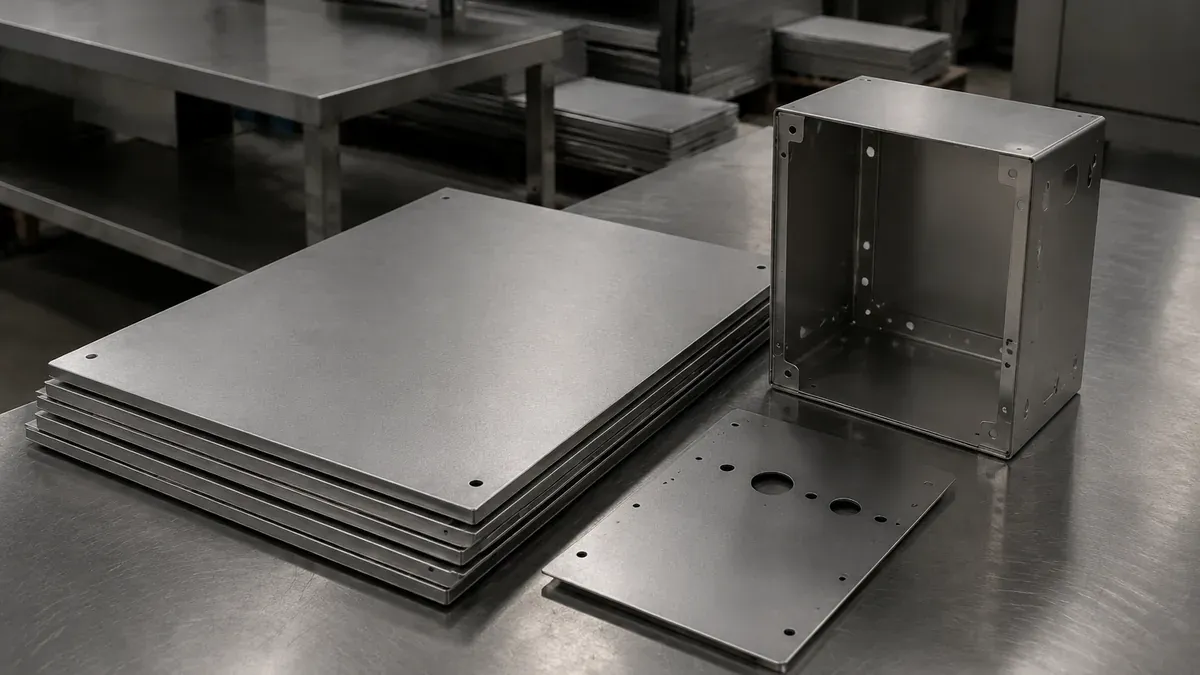
Incoming surface to delivered finish
Finish Class and Process Route
Finish class
Mechanical impact treatment using controlled clean blasting media to create a matte, generally non-directional stainless surface.
Incoming-surface dependency
Mill finish, scale, heat tint, weld profile, previous grinding, pits, scratches, and component geometry affect coverage and final tone. Blasting follows the substrate rather than leveling it, and it can expose defects or make manual repair zones visible.
| Stage | Control to state | Risk if omitted |
|---|---|---|
| Degreasing and substrate preparation | Define incoming finish, weld treatment, oil removal, masking, and defects that must be corrected before blasting. | Oil, scale, adhesive, deep scratches, and inconsistent grinding can cause patchy texture or prevent uniform media contact. |
| Media and equipment qualification | State media type and particle range, require equipment and media protected from carbon-steel contamination, and approve a production sample. | Dirty or mixed media may embed free iron, while changed particle size or worn media alters texture and roughness. |
| Controlled blasting | Qualify pressure, angle, stand-off, traverse, coverage, masking, and access for edges, welds, corners, and internal areas. | Unequal exposure creates shadowing, overlap bands, over-worked edges, and different texture on machine and manual zones. |
| Cleaning and final treatment | Remove dust and media, rinse or clean as specified, and define whether a separate passivation procedure follows. | Retained particles, poor rinsing, or assuming blasting equals passivation can leave contamination and later staining. |
Measurable and visual controls
Acceptance Criteria
| Criterion | What to specify | Boundary |
|---|---|---|
| Texture sample | Approve a sample made with the ordered alloy, starting finish, media, equipment family, and representative geometry. | A photograph or verbal matte description cannot establish particle pattern, shade, or tactile response. |
| Roughness | Where function requires it, state Ra or another parameter with instrument, cutoff, direction, locations, and sampling plan. | One roughness value cannot fully describe visual uniformity, embedded media, or coverage. |
| Coverage and critical zones | Mark faces, welds, interiors, threads, sealing surfaces, machined fits, labels, and masked areas on the drawing. | Shielded or inaccessible geometry may need another treatment route or explicit exclusion. |
| Cleanliness and contamination | Define media segregation, free-iron control, dust removal, rinse condition, and any specified cleanliness or passivation verification. | A visually uniform surface does not prove absence of embedded contamination. |
| Visual defects | Set limits for shadowing, overlap bands, streaks, stains, edge over-blast, dents, pits, and local repair under agreed lighting. | Low glare can mask some marks but does not make damage or inconsistent treatment acceptable. |
Preserve the ordered surface
Fabrication, Cleaning, Film, and Packing
| Stage | Effect on finish | Required control |
|---|---|---|
| Welding and blend preparation | Different weld-metal, heat-affected, and ground zones can respond with different texture and color. | Qualify the weld profile and complete post-weld blasting route on representative joints. |
| Masking and dimensional features | Blasting can change sharp edges, labels, threads, sealing faces, and precision fits. | Mask critical features, control dwell and angle, and inspect dimensions where material change matters. |
| Post-blast forming or repair | Bending, tools, grinding, and local reblasting can create shiny areas or visible patches. | Prefer blasting after major fabrication where geometry permits and approve the repair method before production. |
| Packing and site handling | Oils, dirty gloves, carbon-steel contact, abrasion, and moisture can stain a matte textured surface. | Use clean gloves, segregated contact materials, dry separators, sealed wrap, and protected storage. |
Finish-specific disputes
Defects, Causes, and Prevention
| Defect | Likely cause | Prevention input |
|---|---|---|
| Uneven texture and blast shadowing | Variable angle, distance, pressure, access, traverse, or geometry changes media impact density. | Qualify fixtures and coverage pattern, overlap passes consistently, and inspect representative corners and weldments. |
| Free-iron contamination and rust staining | Shared equipment, carbon-steel dust, contaminated media, racks, or handling tools can transfer iron to the surface. | Use stainless-dedicated media and equipment controls, clean after blasting, and apply the specified contamination verification or passivation route. |
| Over-blasted edges and eroded detail | Concentrated impact at corners, long dwell, or aggressive media can round edges and alter markings or fits. | Mask or fixture critical geometry, reduce exposure, and include dimensional checks after treatment. |
| Patchy weld and repair zones | Different base texture, weld profile, grinding depth, or local reblasting produces visible contrast. | Standardize preparation, blast the complete visual area, and approve a representative welded sample. |
Application-led choice
Where This Finish Fits
| Use case | Selection guidance | Approval boundary |
|---|---|---|
| Architectural and interior panels | Use a panel-scale sample, batch plan, critical-face map, edge detail, cleaning method, and installed-light review. | Low glare does not ensure adjacent-panel color match or resistance to fingerprints and site contamination. |
| Completed machine housings and weldments | Blast after major welding and blending where all required surfaces are accessible and sensitive features can be masked. | Internal pockets, threads, seals, and precision fits may require exclusion or another method. |
| Process-contact or cleaning-critical equipment | Specify functional roughness, weld geometry, cleanliness, contamination verification, and the separate chemical-treatment procedure. | Bead blasting alone does not establish sanitary suitability, passivation, or corrosion performance. |
Copy structure, replace values
Purchase Description Example
Continue the specification
Products, Grades, Standards, and Applications
Product forms
Grade datasheets
Product and finish standards
Application briefs
Buyer questions
Frequently Asked Questions
Does bead blasting automatically passivate stainless steel?
No. Blasting is a mechanical texture process. The order must separately define cleaning, contamination control, and any required pickling or passivation procedure and verification.
Can bead-blasted finish be specified only by an Ra value?
Usually not for visual work. Roughness can support functional acceptance, but media pattern, shade, coverage, embedded contamination, repair zones, and viewing conditions also require a sample and inspection rules.
Why can welded areas look different after bead blasting?
Weld metal, heat-affected zones, grinding, local hardness, and starting texture respond differently to media. Qualify the complete weld preparation and blasting route on a representative joint.
Published by Tsingshan (Shandong) Iron & Steel Co., Ltd..Sources, update policy and technical limitations.
Quotation package
What to Include in the RFQ
- Material standard, edition, grade, form, dimensions, incoming finish, and fabrication condition
- Critical faces, internal and external scope, exclusions, masking, and geometry access
- Media type, particle range, equipment segregation, and contamination controls
- Approved sample, roughness method and locations, viewing light, and defect limits
- Weld, heat-tint, scale, grinding, edge, thread, seal, and machined-feature treatment
- Post-blast dust removal, cleaning, rinsing, pickling or passivation procedure, and records
- Inspection, handling, dry separators, packing, destination, and quantity
Quote request
Get a Stainless Steel Quote
Send the product, grade and quantity you already have. We will complete the specification and quote the supply route.