
Surface procurement brief
Bright Annealed Stainless Steel Finish
Select bright annealed stainless when a smooth reflective mill finish and good forming surface are needed without the directional grain of abrasive polishing. BA is created through controlled-atmosphere annealing, but its brightness, haze, image clarity, and flatness still depend on the incoming strip and mill route. The order must distinguish BA from mirror polishing and define the critical face, approved sample or gloss method, forming sequence, film, visual limits, batch matching, and final protection.
- Use this guide for
- Reflective cold-rolled sheet or coil finish selection
- Relevant to
- Appliance, trim, reflector, kitchen-equipment, and decorative-component buyers
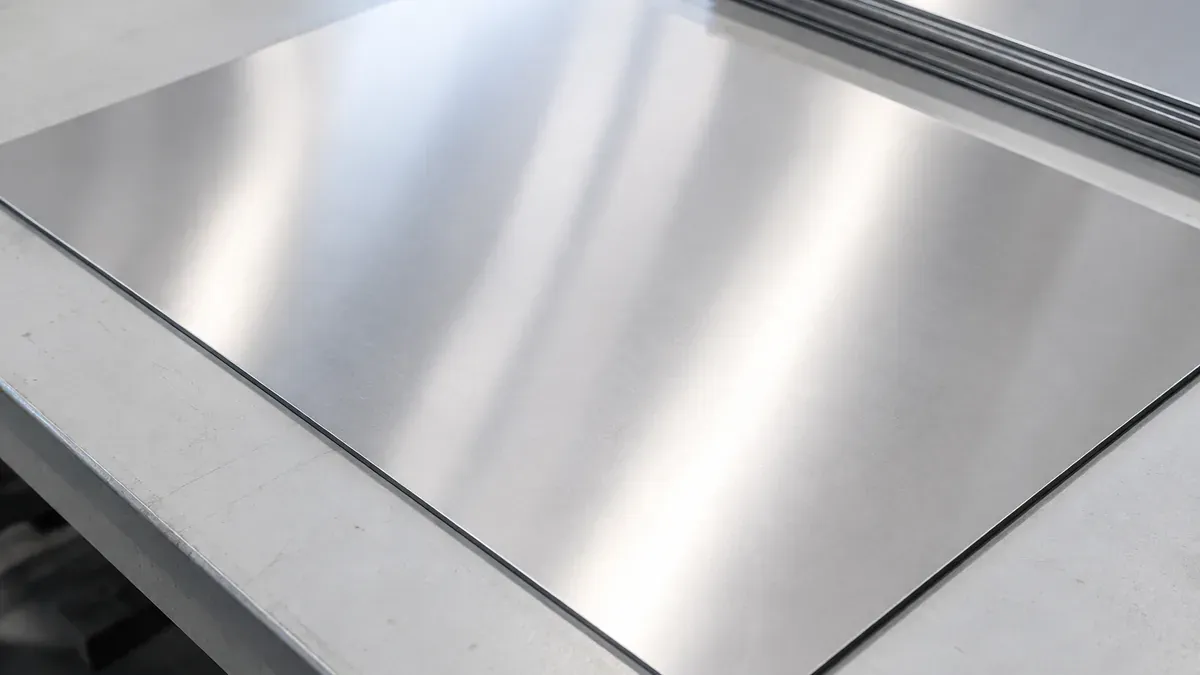
Incoming surface to delivered finish
Finish Class and Process Route
Finish class
Bright cold-rolled mill finish produced by heat treatment in a controlled atmosphere that limits surface oxidation.
Incoming-surface dependency
Cold-reduction quality, cleanliness, roll texture, strip flatness, and the surface entering the furnace are carried into the final appearance. Bright annealing preserves and develops that surface; it does not remove deep roll damage, pits, creases, or geometric waviness.
| Stage | Control to state | Risk if omitted |
|---|---|---|
| Precision cold rolling | Define grade, thickness, width, flatness, and whether the order needs appliance, trim, or forming quality. | Roll texture and strip shape influence final reflection and can expose pressure marks after annealing. |
| Cleaning before annealing | Control rolling-oil removal and strip cleanliness before the furnace. | Residual contamination can create haze, stains, or non-uniform brightness that later polishing may not economically remove. |
| Controlled-atmosphere annealing | Purchase BA to the applicable material standard and approved surface sample without prescribing unverified furnace settings. | Atmosphere, temperature history, and incoming surface affect color and reflectivity; the buyer should accept the delivered result, not infer a proprietary process. |
| Skin pass, film, and packing | State whether a final pass is permitted, identify the critical face, and select film for the intended forming route. | A pass, film adhesive, coil winding, or sheet movement can alter gloss or leave marks on a high-reflectivity face. |
Measurable and visual controls
Acceptance Criteria
| Criterion | What to specify | Boundary |
|---|---|---|
| Brightness and haze | Approve a representative sample or state an agreed gloss method, instrument geometry, direction, and sampling plan. | BA does not establish one universal gloss or haze value. |
| Image clarity | Use a visual reference and viewing distance if reflected-image sharpness matters for the component. | BA is brighter than many 2B surfaces but is not an optical mirror or an 8K polishing specification. |
| Critical face and batch | Mark the visible face, panel orientation, batch grouping, and any adjacent-panel matching requirement. | One-sided visual quality does not imply equivalent appearance on the reverse face. |
| Surface defects | Define acceptance for haze bands, fine roll marks, scratches, stains, dents, edge damage, and film imprint. | Terms such as bright or premium cannot replace a defect list and viewing procedure. |
| Shape and dimensions | Control thickness, flatness, coil set, width, edge, and cut-sheet squareness under the product standard. | A reflective surface makes waviness more visible but BA itself does not define shape tolerance. |
Preserve the ordered surface
Fabrication, Cleaning, Film, and Packing
| Stage | Effect on finish | Required control |
|---|---|---|
| Deep drawing and stamping | Lubricants, dies, blank holders, and stretch can change brightness or create scoring. | Validate film and lubricant compatibility, keep tools clean, and approve a formed sample from production-representative material. |
| Bending and roll forming | The bright face can show die lines, roll pickup, orange peel, and local distortion. | Orient the critical face, protect contact points, and agree the acceptable appearance after forming rather than only on flat sheet. |
| Joining and local finishing | Welding, brazing, heat tint removal, and blending destroy the original BA appearance near the joint. | Define joint placement and the required post-join finish, with a sample where the seam remains visible. |
| Storage and installation | Moisture, film aging, adhesive residue, fingerprints, and edge impacts are conspicuous on a bright surface. | Set film shelf life, removal timing, clean handling, separator material, and installation cleaning method. |
Finish-specific disputes
Defects, Causes, and Prevention
| Defect | Likely cause | Prevention input |
|---|---|---|
| Haze or brightness bands | Incoming strip variation, cleaning, furnace atmosphere, or roll condition may produce longitudinal or cross-strip differences. | Approve a sample range, inspect across width and length, and segregate visible panels by coil and sequence. |
| Fine roll marks | Roll texture, pickup, pressure variation, or particles can repeat through the bright route. | Define the visual threshold, maintain clean rolls and handling surfaces, and inspect before protective film hides the indication. |
| Film imprint or adhesive residue | Incompatible adhesive, heat exposure, aging, pressure, or delayed removal can transfer a pattern or residue. | Select film against the actual forming and storage schedule, document removal conditions, and run a production trial. |
Application-led choice
Where This Finish Fits
| Use case | Selection guidance | Approval boundary |
|---|---|---|
| Appliance trim and bright formed parts | Use BA when a non-directional reflective mill finish can be formed with controlled tooling and film. | Approve the formed appearance because flat-sheet gloss does not predict every draw or bend. |
| Reflectors and lighting components | Specify measurable optical or gloss criteria and sample geometry if reflection performance matters. | Do not use the BA name alone as an optical reflectance or image-clarity guarantee. |
| Mirror-like architectural panels | Compare BA with mechanically polished mirror routes using full-size samples and flatness criteria. | Choose a dedicated mirror specification when high image clarity and polishing control are required. |
Copy structure, replace values
Purchase Description Example
Continue the specification
Products, Grades, Standards, and Applications
Product forms
Grade datasheets
Product and finish standards
Application briefs
Buyer questions
Frequently Asked Questions
Is BA stainless the same as mirror or 8K finish?
No. BA is a bright mill finish created by controlled-atmosphere annealing of cold-rolled material. Mirror or 8K usually involves progressive mechanical polishing and buffing. Compare actual samples, image clarity, flatness, defect limits, and fabrication effects rather than treating the names as interchangeable.
How should gloss be specified for bright annealed sheet?
Name the instrument geometry, measurement direction, sampling positions, condition of the protective film, and acceptance range, or approve a physical sample. A gloss number without method and sampling is not a complete acceptance rule.
Can BA sheet be formed without changing its appearance?
Forming normally changes local reflection and can introduce die lines, scoring, orange peel, or lubricant marks. Tooling, film, lubricant, grain orientation, and draw severity should be validated on a formed sample representative of production.
Published by Tsingshan (Shandong) Iron & Steel Co., Ltd..Sources, update policy and technical limitations.
Quotation package
What to Include in the RFQ
- Material standard, edition, grade, and cold-rolled condition
- Coil or sheet dimensions, tolerance, flatness, and quantity
- BA critical face and coil winding direction
- Approved sample or gloss, haze, and image-clarity method
- Drawing, forming severity, lubricant, and film compatibility
- Defect criteria, batch matching, marking, and inspection report
- Separator, moisture protection, film removal window, packing, and destination
Quote request
Get a Stainless Steel Quote
Send the product, grade and quantity you already have. We will complete the specification and quote the supply route.