
No.4 vs Hairline Stainless Finish: Ordering Fields That Stop Quote Mismatches
Order No.4 vs hairline stainless finish with polish direction, grit or brush route, protective film, sample approval, sheet vs coil and inspection-light fields that stop quote mismatches.
Published Sep 11, 2026 · Technical content updated: Sep 11, 2026 ·Tsingshan (Shandong) Iron & Steel Co., Ltd.

Reference image for this topic; it does not show Tsingshan Steel facilities, inventory or completed orders.
Featured answer
No.4 vs hairline stainless finish ordering fails when the purchase line names only brushed stainless. No.4 is a general directional satin description under common ASTM A480 terminology — typically shorter, interrupted polish lines. Hairline (HL) is a commercial or JIS/trade long continuous grain used on architectural and equipment panels. Freeze polish direction, grit or brush route, protective film, sample approval, sheet versus coil form, and visual inspection light on the same commercial line so quotes, samples and receiving checks describe one finish route.
| Ordering field | Weak line | Stronger No.4 line | Stronger hairline (HL) line |
|---|---|---|---|
| Finish name | Brushed stainless | No.4 directional satin per ASTM A480 terminology + approved sample | Hairline (HL) long continuous grain + approved sample |
| Grain / polish direction | Not stated | Parallel to length (or width) on critical face; panel layout diagram attached | Parallel to length (or width) on critical face; continuous grain across visible joints |
| Grit / brush route | Brushed only | Named grit band or mill brush route when appearance-critical (commercial practice often ~150–180 for No.4 — confirm on sample) | Named grit/brush route for long continuous lines (commercial HL often finer or continuous-belt — confirm on sample) |
| Product form | Stainless plate | Sheet or coil stated; slit/cut edges and critical face named | Sheet or coil stated; long-panel joints and grain continuity named |
| Film | Film if needed | PVC/PE film on polished face; thickness/type and peel timing named | Same; long continuous grain is scratch-sensitive across the grain |
| Sample / inspection | Photo OK | Physical sample ID, retained mill twin, viewing distance and light basis | Same; reject photo-only approval for multi-batch architectural work |
For the broad mill and mechanical finish map (2B, BA, No.4, 8K), use the stainless steel finishes 2B BA No.4 8K guide. This article owns ordering and PO fields that stop No.4 versus hairline quote mismatches.
Ordering fields that make No.4 and hairline quotes incomparable
Treat each missing field as a bid failure mode, not as mill preference.
- Finish identity. No.4 and HL are not automatic synonyms for EN 10088-2 2G/2J or for a grit number. Name the finish the project will accept and attach the sample that owns appearance.
- Polish / grain direction. Directional finishes look different when grain runs with the panel length versus across it. Elevator doors, kitchen fronts and facade modules need direction relative to length, width or an attached layout sketch.
- Grit or brush route. Grit is a process aid, not a full appearance spec. When you name grit, say whether grit, sample match, Ra or gloss owns acceptance. Do not assume one mill’s 180 grit equals another mill’s hairline.
- Critical face and base surface. State which side is polished, whether both sides matter, and the base mill finish (often 2B) before mechanical brushing.
- Sheet versus coil. Coil polish continuity, slit-edge condition and cut-to-length grain alignment differ from cut sheet packs. Name the product form on the same line as the finish.
- Protective film. PVC or PE film type, thickness class, filmed side and removal timing protect directional polish during export and fabrication. Film is part of the commercial line for appearance lots.
- Visual inspection light. Appearance disputes start when one party views under shop fluorescent light and another under showroom LEDs. Freeze distance, angle and light type for sample and lot acceptance.
- Documents. Heat-linked EN 10204 Type 3.1 covers chemistry and named tests. It does not invent a missing sample ID, film rule or polish direction. Keep finish evidence separate when the contract requires it.
Use the general stainless steel purchase order wording examples for grade, size and document freeze language; keep this page focused on No.4 versus HL surface fields.
Side-by-side No.4 vs hairline ordering checklist
Use this checklist before prices are compared. It is the unique ordering artifact for this pair.
| Checklist item | No.4 (directional satin) | Hairline / HL (long continuous grain) | Pass / fail on RFQ |
|---|---|---|---|
| Finish name on PO | No.4 (or ASTM A480 No.4 terminology) | Hairline / HL (trade or JIS-style naming as ordered) | Fail if only brushed |
| Appearance owner | Approved physical sample ID | Approved physical sample ID | Fail if photo-only on critical jobs |
| Grain direction | Length / width / drawing reference | Length / width / drawing reference; joint continuity noted | Fail if omitted |
| Abrasive route | Grit band or brush route when required | Continuous-belt or named HL route when required | Fail if grit used as sole acceptance without sample |
| Reflectivity / roughness | Optional Ra or gloss limit if contractual | Optional Ra or gloss limit if contractual | Fail if unspoken showroom gloss expectation |
| Critical face | Face A / both sides | Face A / both sides | Fail if reverse-side marks surprise receiving |
| Product form | Sheet pack or coil / slit coil | Sheet pack or coil / slit coil | Fail if form changes after award |
| Protective film | Type, side, peel rule | Type, side, peel rule | Fail if bare polished face ships export |
| Inspection light | Named light / distance / angle | Named light / distance / angle | Fail if acceptance light undefined |
| Substitution rule | No HL substitute without written approval | No No.4 substitute without written approval | Fail if silent swap allowed |
| Defect / handling hold | Scratches across grain, film dents, stain under film | Same plus broken continuous lines on visible joints | Fail if no hold rule |
| Documents | Type 3.1 + sample/finish note as ordered | Type 3.1 + sample/finish note as ordered | Fail if MTC treated as polish proof |
Link finish hubs when buyers need visual finish pages: No.4 and hairline finish guides. For sheet or coil commercial pages after the finish line is frozen, see stainless steel sheet and coil product range.
Bid failures when polish direction, grit or film is missing
These failure modes repeat on export brushed-finish awards:
| Missing or weak field | What suppliers quote instead | What receiving sees | Hold rule |
|---|---|---|---|
| Only brushed on RFQ | Mix of No.4-like short grain and HL-like long grain | Panel mismatch across lots | Reject silent finish-family swap |
| No grain direction | Grain along coil length by mill default | Door or facade modules with crossed grain | Hold until layout direction confirmed |
| Grit number without sample | Lowest-cost grit that still reads brushed | Gloss and line continuity differ from mock-up | Sample owns acceptance; grit is supporting only |
| No film on polished face | Bare export wrap | Rub marks, water stains, handling scratches across grain | Hold damaged face; do not install as architectural first quality |
| Sheet awarded, coil delivered (or reverse) | Different polish continuity and cut strategy | Edge and joint appearance diverge from sample | Re-approve form change in writing |
| Photo approval only | Phone photos under unknown light | Lot fails under site light | Require physical sample + named inspection light |
| MTC only | Chemistry correct 304/316L | Finish not matching mock-up | Type 3.1 is not polish acceptance |
Surface defect language for dents, stains and scratches belongs with the stainless steel sheet surface defects inspection checklist. Keep No.4 versus HL identity and ordering fields on this page.
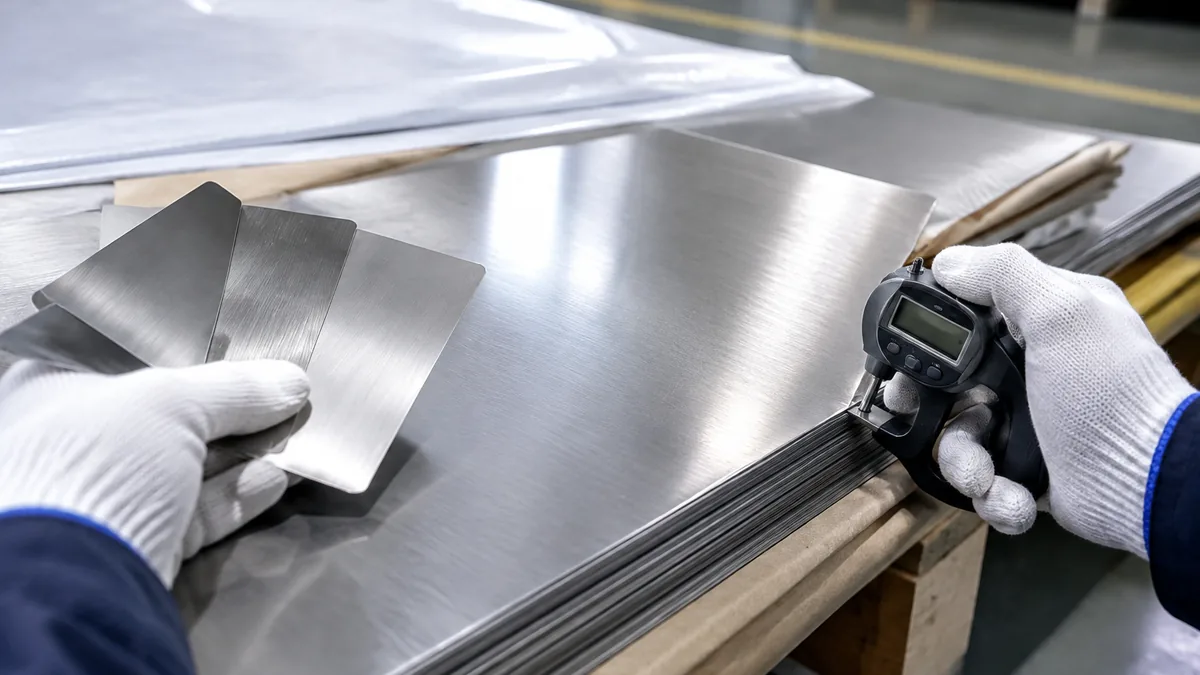
Copy-paste PO lines for No.4 versus hairline
Copy and adapt. Replace bracketed fields before release.
Line 1 — Finish identity (choose one; do not mix without approval):
No.4 directional satin stainless finish (ASTM A480 terminology) / OR / Hairline (HL) long continuous directional polish.
No silent substitution between No.4 and HL.

Line 2 — Product identity:
Grade [304 / 304L / 316L / other], product standard [ASTM A240 / EN 10088-2 / as ordered],
product form [sheet / coil / slit coil], thickness x width x length (or coil ID/OD limits),
tolerance basis as ordered, quantity [MT / sheets].

Line 3 — Polish fields (mandatory for appearance lots):
Critical face = [Face A / both]; base surface before polish = [2B / other];
grain / polish direction = [parallel to length / parallel to width / per attached layout];
abrasive route = [named grit band or brush/HL route] — sample match owns appearance;
optional measured limit = [Ra or gloss if contractual; method and direction stated].

Line 4 — Sample and inspection:
Approved sample ID [____]; mill retains twin sample for lot matching;
visual inspection at [distance] under [light type]; viewing angle [__];
reject photo-only approval for multi-batch architectural or appliance faces.

Line 5 — Film, packing and documents:
Protective [PVC/PE] film on polished face, type/thickness class [____], remove only at [fabrication stage];
seaworthy export packing with edge protection; heat identity on tags and packing list;
heat-linked EN 10204 Type 3.1; finish/sample reference on packing list when appearance is contractual.
For the wider RFQ field set beyond finish, use the stainless steel RFQ checklist.
Sample approval, sheet vs coil, and visual inspection light
Appearance-critical brushed lots need a short acceptance chain:
Directional finish acceptance chain
- Freeze finish family: No.4 or HL — not brushed alone.
- Approve a physical sample: stamp or ID both buyer and mill twins; photos are screening only.
- Lock grain direction to the drawing: length, width or module layout.
- Name product form: sheet packs versus coil or slit coil change polish continuity and cut strategy.
- Name film and peel timing: protect the polished face through export and shop handling.
- Name inspection light: same light family for sample sign-off and lot receiving.
- Separate chemistry documents from appearance: Type 3.1 heat identity stays mandatory; it does not replace sample match.
Sheet vs coil traps. Coil can deliver long continuous grain favorable to HL facades, but slit edges, camber and cut-to-length grain alignment must stay on the order. Sheet packs simplify panel kits but can show lot-to-lot polish variation if sample control is weak. Do not change form after award without re-approving appearance.
Inspection light traps. Cross-grain scratches and film haze read differently under diffuse warehouse light versus directional showroom LEDs. Write the light basis once on the sample form and reuse it at destination.
Practical notes from No.4/HL quote mismatches
These are repeating export and project handover patterns, not personal anecdotes:
- Lowest brushed price wins an architectural bid. Material arrives as a short-grain No.4-like face while the mock-up was long continuous HL.
- Grain runs the wrong way on elevator doors. Mill defaulted to coil-length grain; the drawing needed vertical continuous lines.
- Grit written without sample ownership. Buyer expected showroom gloss; mill shipped a coarser satin that still matched the grit number.
- Film peeled at port for casual checks and not replaced. Rub marks across grain became visible after installation lighting.
- Coil substituted for sheet after award. Cut strategy changed joint grain continuity; panels no longer matched the retained sample.
- MTC treated as finish certificate. Chemistry and mechanical results were correct; appearance still failed the sample.
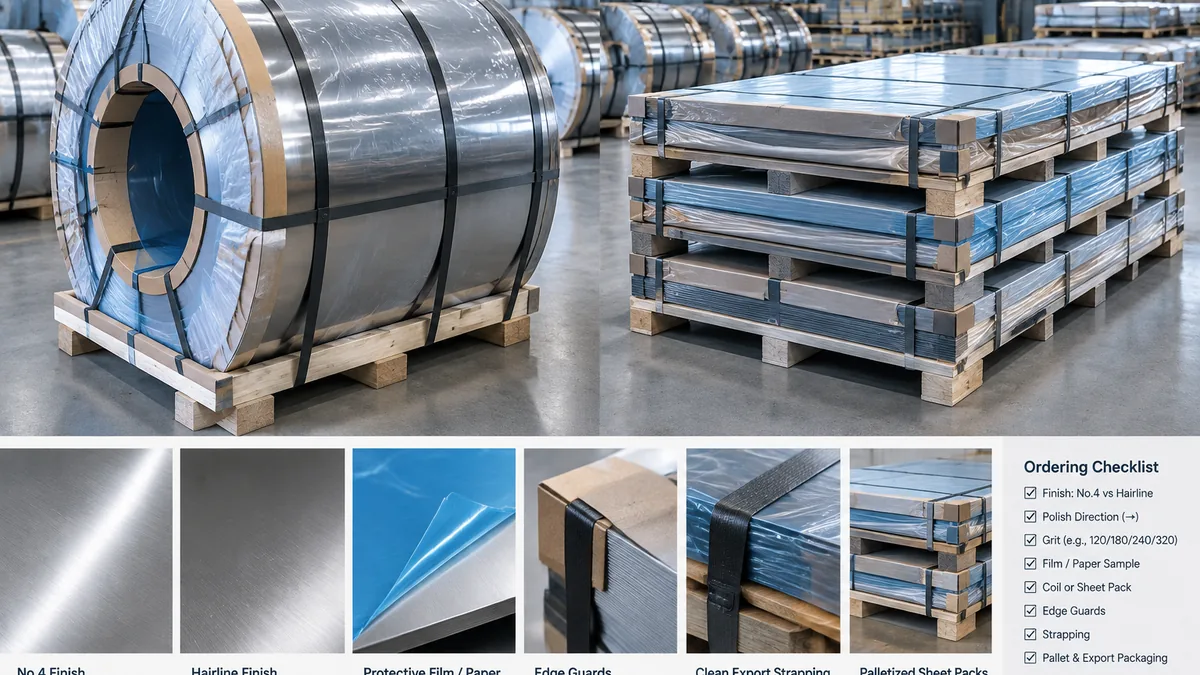
Freeze the finish line before production
Do not release production on a No.4 or hairline line until finish name, grain direction, sample ID, product form, film and inspection light are frozen on one commercial description. Keep the broad finish encyclopedia on the 2B BA No.4 8K finishes guide; keep defects and handling holds on the surface defects inspection checklist; keep generic PO grammar on the purchase order wording examples.
Planning an order or need a technical verification?
If you are sourcing No.4 or hairline stainless sheet/coil and need quotes that match one appearance route:
- Fast technical quote: Send grade, product form, dimensions, finish (No.4 or HL), grain direction, sample or acceptance rule, film requirement and destination through the stainless steel inquiry form.
- Quality assurance: Heat-linked EN 10204 Type 3.1 mill documents, with sample-referenced finish control when appearance is contractual. Third-party inspection can be arranged when the PO names it.
- Urgent commercial follow-up: Email sales@tsingshansts.com or phone/WhatsApp +86 176 8661 3207. Tsingshan (Shandong) Iron & Steel Co., Ltd. can separate No.4 and hairline ordering fields before production so quotes, samples and receiving checks use the same finish owner.
Sources and application limits
This guide supports purchasing decisions. The ordered product standard, project specification and approved inspection plan control the final decision.
- ASTM A480/A480M flat-rolled stainless finish terminology including No.4 as a general directional polished description
- EN 10088-2 ground or brushed finish designations (for example 2G/2J) used as cross-reference language when ordered, not as automatic No.4 or hairline identity
- Commercial and JIS/trade practice treating hairline (HL) as a long continuous directional polish that is not a single universal grit or gloss
- Buyer practice that appearance-critical brushed lots need approved samples, named grain direction, protective film and controlled viewing light
Technical content updated: Sep 11, 2026
Frequently Asked Questions
Is No.4 stainless finish the same as hairline?
No. No.4 is a general directional brushed or satin description under common ASTM A480 terminology, usually with shorter broken polish lines. Hairline (HL) is a commercial or JIS/trade long continuous grain look. Mills can deliver different grit, gloss and line continuity under either name, so quotes are not interchangeable without sample approval and PO fields.
What PO fields stop No.4 vs hairline quote mismatches?
Freeze finish name, product form (sheet or coil), critical face, polish or grain direction relative to length or width, abrasive grit or brush route when appearance-critical, protective film type and side, approved sample ID, visual inspection light, and whether grit alone or a measured Ra/gloss limit owns acceptance.
Can a supplier substitute hairline when the PO says No.4?
Not without written buyer approval. The two finishes can look similar in photos but differ in line continuity, reflectivity and how they hide fingerprints or cross-grain scratches. Substitution is a common bid-failure mode when the PO only says brushed stainless.
Does an EN 10204 Type 3.1 MTC prove No.4 or hairline appearance?
No. Type 3.1 supports heat identity, chemistry and the mechanical or inspection results named on the order. Directional polish appearance needs sample reference, finish naming, film and viewing rules — and, when contractual, a separate finish or roughness record tied to the same lot.
Send the product form, grade and quantity from this guide. We quote the matching stainless route.
Ready to quote your stainless specification?
Send product, grade and quantity. We quote the confirmed supply route.