
Stainless Steel Pipe vs Tube: How to Specify the Order
Specify stainless steel pipe vs tube by ASTM A312, A269, A270 or A554, then lock NPS or OD, schedule or wall, route, tests and packing.
Published Aug 31, 2026 · Technical content updated: Aug 31, 2026 ·Tsingshan (Shandong) Iron & Steel Co., Ltd.
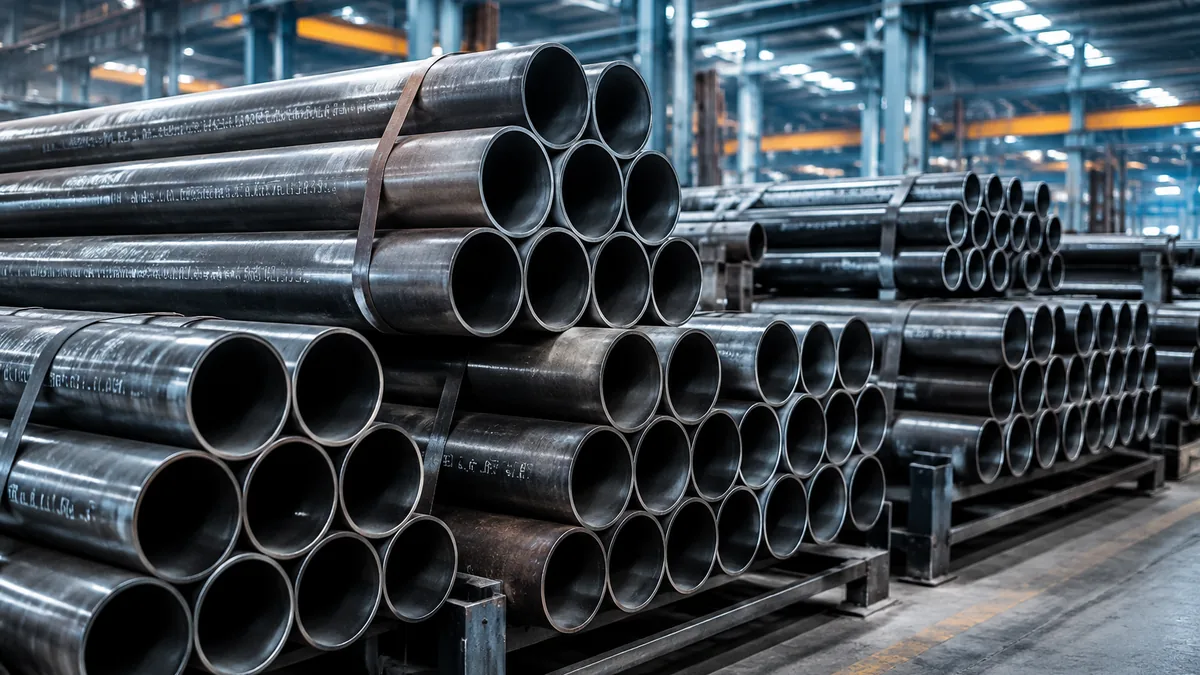
Reference image for this topic; it does not show Tsingshan Steel facilities, inventory or completed orders.
Stainless pipe and stainless tube are not two names for the same mill item. The grade can be identical and the quotation still wrong if the product form, governing standard and dimensional language do not match the drawing.
Use this guide before you send a process-pipe, instrumentation-tube, sanitary-tube or mechanical-tube inquiry. For the broader catalogue, start with our stainless product families and name pipe or tube as the form, not a generic “stainless round hollow.”
Pipe and tube are not interchangeable line items
In mill and stockist language, pipe is usually a pressure or process conduit ordered by nominal pipe size and schedule. Tube is usually a precision or application-specific hollow ordered by actual outside diameter and wall, sometimes with a hygiene, heat-transfer or mechanical function that pipe does not cover.
That split changes more than vocabulary:
- the product standard and permitted manufacturing route;
- how dimensions are written and inspected;
- which fittings, flanges, ferrules or sanitary joints will match;
- which tests, surface condition and packing belong on the order.
A 316L label does not decide those points. Neither does a photo of a shiny round section. Write the product form first, then the standard, then the size system.
| Buying question | Stainless pipe | Stainless tube |
|---|---|---|
| Typical product standard | ASTM A312/A312M for covered austenitic pipe | ASTM A269, A270, A249/A213 family or A554, according to duty |
| Size language | NPS (or DN) and schedule, or a stated pipe wall | Actual OD and wall; shape if not round |
| Usual duty | Process, utility and pressure piping classes | Instrumentation, sanitary, heat-exchange or mechanical/ornamental |
| Matching components | Pipe fittings and flanges to the piping class | Tube fittings, sanitary clamps, HX sheets or fabricated joints |
| What must not be assumed | That NPS equals measured OD | That a pipe schedule can be dropped onto a tube RFQ |
Match the product standard to the job
Name one governing material specification per line item. A312 is a pipe specification. It does not automatically cover general tube, sanitary tube or ornamental hollow sections.
| If the drawing or piping class says | Start with | Then add |
|---|---|---|
| NPS / DN, schedule, elbows, flanges, pressure piping | ASTM A312/A312M for covered austenitic pipe | Grade, seamless or welded route, length, ends, tests, documents |
| Exact OD x wall for general corrosion-resisting service | ASTM A269/A269M | Route, tolerance, surface, length, tests |
| Hygienic process line, dairy, food or similar clean service | ASTM A270/A270M or the named hygienic tube spec | ID/OD finish, roughness if required, end caps, cleanliness |
| Structural, ornamental or mechanical hollow | ASTM A554 for welded mechanical tubing | Shape, weld-bead condition, finish, straightness |
| Heat-exchanger or boiler tube on the equipment datasheet | The named HX/boiler tube specification, not a pipe schedule | OD, wall basis, U-bend or cut length, NDE |
ASTM A312/A312M covers seamless, straight-seam welded and heavily cold-worked austenitic stainless steel pipe for high-temperature and general corrosive service. It is a material and manufacturing specification, not a complete piping class. It does not select the alloy for the process fluid, set the design pressure, or make tube descriptions interchangeable with pipe.
ASTM A269/A269M is the usual starting point for general-service austenitic stainless tubing. ASTM A270/A270M is a sanitary tubing specification; surface finish and cleanliness sit in the order, not in a pipe schedule. ASTM A554 covers welded stainless mechanical tubing in round, square, rectangular and special shapes.
Duplex pipe is a different product family. Do not assume ASTM A312 covers 2205 or other duplex grades; quote the duplex pipe standard named on the project, then the grade, route and tests.
Our standards library records which ASTM, ASME and EN documents the site publishes. Confirm the edition on the purchase order.
Use NPS and schedule for pipe, OD and wall for tube
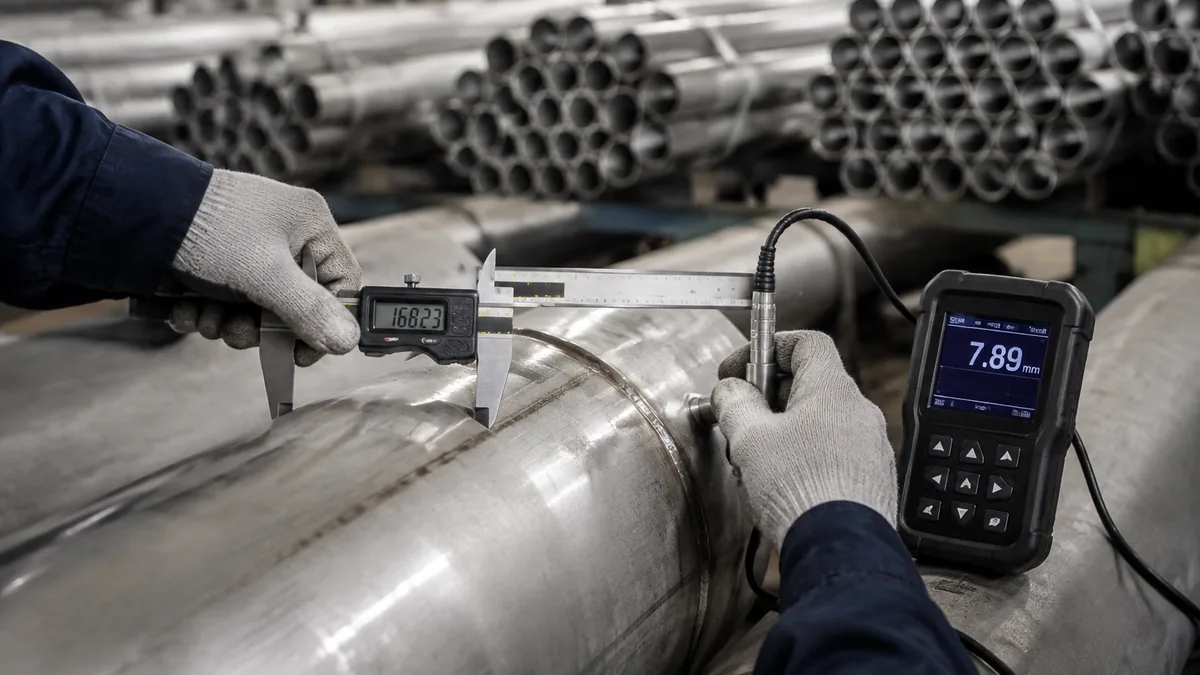
NPS is a size designator, not a tape measurement of outside diameter. For a given NPS, the outside diameter is fixed in the dimensional table; a heavier schedule increases wall and reduces inside diameter.
Stainless process pipe commonly uses the “S” schedules in ASME B36.19M, such as 5S, 10S, 40S and 80S. Schedule is not a pressure rating by itself. Design code, material, temperature, joint type, corrosion allowance and tolerance still need engineering approval.
When you need a starting OD, wall and theoretical mass for a named NPS and schedule, use the stainless pipe schedule chart. Do not paste a carbon-steel schedule table onto a stainless inquiry without checking the stainless dimensional standard.
Tube RFQs should state actual outside diameter and wall, plus whether wall is minimum or average if the specification uses that distinction. Compression fittings, ferrules and sanitary joints do not forgive a pipe-size OD written as if it were tube.
Do not write “2 inch 316L stainless” and leave the mill to guess NPS 2 Schedule 10S pipe versus 50.8 mm OD tube.
Treat seamless or welded as a named route
Seamless and welded are manufacturing routes, not quality adjectives. ASTM A312 includes covered seamless, straight-seam welded and heavily cold-worked pipe. The purchase order should say which routes are permitted.
Ask for welded pipe only when the project allows it, and state any extra controls for weld condition, heat treatment, NDE and marking. Ask for seamless only when the specification or client document requires a weld-seam-free product; seamless is not a substitute for missing tests.
The same logic applies to tube. A269 and A270 include seamless and welded routes within their scopes. A554 is a welded mechanical-tubing specification. Heat-exchanger duties often name a dedicated tube specification rather than “A312 thin wall.”
If both routes are acceptable, request clearly separated prices on the same grade, size, finish, tests and delivery basis. Silent substitution after award is not a clarification; it is a different product.
Finish, ends, tests and documents belong on the RFQ
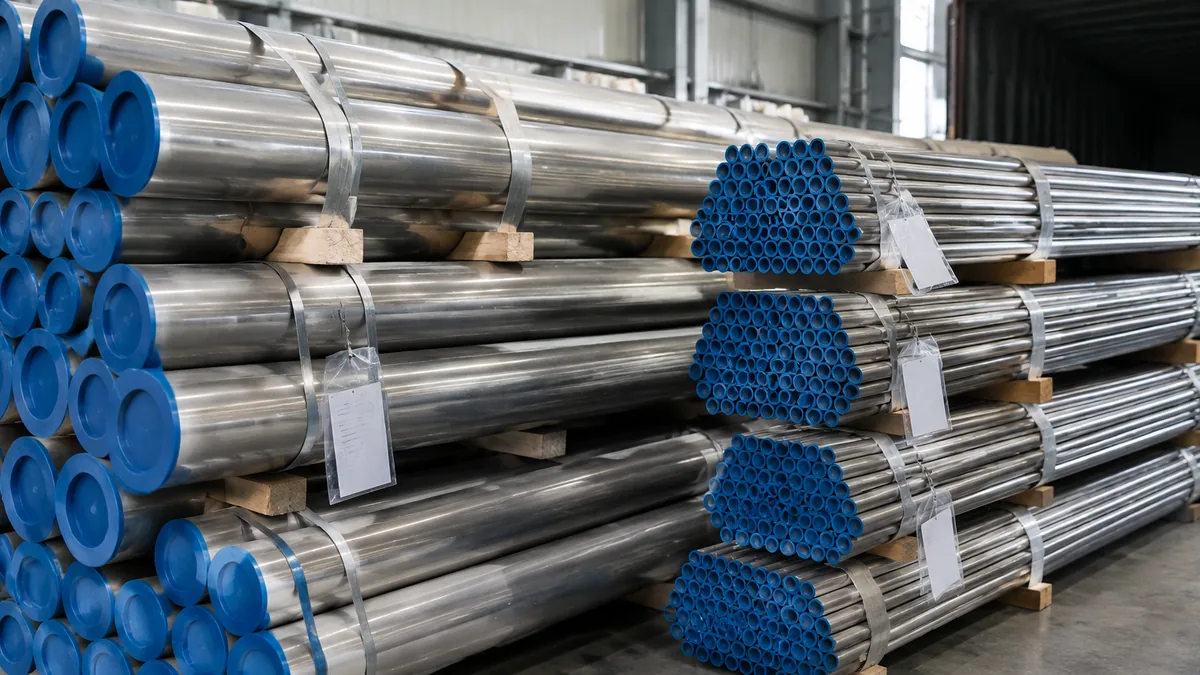
Pickled and annealed mill finish is common on process pipe. It is not a sanitary ID. Decorative or mechanical tube may need a stated external finish and weld-bead treatment. Sanitary tube may need a named internal and external finish, and sometimes a roughness limit, with protected ends.
Ends are commercial, not decorative:
- plain or beveled pipe ends, including bevel detail when welding procedure requires it;
- squared, deburred tube ends for fittings;
- capped or bagged sanitary ends to keep the bore clean.
Tests follow the named specification edition plus any project supplement. Hydrostatic testing or a nondestructive electric test may be required by the product standard; optional PMI, corrosion tests, roughness records or witnessed inspection must be written before production. A certificate name does not create a test that was never ordered.
Read the document type against the mill test certificate guide before you write “MTC required.” Then state EN 10204 3.1 or the project equivalent, heat identity and any marking transfer after cutting.
Common Buyer Mistakes
These are the mix-ups that show up on stainless pipe and tube inquiries and then reappear as clarification emails:
- Using “pipe” and “tube” as synonyms, then comparing two quotes that are not the same product form.
- Treating NPS as the measured OD, or ordering tube by a pipe schedule.
- Assuming Schedule 10S is a hygienic finish or a sanitary standard.
- Requesting 316L without the product standard, route, ends and test scope.
- Asking for seamless as a quality word while accepting welded dimensions, tests or packing.
- Applying an austenitic pipe specification to duplex, sanitary or heat-exchanger duty by habit.
- Adding PMI, NDE or roughness after the quotation instead of defining sampling and acceptance in the RFQ.
RFQ Details That Prevent Misquoting
Copy the relevant block into the inquiry, then replace every example value with the project requirement. Keep one product form per line.
Product form: austenitic stainless steel pipe (not tube) Standard: ASTM A312/A312M, named edition Grade: TP316L Route: seamless; welded not permitted Size: NPS 2 Schedule 10S (do not convert this line to OD x wall unless the specification allows that ordering system) Length: 6 m fixed, state cut tolerance Ends: beveled to the project weld detail Tests and documents: standard tests to the named edition, plus stated PMI sampling; EN 10204 3.1 with heat identity Packing: export bundles, end protectors, seaworthy wrap
Product form: stainless steel tube (not pipe) Standard: ASTM A269/A269M, named edition Grade: TP316L Route: welded or seamless, quote separately Size: 25.4 mm OD x 1.65 mm wall; state whether wall is minimum or average Length: 6 m, ends suitable for compression fittings Surface: pickled / bright as applicable, no sanitary roughness claimed Tests and documents: as required by the named edition plus any project NDE; EN 10204 3.1
For sanitary tube, replace the standard with ASTM A270/A270M or the named hygienic specification, add ID/OD finish and any roughness, and specify end caps and cleanliness. For mechanical tube, use ASTM A554, the shape, weld-bead condition and the drawing tolerance.
The field-by-field template in our stainless steel RFQ checklist still applies: quantity per size, over/under delivery, destination, trade term and packing limits belong on the same page.
Write the specification before you request a quote
A usable stainless hollow-section RFQ names product form, standard, grade, route, dimensional system, ends, tests, documents and packing. If any of those is missing, the mill will fill the gap with a stock assumption.
When the line is complete, send it through the stainless steel inquiry form. We quote the matching pipe or tube route against the named standard, size system and inspection package. Do not treat a missing form as dual certification, sanitary finish or a default schedule.
Sources and application limits
This guide supports purchasing decisions. The ordered product standard, project specification and approved inspection plan control the final decision.
- ASTM A312/A312M austenitic stainless steel pipe scope
- ASTM A269/A269M general-service stainless tubing scope
- ASTM A270/A270M sanitary stainless tubing scope
- ASTM A554 welded stainless mechanical tubing scope
- ASME B36.19M stainless steel pipe dimensional schedules
Technical content updated: Aug 31, 2026
Frequently Asked Questions
Can ASTM A312 pipe replace ASTM A269 tube?
Not by title. Pipe and tube use different dimensional language, product standards and often different fittings, tests and packing. Name the governing specification, then compare OD or NPS, wall, route, surface, tests and design rules on the same line item.
Should I order stainless pipe by NPS and schedule or by OD and wall?
Process pipe to ASTM A312 is normally ordered by NPS and schedule, or by a stated wall when the specification and purchase order allow it. Tube is normally ordered by actual outside diameter and wall thickness. Do not mix the two systems on one line.
Is sanitary tubing the same as Schedule 10S pipe?
No. Sanitary tubing is specified to a hygienic tube standard such as ASTM A270, with OD, wall and surface-finish controls. Schedule 10S is a stainless pipe wall designation used with NPS, not a sanitary finish.
Send the product form, grade and quantity from this guide. We quote the matching stainless route.
Ready to quote your stainless specification?
Send product, grade and quantity. We quote the confirmed supply route.