
ASTM A240 vs EN 10088 Stainless Steel Guide
Compare ASTM A240 and EN 10088 for stainless sheet, plate and strip, including grade names, mechanical conditions, tolerances, inspection documents and RFQ wording.
Published Jul 28, 2026 · Technical content updated: Jul 29, 2026 ·Tsingshan (Shandong) Iron & Steel Co., Ltd.
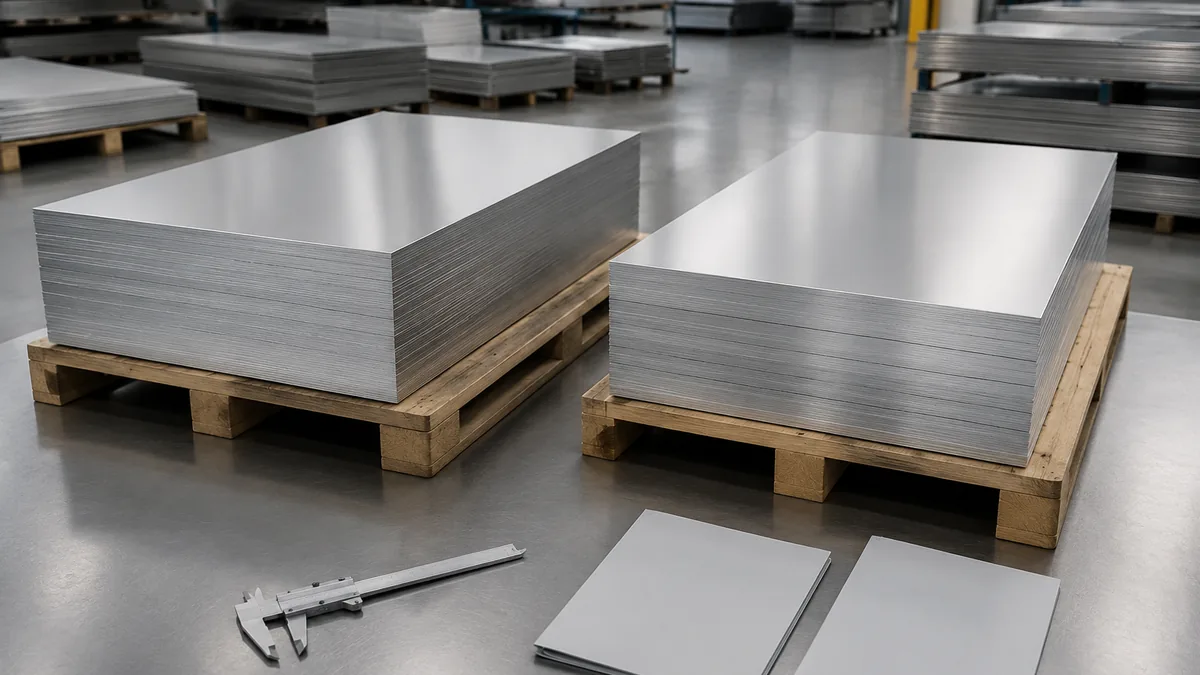
Reference image for this topic; it does not show Tsingshan Steel facilities, inventory or completed orders.
ASTM A240/A240M and EN 10088-2 both appear on stainless steel sheet, plate and strip inquiries, but they are not two labels for one identical specification. A buyer should choose one governing product standard, then state the grade, dimensions, finish, tolerances and inspection document needed for that system.
For the short answer: ASTM A240/A240M is widely used for chromium and chromium-nickel stainless plate, sheet and strip in pressure-vessel and general applications. EN 10088 is a multi-part European series; EN 10088-2 addresses sheet, plate and strip for general purposes.
What the two systems organize differently
| Buying question | ASTM route | EN route |
|---|---|---|
| Flat-product material | ASTM A240/A240M | EN 10088-2 for general-purpose flat products |
| General delivery and tolerances | Commonly read with ASTM A480/A480M | Referenced EN dimensional and delivery standards depend on product and order |
| Grade identity | Type and UNS, such as 304 / S30400 | Steel name and number, such as X5CrNi18-10 / 1.4301 |
| Inspection document | State the required report or certificate | Commonly ordered under EN 10204, with document type stated |
| Construction products | Project specifications add applicable rules | EN 10088-4 and related construction requirements may apply |
The purchase order should cite the exact document and edition required by the project. Writing only “EN 10088” is incomplete because the series covers different information and product scopes.
Grade correspondence is not unconditional equivalence
304 and EN 1.4301, or 316L and EN 1.4404, are familiar commercial correspondences. That does not mean material can be substituted without review.
Check at least:
- chemical limits and any project-specific restrictions;
- mechanical properties for the actual thickness and delivery condition;
- product form and manufacturing route;
- heat treatment and surface condition;
- dimensions and tolerance standard;
- pressure, construction or end-user approvals.
Our 304 grade page and 316L grade page present common designations with the same substitution warning.
Dimensions and finish need their own references
ASTM A240 defines material requirements, but general dimensional tolerances and finish terminology are normally coordinated with ASTM A480/A480M. An order written only to A240 can still be unclear about flatness, width, length, edge and surface acceptance.
In the EN system, the referenced tolerance standard depends on product and dimensional range. The safest RFQ states the product standard and the exact dimensional/tolerance requirement rather than assuming the supplier will infer it.
Finish names also need care. Review 2B, BA, No.4 and other finish definitions and add a sample for appearance-critical architectural work.
Inspection documents are a separate choice
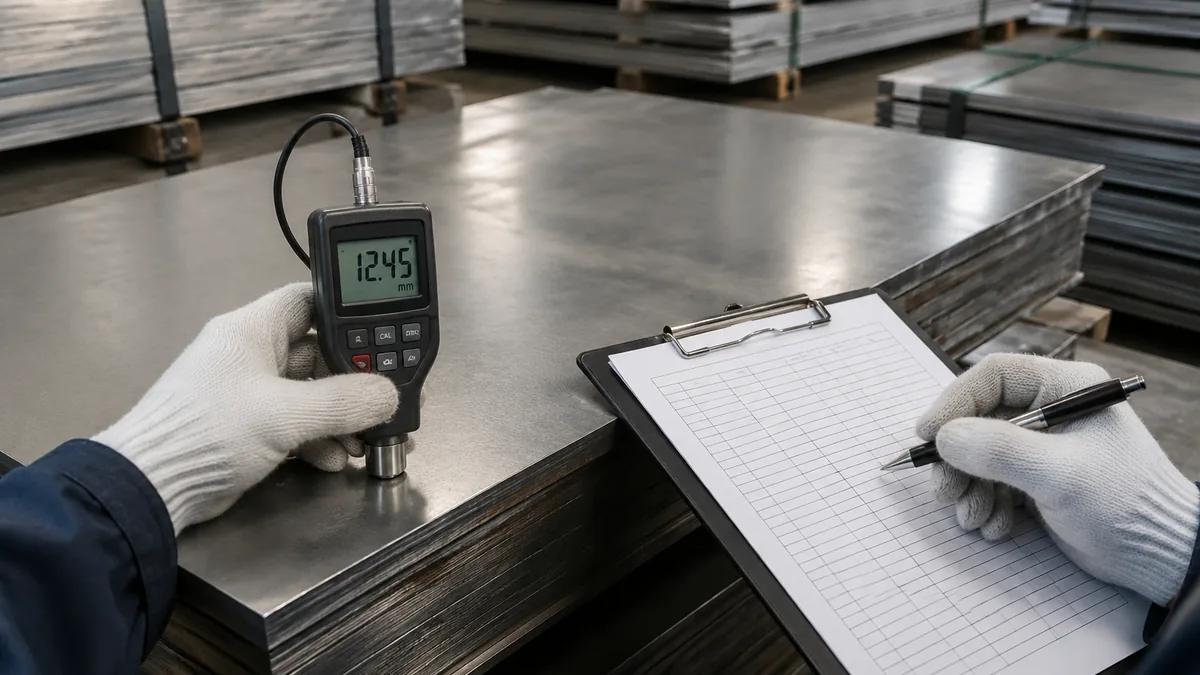
EN 10204 describes inspection document types; it is not itself a stainless material specification. A 3.1 document does not replace ASTM A240 or EN 10088-2, and it does not prove supplementary tests unless those results and requirements are included.
Specify:
- document type;
- heat and product traceability;
- required chemistry and mechanical results;
- supplementary PMI, corrosion, NDT or surface records;
- third-party witness or review points.
How to write the RFQ
For an ASTM-based order:
316L cold-rolled stainless sheet to ASTM A240/A240M, dimensional and finish requirements per ASTM A480/A480M, 2B finish, stated thickness tolerance, EN 10204 3.1 inspection document when supported by the approved supply route.
For an EN-based order:
1.4404 stainless sheet to EN 10088-2, delivery condition and dimensions per the stated EN references, 2B finish, EN 10204 3.1 inspection document, with project supplementary requirements attached.
Do not combine the strictest clause from each system into a hybrid specification without confirming that a mill can certify the result. If a project allows either route, ask for separate compliant alternatives and compare them on the same dimensions, finish, tests and delivery basis.
For a product-specific review, start with our ASTM A240 guide or EN 10088 guide, then send the completed requirement through the quotation form.
A responsibility chain for international orders
Treat the standard references as a chain with separate jobs. The material standard defines the grade and product requirements. The dimensional reference defines permitted size and shape variation. The manufacturing route defines how the product is made and finished. The inspection document records the results that were ordered. The project specification can add tests, witness points or acceptance criteria. If one link is missing, a supplier may still return a price, but the buyer cannot tell which requirement the price includes.
For example, an order for cold-rolled 316L sheet can name ASTM A240/A240M for material, ASTM A480/A480M for general requirements, a stated thickness and flatness tolerance, 2B finish, a defined edge condition, EN 10204 3.1 when available through the approved route, and seaworthy packing. An EN-based order should state EN 10088-2 plus the applicable dimensional and inspection references rather than copying the ASTM line and changing only the grade name.
Edition and revision discipline
Standards change, and project specifications can freeze an older edition. Do not describe a document as the latest edition unless the project has verified that status. Put the edition or contractual revision in the RFQ, then ask the supplier to identify any conflict between the requested text and the available production route. Keep the accepted quote, drawing revision, certificate reference and inspection plan together so a later purchaser does not combine requirements from two different revisions.
When an end user accepts either ASTM or EN supply, request separate alternatives with the same dimensions, finish, tests and delivery basis. The approval record should state which alternative was selected and whether any additional review was required. The cross-reference tool can help locate designation names, but it does not grant automatic equivalence.
This discipline is especially important when a buyer changes destination or fabrication route after quotation. Recheck the dimensional standard, document language, marking and packing requirements instead of carrying an old clause forward unchanged. The final order should make it possible for a receiver to identify the governing standard from the material mark and certificate without guessing which cross-reference was intended.
Quote ASTM A240 and EN 10088 as separate lines with the same dimensions, finish, tests and documents. Send the governing edition in the RFQ; a designation cross-reference does not make the two standards interchangeable.
Sources and application limits
This guide supports purchasing decisions. The ordered product standard, project specification and approved inspection plan control the final decision.
- ASTM A240/A240M product standard scope
- EN 10088 stainless steel delivery boundary
- ASTM A480/A480M general requirements
Technical content updated: Jul 29, 2026
Frequently Asked Questions
Is ASTM A240 equivalent to EN 10088-2?
They cover overlapping stainless flat-product requirements but are not interchangeable documents. Grade chemistry, mechanical conditions, tolerances and purchaser options must be checked line by line.
Is 304 exactly the same as EN 1.4301?
They are commonly treated as corresponding designations, but final substitution requires review of chemistry, mechanical requirements, product form, condition, dimensions and project approval.
Does either standard automatically require an EN 10204 3.1 certificate?
No. The required inspection document should be stated on the purchase order and supported by the selected supply route.
Send the product form, grade and quantity from this guide. We quote the matching stainless route.
Ready to quote your stainless specification?
Send product, grade and quantity. We quote the confirmed supply route.